Here is a pattern we see often. A software house in Dhaka says its marketing “does not work”. It has 400 Facebook likes, a few dozen enquiries a month from students asking about internships, and two client deals a year, both from referrals. The ads are reaching people. They are just the wrong people, asked to do the wrong thing.
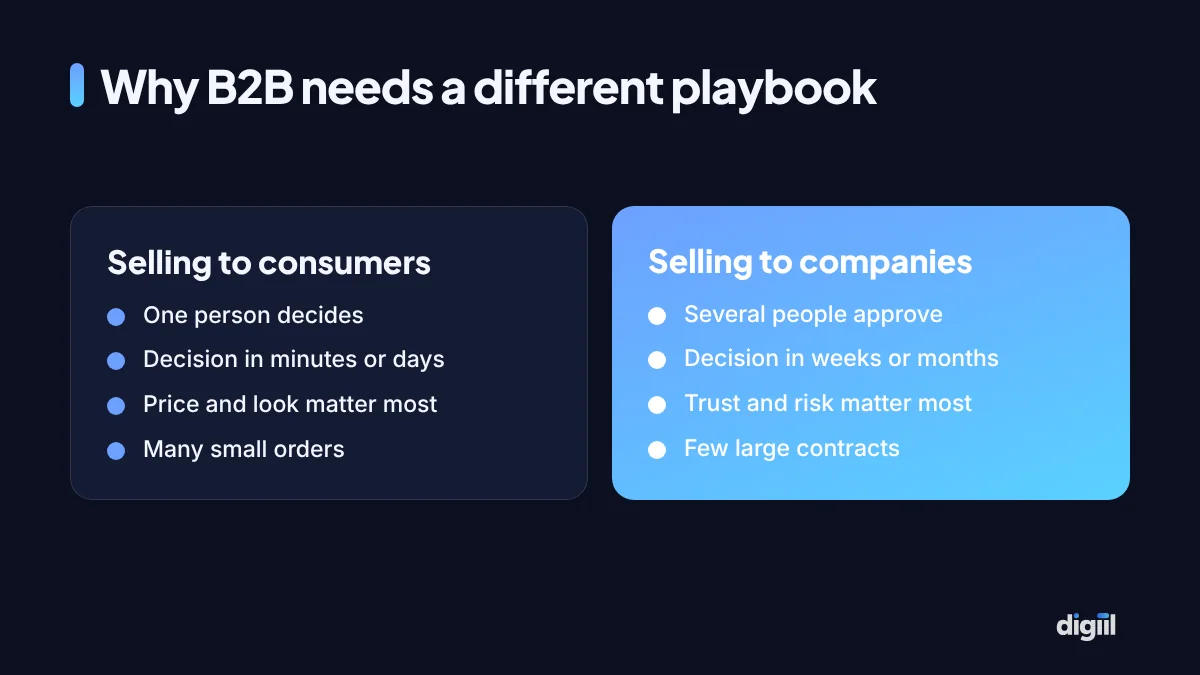
B2B lead generation works differently from selling to consumers. The buyers are fewer, the decisions slower, the contracts larger, and trust decides almost everything. This playbook is written for Bangladeshi companies that sell to other businesses: IT and software firms, manufacturers and suppliers, logistics and professional services, agencies, and B2B wholesalers.
Step 1: Decide exactly who you want
Most weak B2B marketing starts with a vague target: “SMEs” or “corporates”. Nobody can write a convincing message to a category. Write down your ideal customer profile instead.
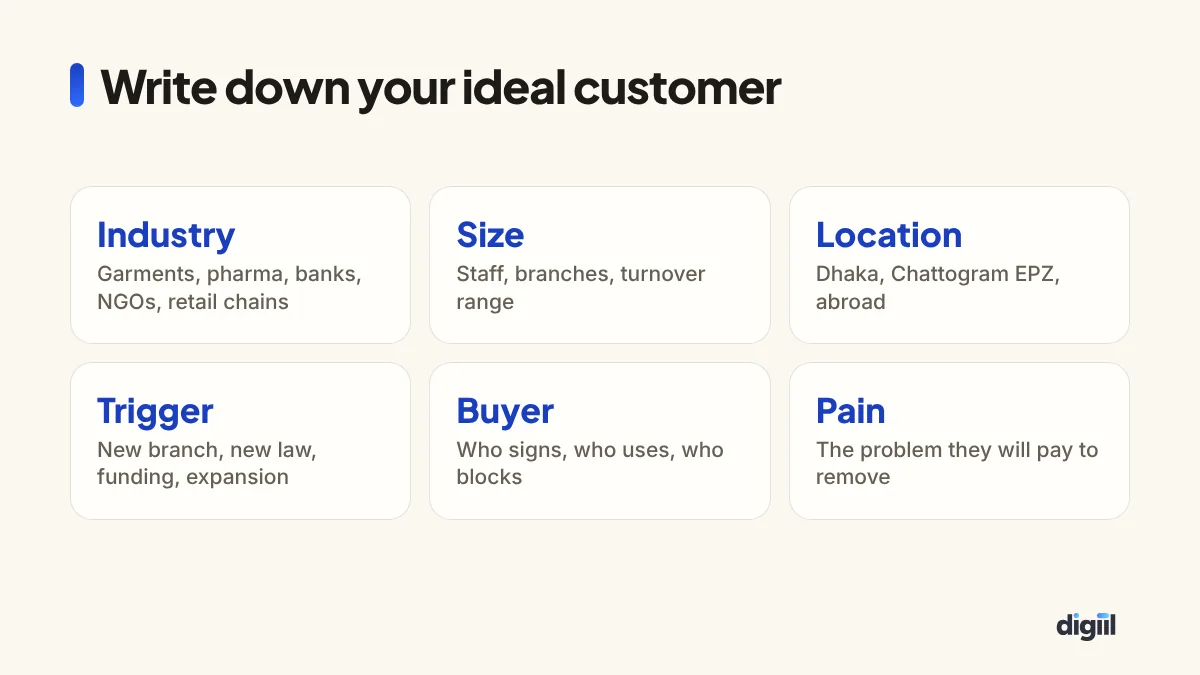
Then look at your five best current clients, meaning the ones who paid well, on time, and were pleasant to work with. What do they have in common? That pattern is usually more accurate than any profile you would invent from scratch.
Map the buying group
In a mid-sized company, a purchase often involves the person who feels the problem, a manager who approves the budget, finance or procurement who checks the terms, and sometimes IT or compliance who can block it. Each needs a different message. The user wants to know it will work. The manager wants results. Finance wants a clear price and payment terms. Write down who they are for your typical deal.
Look for triggers
Companies buy when something changes: a new branch, a new regulation, an export order from a new buyer with audit requirements, funding, a new manager, a system failure. Watching for these events in the news, on LinkedIn and through your network tells you who is likely to need you now, which is far more efficient than contacting everyone.
Step 2: Build an offer worth responding to
“Contact us for a quote” is not an offer. Busy managers respond to something that is useful by itself and low risk to accept.
- An audit or assessment: a free review of their website, security, energy use, compliance gaps or logistics costs, with a short written report.
- A calculator or benchmark: how much they might save, how they compare with similar companies.
- A practical guide: “What buyers in Europe now ask garment suppliers for”, “How to choose an ERP for a pharma distributor”.
- A short pilot: a paid or free trial on a limited scope, with clear success criteria.
- A case study from a similar company, with numbers the client agreed to share.
The best offer shows your expertise while solving a small part of the problem. It also qualifies leads: someone who requests an export compliance guide is far more likely to be a real prospect than someone who liked a post.
Step 3: Choose two or three channels
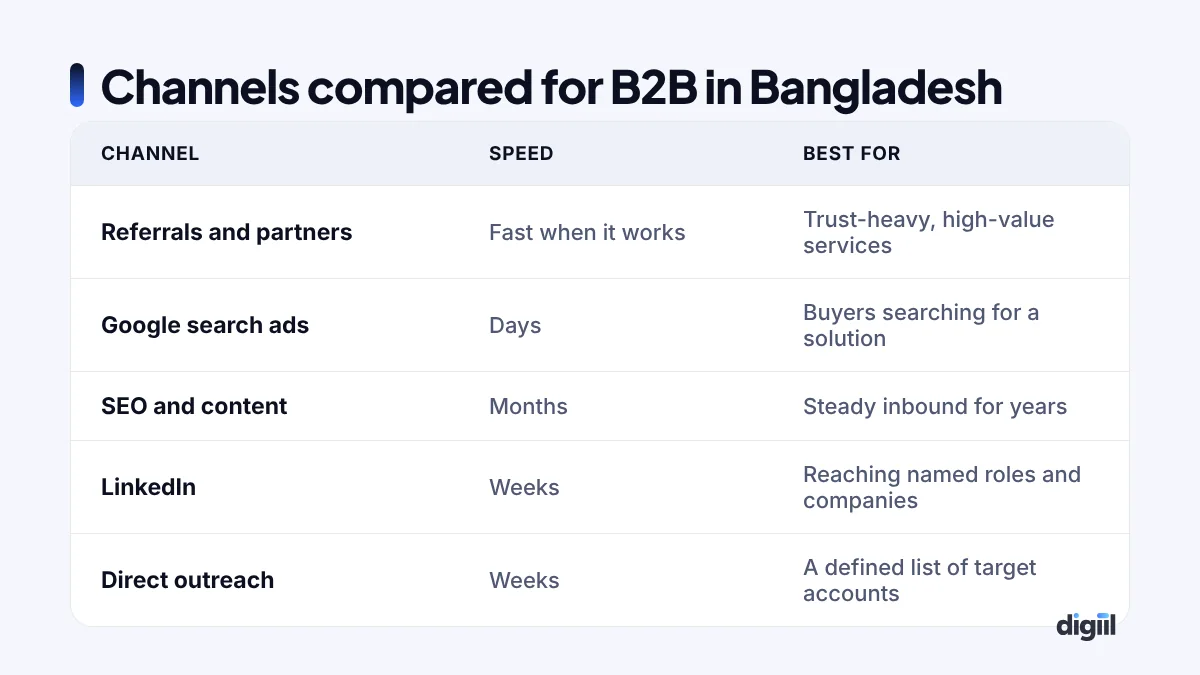
Referrals and partners
Still the strongest source of B2B work in Bangladesh, where business runs heavily on relationships. Make it a system rather than luck: ask satisfied clients for introductions at the end of a successful project, offer partners such as accountants, consultants or complementary suppliers a reason to refer you, and stay in touch with former colleagues who now work at potential clients.
Google search ads
When a manager searches “warehouse management software Bangladesh” or “ISO consultant Chattogram”, they are telling you they have a need. Search ads put you in front of them that day. Use tight phrase and exact match keywords, a long negative keyword list (jobs, salary, course, free, pdf, internship) and a landing page for each service. See Google Ads in Bangladesh.
SEO and content
Slower, and the most valuable over time. Pages for each service and industry you serve, answers to the questions buyers ask before contacting a supplier, comparison and pricing pages. Volumes are small, but every visitor is relevant. Start with keyword research for Bangladesh.
The place to reach named roles in named companies. Founders and senior staff posting useful, specific content build familiarity with the right people over months. LinkedIn ads can target by job title, industry and company size, at a higher cost per click than other platforms. Our guide to LinkedIn marketing for B2B covers both.
Direct outreach
Personal emails or LinkedIn messages to a short, researched list of target companies. It works when the message is specific to the company and offers something useful, and fails completely when it is a template blast. More on this below.
Industry events and associations
Trade fairs, chamber events, association meetings and seminars put you in a room with buyers. Their value multiplies when you follow up properly afterwards, which most exhibitors never do.
Facebook and Meta ads
Weaker for reaching corporate roles, but useful for owner-run small and medium businesses, and for retargeting people who visited your website with case studies and guides.
Often where B2B conversations actually happen in Bangladesh after the first contact. Use a business number, keep a professional profile, and log important conversations in your CRM so they are not lost on one person’s phone.
Outreach that does not feel like spam
Good outreach is research first, writing second.
- Pick 20 to 50 companies that match your profile, not 2,000.
- Find the right person from the company website, LinkedIn or annual reports.
- Find a reason to write: a recent expansion, a hiring post, a new product, a problem common in their sector.
- Write four to six sentences: why them, what you noticed, one relevant result you achieved for a similar company, and a small next step.
- Follow up twice, a few days apart, adding something useful each time. Then stop.
Subject: Faster sample approvals for [Company]
Hello Mr [Name], I saw [Company] has added a second knitting unit in Gazipur. Congratulations. When a factory grows, sample approval emails with buyers often become the bottleneck. We built a shared sample-tracking portal for [similar client], which cut their approval time noticeably within two months. Would a 15-minute call next week be useful to see whether something similar fits your team?
Send from a properly set-up business domain, with SPF, DKIM and DMARC records in place, and keep volumes modest. Our guide to email marketing in Bangladesh covers deliverability.
Step 4: Turn the website into a lead machine
B2B buyers research quietly before they contact anyone. Your website does the selling while they do.
- One page per service and per industry, each explaining the problem, your approach, results and price ranges where possible.
- Proof: client logos with permission, case studies with numbers, certifications, team credentials.
- Clear next steps on every page: book a call, request a proposal, download the guide.
- Short forms. Name, company, email or phone and one question are enough. Every extra field loses enquiries.
- Fast replies. An auto-confirmation, then a human reply within the hour during working days.
For layout and conversion details, see landing page design tips.
Step 5: Qualify before you chase
Not every enquiry deserves a proposal. Ask four questions early, in conversation rather than as an interrogation:
- Need
- What problem are they trying to solve, and what happens if they do nothing?
- Fit
- Do they match your ideal customer profile?
- Authority
- Who else is involved in the decision?
- Timing and budget
- When do they want to start, and is there a budget range?
A lead that fails two of these goes into a nurturing list, not a proposal queue. This single habit saves many hours of proposal writing for clients who were never going to buy.
Step 6: Follow up like it matters
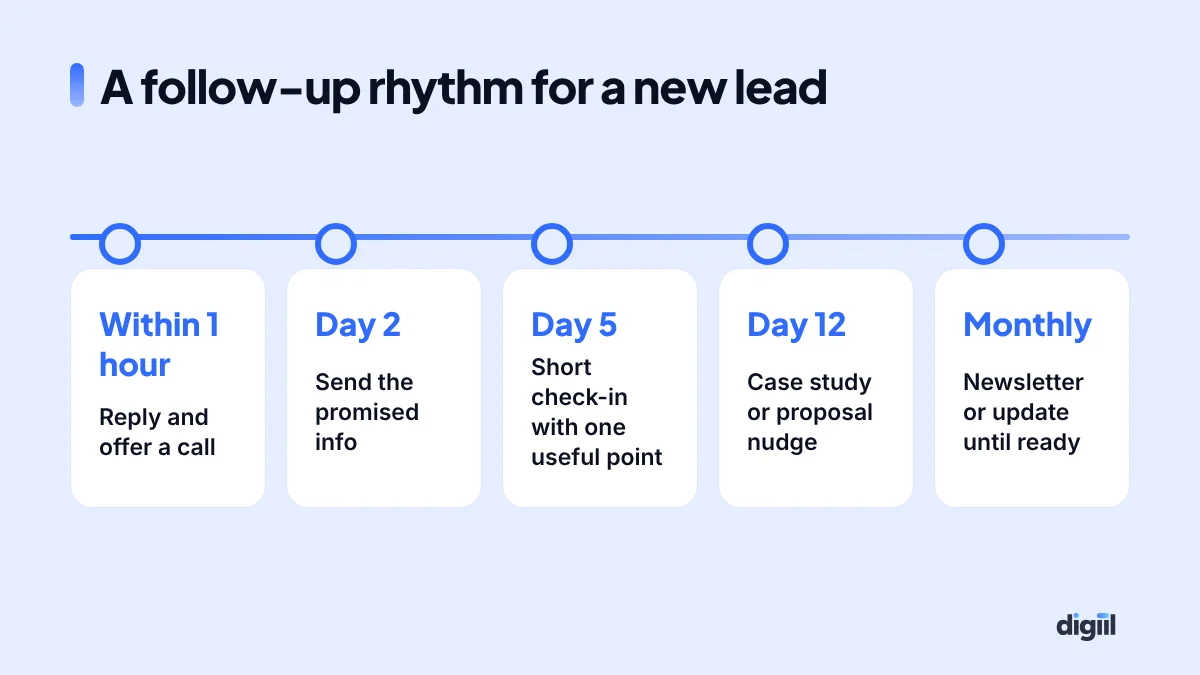
Most B2B deals are lost to silence, not to competitors. The first reply sets the tone: a company that answers within the hour looks more reliable than one that answers in three days. After that, a steady, helpful rhythm keeps you in mind until the buyer is ready.
Keep every lead in a CRM, even a simple one, with the next action and its date. If follow-up depends on someone remembering, it will not happen.
Step 7: Measure the pipeline, not the likes
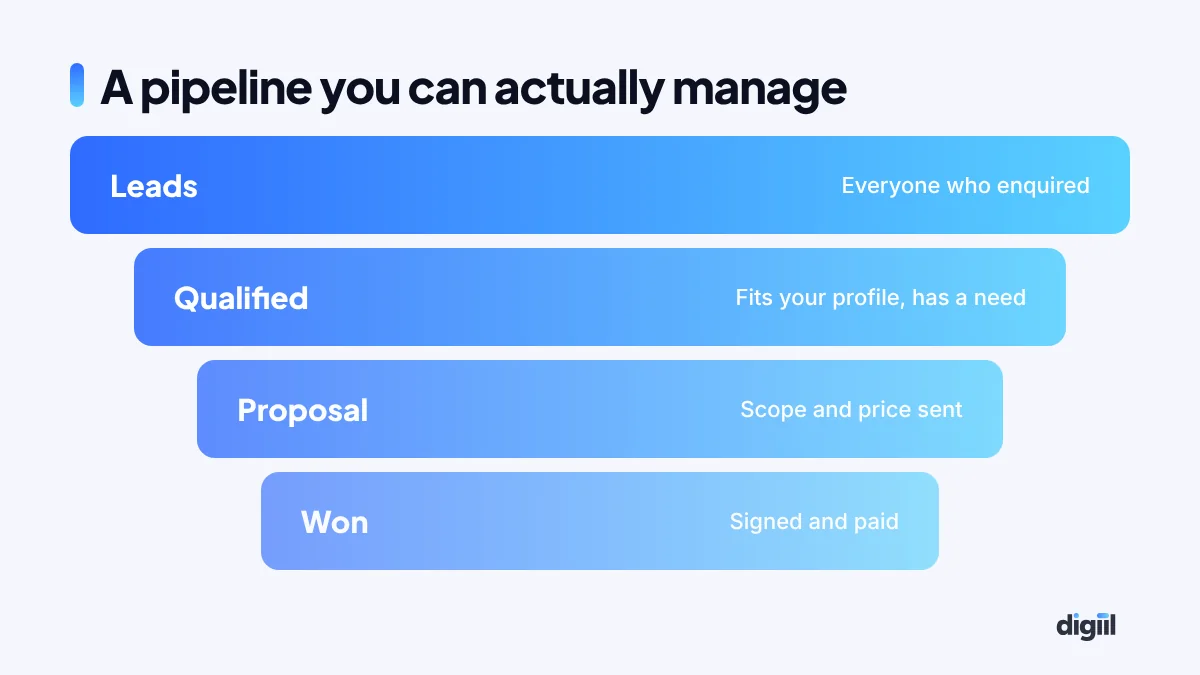
Track a few numbers monthly: leads by source, percentage qualified, proposals sent, deals won, average deal value, and time from first contact to signature. Together they show which channel brings clients, not just enquiries.
Then work out what a client is worth over the relationship, because that decides how much you can spend to win one.
Lifetime value = average monthly or yearly revenue per client × gross margin × how long clients typically stay. If a client is worth Tk 6 lakh in gross profit over three years, spending Tk 50,000 to win one is a bargain. That number gives you permission to invest in content, events and paid search that a consumer business could not afford.
A 90-day starting plan
| Month | Focus | Output |
|---|---|---|
| 1 | Profile, offer, website fixes, CRM | Written ICP, one lead magnet, service pages, tracking |
| 2 | Two channels live | Search ads on core services, outreach to 30 target accounts, referral asks |
| 3 | Follow-up and content | Two case studies, nurturing emails, first review of pipeline numbers |
After 90 days you will know which channel produced qualified conversations at a cost you can sustain. Put more into that, and keep testing one new idea a month.
Common mistakes
- Targeting “everyone” and attracting no one.
- Measuring likes, followers and impressions instead of qualified conversations.
- Generic outreach copied to hundreds of people.
- A website with no prices, no proof and a single contact form.
- Slow first replies and no follow-up after the first proposal.
- Leads kept in personal WhatsApp chats and email inboxes, lost when staff leave.
If you want a partner to plan and run this, see our SEO services and LinkedIn ads service, or book a free 15-minute strategy call.
B2B lead generation questions
What is the best channel for B2B leads in Bangladesh?
For most firms, referrals and partnerships produce the best clients, and Google search produces the most predictable new enquiries. LinkedIn and direct outreach work when you know exactly which companies you want. Most firms need two or three channels working together.
Is cold email legal in Bangladesh?
Rules on commercial email differ by country, and data protection rules in Bangladesh have been changing, so check the current position. If you email contacts in the EU, UK or US, their stricter rules apply. In every case, send relevant, personal messages to business addresses, identify yourself clearly and stop immediately when asked.
How long does B2B lead generation take to show results?
Paid search and outreach can produce conversations within weeks. Deals take longer, often one to six months depending on contract size. SEO and content usually take several months before enquiries arrive steadily.
How many leads do I need?
Work backwards from your goal. If you need four new clients a quarter, close one in five proposals, and send a proposal to half of your qualified leads, you need around forty qualified leads a quarter.
Should I buy a list of company contacts?
Bought lists are often outdated and collected without consent, and emailing them hurts your domain reputation. Build your own list from public company information, events and your network instead.

Amanat has 7+ years in digital marketing and has managed $8M+ in Google and Meta ad spend for 235+ brands in the UK, USA, Australia and Bangladesh. He holds 20+ certifications, including Digital Marketing Strategy from Harvard Business School Online. More about Amanat