A pharmacy chain in Sylhet asked for app quotes and received three: Tk 2.5 lakh, Tk 9 lakh and Tk 28 lakh. The owner assumed the cheapest firm was efficient and the most expensive was greedy. Laid side by side, the cheapest quote had no admin panel, no prescription upload and no delivery tracking. It was not a cheaper version of the same app. It was a smaller, different app.
Ask five developers what an app costs and you may hear five very different numbers, and several of them may be honest. App development cost in Bangladesh depends far more on what is being built than on where. A food delivery app with three user types, live tracking and payments is a different project from an appointment app for one clinic, even if both are described as “an app like Foodpanda” or “an app for my business”.
We have not printed a price list. Ranges copied from the internet hide exactly the details that change the price. Instead, this guide shows how a quote is built, so you can estimate your own app, cut cost safely and compare quotes properly.
How a quote is really calculated
Almost every quote, however it is presented, comes from the same sum:
Cost ≈ estimated hours of work × the team’s hourly rate, plus third-party costs (servers, paid services, store accounts), plus a margin for risk.
The hours are what vary most. They depend on six factors.
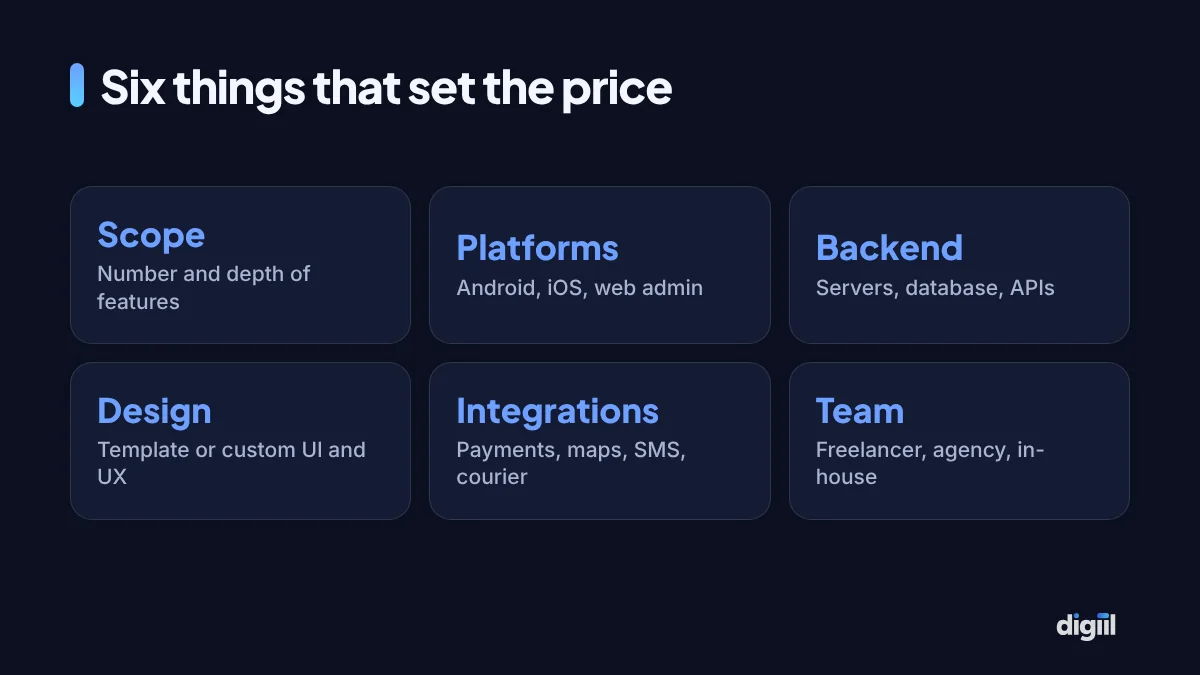
1. Scope: the features you need
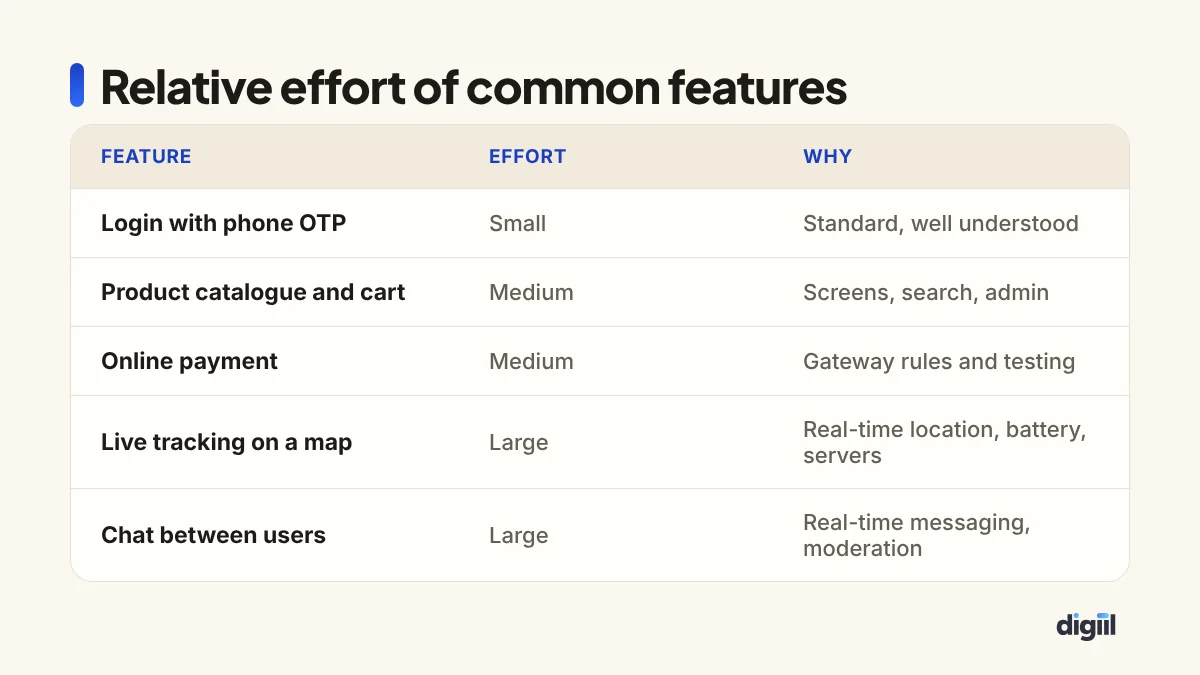
A useful exercise before talking to any developer: list every screen a user will see and every action they can take, then mark each “must have for launch” or “later”. Most first versions can lose a third of their feature list without hurting the core idea. That first version is often called an MVP, a minimum viable product.
Remember that each type of user needs its own set of screens. A ride or delivery app has customers, riders and an admin team, which is three apps’ worth of thinking even if two are inside one codebase.
2. Platforms
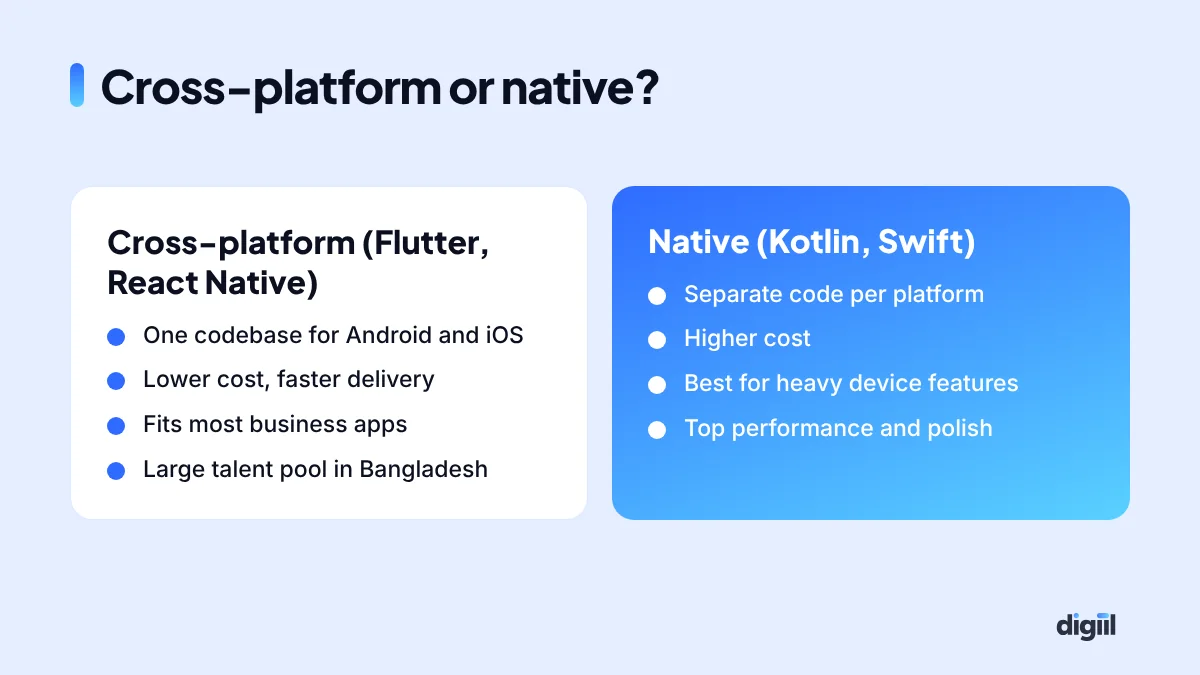
For most business apps, a cross-platform framework such as Flutter or React Native gives Android and iOS from one codebase at a noticeably lower cost than two native apps. Native development makes sense for apps that lean heavily on device hardware, complex animation or the highest performance.
Do not forget the web admin panel. Someone has to manage products, orders, users and content. It is often a significant part of the project and is sometimes left out of cheap quotes.
3. Backend
The backend is the server side: database, business logic, APIs, notifications and file storage. Some apps can use ready-made services such as Firebase to move faster. Others need a custom backend for complex rules, integrations or data ownership. Ask how the backend is built, where it is hosted and what it will cost each month as users grow.
4. Design
A design based on a standard component library is quicker and cheaper. A fully custom design with user research, prototypes and animation costs more and is worth it when the app itself is the product. Either way, ask to see clickable designs before development starts. Changing a design costs hours. Changing built code costs days.
5. Integrations
Each connection to another system takes design, coding and testing: payment gateways, SMS and OTP providers, maps, courier APIs, accounting software, your existing website. Local payments in particular need careful testing. See payment gateways in Bangladesh for what providers require.
6. Who builds it
| Option | Strengths | Risks |
|---|---|---|
| Freelancer | Lowest rates, flexible | One person for design, code and testing; disappears more often |
| Small agency | A team with design, development and testing | Quality varies; check past apps |
| Established software company | Process, documentation, support | Higher rates, may prefer bigger projects |
| In-house team | Full control, long-term knowledge | Hiring cost and time; worth it for a core product |
A worked estimate
Here is how to think through a simple example: a booking app for a chain of three salons. The hours below are illustrative, to show the method, not a quote.
- Customer app: sign-up with phone, browse services, choose branch and time, pay or pay at salon, booking history, notifications.
- Staff view: today’s bookings, mark as done.
- Admin panel: services, prices, staff, schedules, reports.
- Integrations: SMS for OTP and reminders, one payment gateway.
A team would estimate each item in hours, add design, testing and project management, and multiply by its rate. Then add monthly costs: server, SMS, the Google Play developer fee and an Apple developer membership if you publish on iOS. Ask every bidder to show this breakdown. A quote without one is a guess, or a price designed to win the deal and recover later through change requests.
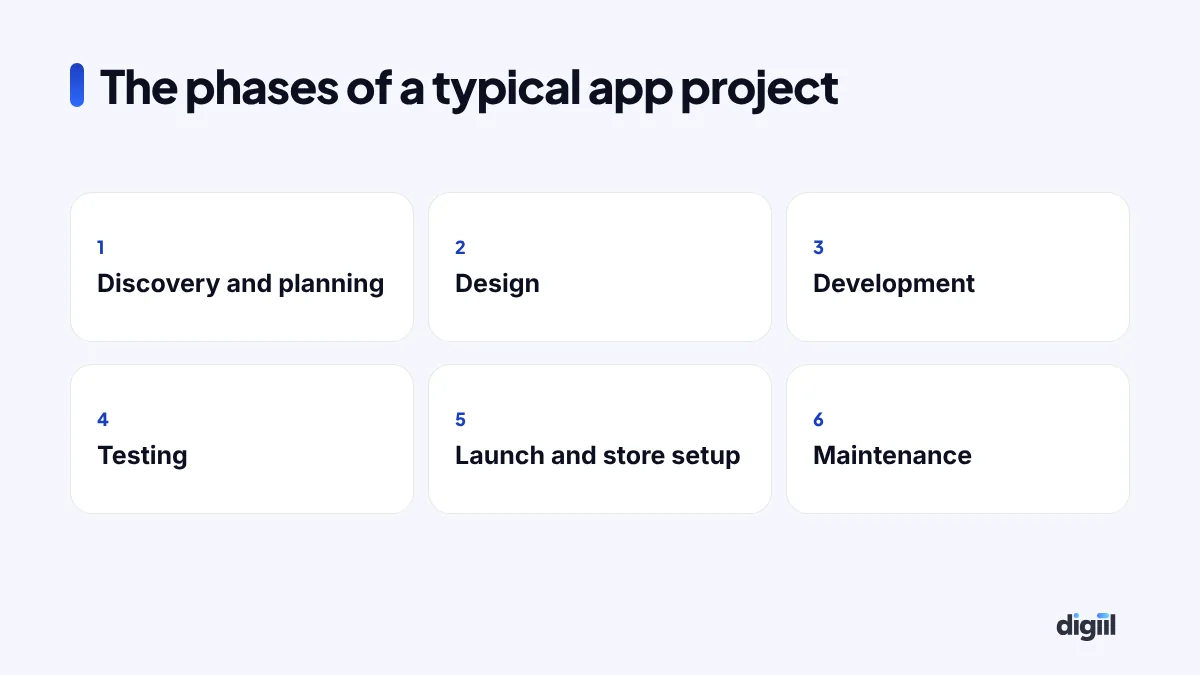
A typical timeline
| Phase | What happens | Usual length |
|---|---|---|
| Discovery | Goals, users, feature list, technical plan | 1 to 3 weeks |
| Design | User flows, wireframes, clickable design | 2 to 5 weeks |
| Development | App, backend and admin panel in short cycles | 6 to 16 weeks or more |
| Testing | Device testing, bug fixing, payment tests | 2 to 4 weeks, overlapping |
| Launch | Store listings, review, release | 1 to 2 weeks |
Apple’s App Store reviews every app before publication, and both stores have content and privacy requirements, so plan launch time for possible rejections and resubmission.
Red flags in a quote
- A fixed price given after a five-minute conversation, with no feature list.
- No mention of the admin panel, testing or deployment.
- “Unlimited revisions” with no scope document. Something will give.
- Code, store accounts or servers kept under the developer’s name.
- No examples of published apps you can download and try.
- Payment of most of the total before any design is shown.
A healthy arrangement ties payments to milestones you can see: approved designs, a working test build, a release to the stores.
The costs after launch
An app is never finished. Operating systems update every year, libraries need upgrading, bugs appear, and users ask for features. A common rule of thumb is to budget around 15 to 20 percent of the original build cost per year for maintenance, before new features. Add server and service costs, which grow with users.
How to cut cost without cutting corners
- Launch an MVP. Build the one journey that proves the idea, and add the rest once people use it.
- Use cross-platform unless you have a clear reason not to.
- Start on Android if most of your customers use it, while building in a way that makes iOS easy later.
- Use ready-made services for login, notifications and analytics instead of building them.
- Consider a web app first. A fast mobile website can test demand at a fraction of the cost. See website development cost in Bangladesh and WordPress vs custom websites.
- Write a clear brief. Unclear requirements are the biggest source of overruns.
Comparing quotes
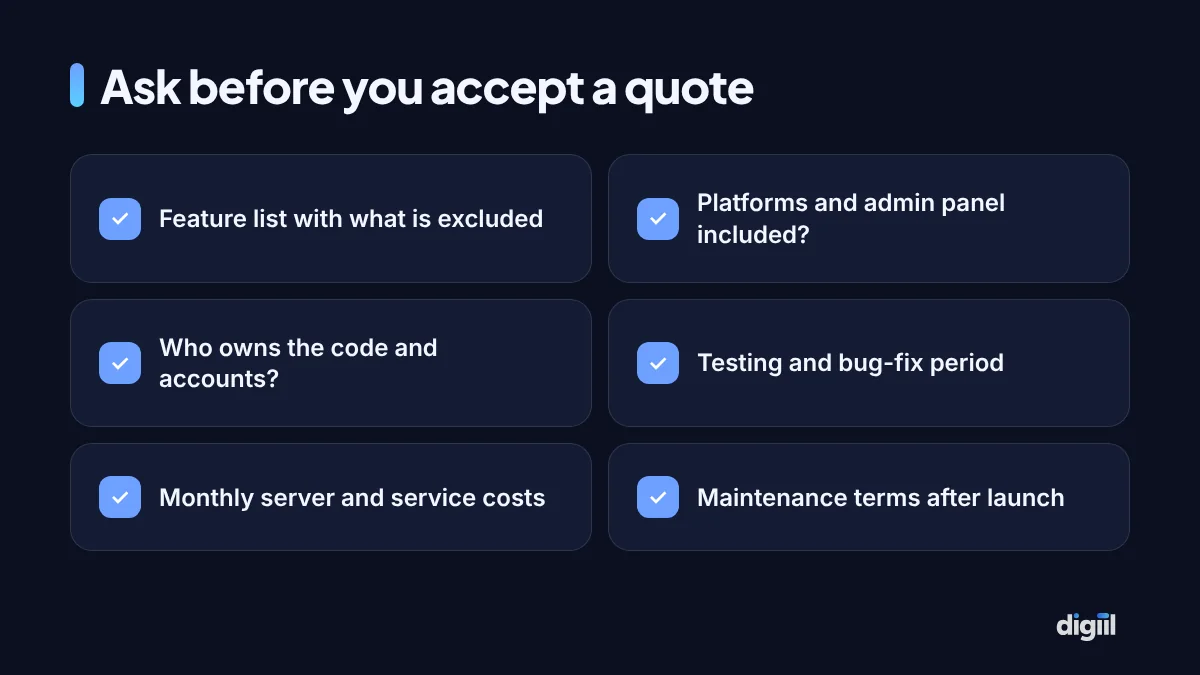
A cheap quote that excludes the admin panel, testing or deployment is not cheaper. Line up quotes by the same feature list. Ask to see two apps each team has built and published, and try them yourself. Speak to a past client if you can.
Insist that the source code, the app store accounts, the server and the domain are in the business’s name. Apps published under a developer’s personal account can become impossible to update if the relationship ends.
Before you decide
The pharmacy chain chose none of the three at first. It wrote a one-page brief, asked all three firms to quote against it, and the gap between the quotes narrowed to something it could actually compare.
Write down the problem the app solves, who will use it, how often, and what one action matters most. If you cannot fill that in clearly, you are not ready for a quote yet, and an hour of planning will save you a great deal of money. When you are ready, see our mobile app development service or book a free 15-minute strategy call to talk through scope.
App cost questions
Is it cheaper to build an app in Bangladesh than abroad?
Hourly rates in Bangladesh are generally lower than in Western Europe or North America, which is why many foreign companies outsource here. Quality varies widely, so judge teams by their past apps and process, not by rate alone.
Do I need both Android and iOS?
In Bangladesh, Android has a large majority of smartphone users, so many local apps launch on Android first. If your customers are premium or international, iOS matters more. Cross-platform frameworks make doing both cheaper.
How long does it take to build an app?
A focused first version often takes two to four months. Complex platforms with several user types, real-time features and integrations take longer.
Can I build an app with a no-code tool?
For prototypes, internal tools and simple apps, no-code builders can work well and cost much less. They become limiting when you need custom features, scale or full ownership of the code.
Should I build an app or a website first?
If customers need the product once in a while, a fast mobile website is usually enough and much cheaper. An app makes sense when people use it frequently, need notifications, or need device features such as location or the camera.

Amanat has 7+ years in digital marketing and has managed $8M+ in Google and Meta ad spend for 235+ brands in the UK, USA, Australia and Bangladesh. He holds 20+ certifications, including Digital Marketing Strategy from Harvard Business School Online. More about Amanat