Performance Max campaigns are Google’s all-in-one campaign type. You give Google a goal, a budget, your creative and some hints, and its system decides where, when and to whom to show your ads across almost all of Google’s advertising space. For some businesses it is the most efficient campaign in the account. For others it is a quiet way to spend money on placements nobody would have chosen.
This guide explains how it works, how to tell whether you are ready, how to set it up, and how to steer it.
How it works
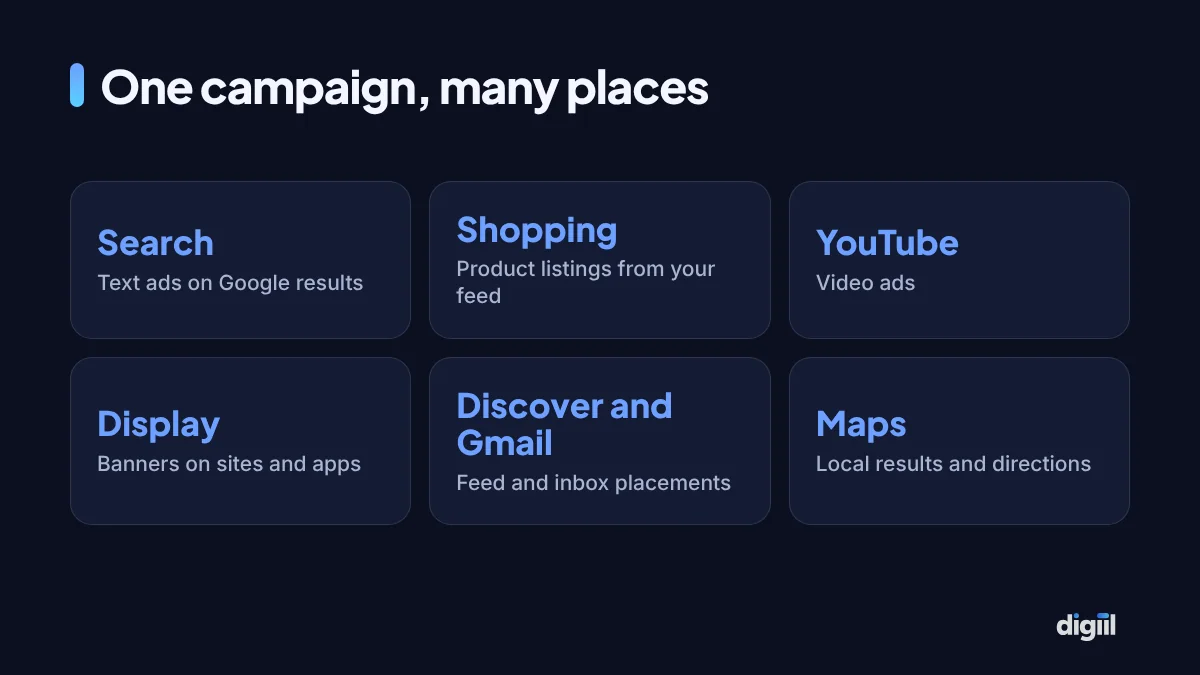
Traditional campaigns are built around a channel and a targeting choice: keywords for Search, placements for Display, a feed for Shopping. Performance Max removes those boundaries. A single campaign can serve on every inventory in the image, and Google chooses the mix for each auction based on its prediction of which impression is most likely to produce your conversion.
Three things drive those predictions:
- Your conversion goal, and the value you assign to each conversion.
- Your assets: headlines, descriptions, images, logos, videos and, for stores, the product feed.
- Your signals: audiences and search themes that suggest where to start looking.
Everything else is automated: bids, placements, combinations of assets and audiences. That is why the quality of what you feed it matters so much.
Are you ready for it?
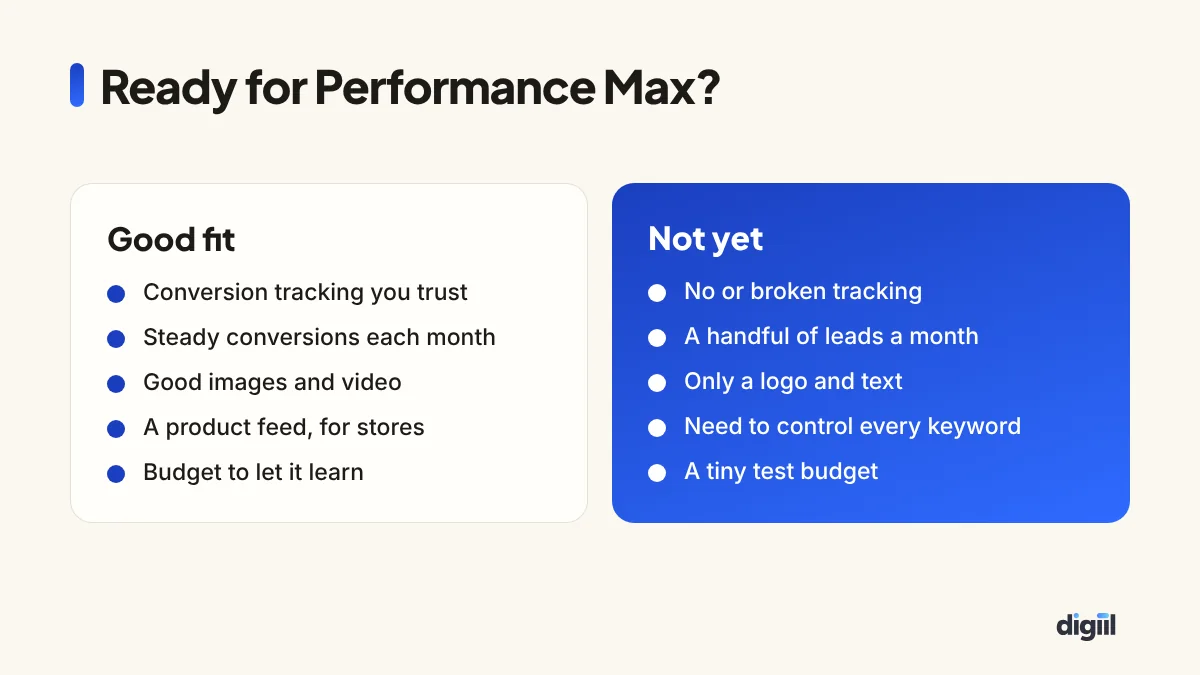
The single most important requirement is tracking you trust. Performance Max optimises towards whatever you count as a conversion. If that is page views, it finds page viewers. If your purchase tag fires twice, it chases a ghost. Check your setup with our Google Tag Manager guide before you launch.
Volume matters too. With only a few conversions a month, automated bidding has little to learn from. A well-built Search campaign usually serves smaller accounts better. If you are new to Google Ads, read Google Ads in Bangladesh and Google Ads cost in Bangladesh first.
Setting one up
- Choose the objective (Sales or Leads, usually) and the conversion goals the campaign should use. Remove goals that do not represent real business value.
- Connect Merchant Center if you sell products, so the campaign can use your product feed.
- Set budget and bidding. Start with Maximise conversions or Maximise conversion value. Add a target cost per acquisition or return on ad spend later, once you know what the campaign achieves.
- Set locations and languages. For Bangladesh-only businesses, choose people in your locations rather than people interested in them.
- Decide on final URL expansion. When on, Google may send people to other pages of your site it thinks fit better. Turn it off or exclude pages if only certain pages should receive traffic.
- Build asset groups. One per product line or theme, each with its own headlines, descriptions, images, videos and landing page.
- Add signals: your customer list, website visitors, custom segments based on searches, and search themes describing what you sell.
- Add negative keywords and brand exclusions where needed, then launch.
Assets: the part you control most
Performance Max mixes your assets into ads for each channel. If you provide only text and a logo, Google will still try to fill video and image placements, sometimes by generating its own video from your images, which rarely looks good.
- Headlines and descriptions: fill every slot with distinct messages: product, benefit, proof, offer, price, delivery.
- Images: landscape, square and portrait versions of real product and lifestyle photos.
- Video: at least one short vertical and one horizontal video. Even a simple phone-made product video beats an auto-generated one.
- Logos in square and landscape formats.
Asset reporting now shows conversions and cost per asset. Replace the weakest ones every few weeks rather than rebuilding the whole group.
Instead of one asset group with everything, the shop builds three: air conditioners, refrigerators and small kitchen appliances. Each has its own photos, headlines about that category, its own landing page and search themes such as “inverter AC price” or “double door fridge”. The system learns faster because each group has a clear purpose, and the shop can see which category earns its budget.
Signals are hints, not targeting
Audience signals and search themes tell Google where to start. They do not restrict who sees your ads. Once the system finds conversions elsewhere, it goes there. Treat signals as a way to shorten the learning period, not as a fence.
The strongest signal is your own data: a list of past customers and recent website visitors. Custom segments built from the search terms your buyers use come next.
The controls you still have
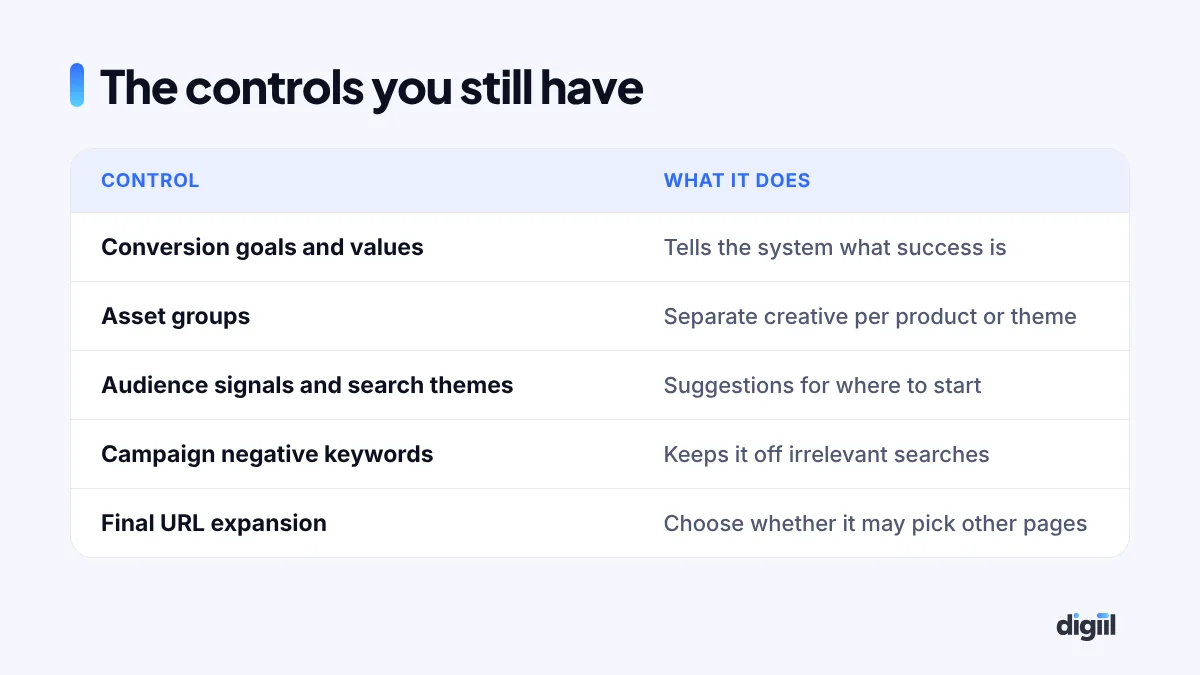
When Performance Max launched, advertisers complained about how little they could see or control. Google has added a great deal since. Campaign-level negative keywords and shared negative keyword lists are now available in every Performance Max campaign, search themes per asset group have increased, and device and age controls have been added. On the reporting side there is a search terms report, full asset statistics and channel performance reporting. Check Google’s help centre for the current list, because it keeps changing.
Performance Max alongside Search
Many accounts run both. A common pattern:
- A Search campaign for your brand name and your most important keywords, where you want exact control over the message and the price you pay.
- Performance Max for wider reach, with your brand terms excluded so it does not take credit for people who were already searching for you.
When the same search could be served by both, Google generally prefers a Search campaign whose keyword exactly matches the query. Still, watch for overlap in the search terms report and adjust negatives.
Whether Google or Meta suits your business better is a separate question, covered in Google Ads vs Facebook Ads.
Reading results honestly
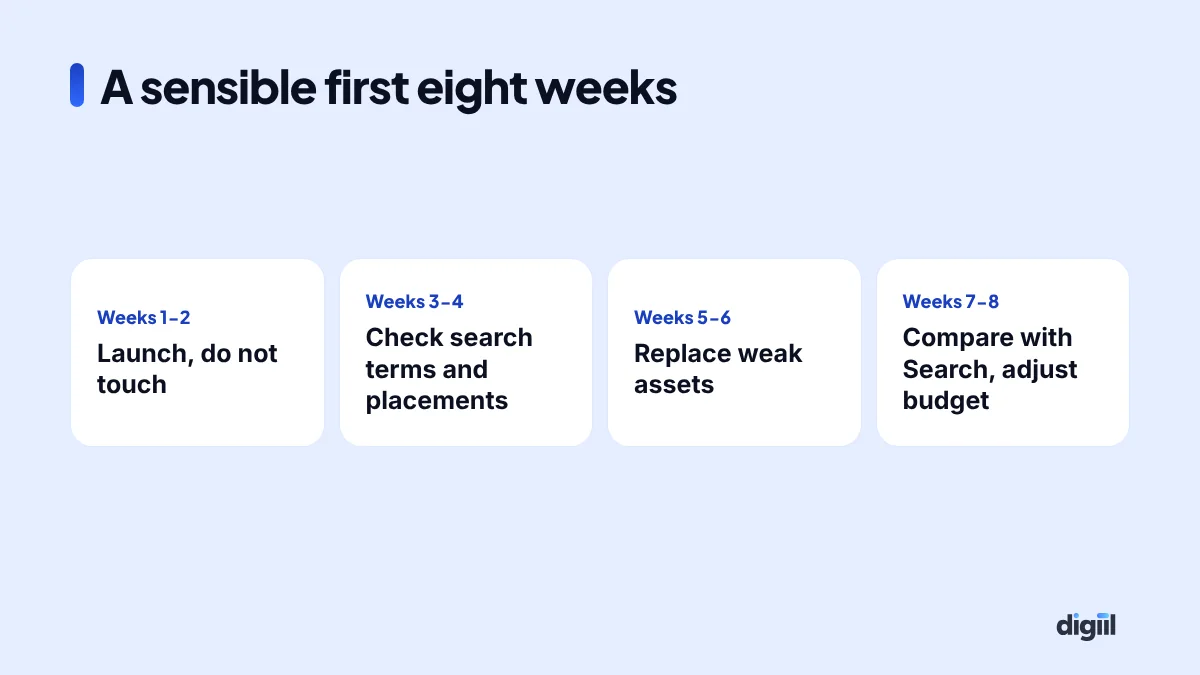
Give a new campaign two weeks before making changes. After that, look beyond the headline cost per conversion.
- Where did the conversions come from? If most came from your brand searches or past customers, the campaign may be harvesting sales you would have had anyway.
- Which channels spent the money? A large share on Display with few conversions is worth questioning.
- Are leads real? For lead generation, check the quality of form submissions. Spam and low-intent leads are a known weakness when the only goal is “form submitted”.
- Did total sales grow? Compare overall business results before and after, not only what Google reports.
When to avoid it
- Your conversion tracking is missing, broken or counts things that are not business results.
- You get only a few conversions a month.
- Your landing page is weak. Automation sends more traffic to a page that does not convert, faster.
- You have no images or video and no plan to make any.
- You need strict control over exactly where every taka goes, for legal, brand or budget reasons.
Fix the landing page first if needed. See landing page design tips. When you are ready to run Performance Max properly, or want someone to audit an existing campaign, see our Google Ads service.
Performance Max questions
Is Performance Max better than a Search campaign?
Not always. Search gives you keyword-level control and is often better for services with clear search demand. Performance Max can find extra conversions across Google's other channels. Many advertisers run both, with Search covering their most important keywords.
How much budget does Performance Max need?
Enough to produce conversions regularly. Google's system learns from conversion data, so a budget that yields only a few conversions a month gives it little to work with. If your account has low volume, start with Search.
Can I see which searches Performance Max showed my ads for?
Yes. Performance Max now has a search terms report, along with asset reporting and channel performance reporting, so you can see far more than when it launched.
Can I stop Performance Max showing on my brand name?
You can add campaign-level negative keywords and use brand exclusions to keep Performance Max away from your own brand searches, which a separate brand Search campaign usually covers more cheaply.
Does Performance Max work for lead generation?
It can, but it tends to find cheap, low-quality leads if it is optimised only for form submissions. Import qualified leads or sales from your CRM as conversions so it learns which leads matter.

Amanat has 7+ years in digital marketing and has managed $8M+ in Google and Meta ad spend for 235+ brands in the UK, USA, Australia and Bangladesh. He holds 20+ certifications, including Digital Marketing Strategy from Harvard Business School Online. More about Amanat