
Most advice about ChatGPT for business is either a list of a hundred prompts nobody uses or a warning that robots are coming for your job. This is neither. It is fifteen specific jobs that a shop, agency, clinic or small factory can hand over this week, each with a prompt to copy and adjust.
Read the next section first. The prompts work far better once you know why they are written the way they are.
How to ask so the answer is usable
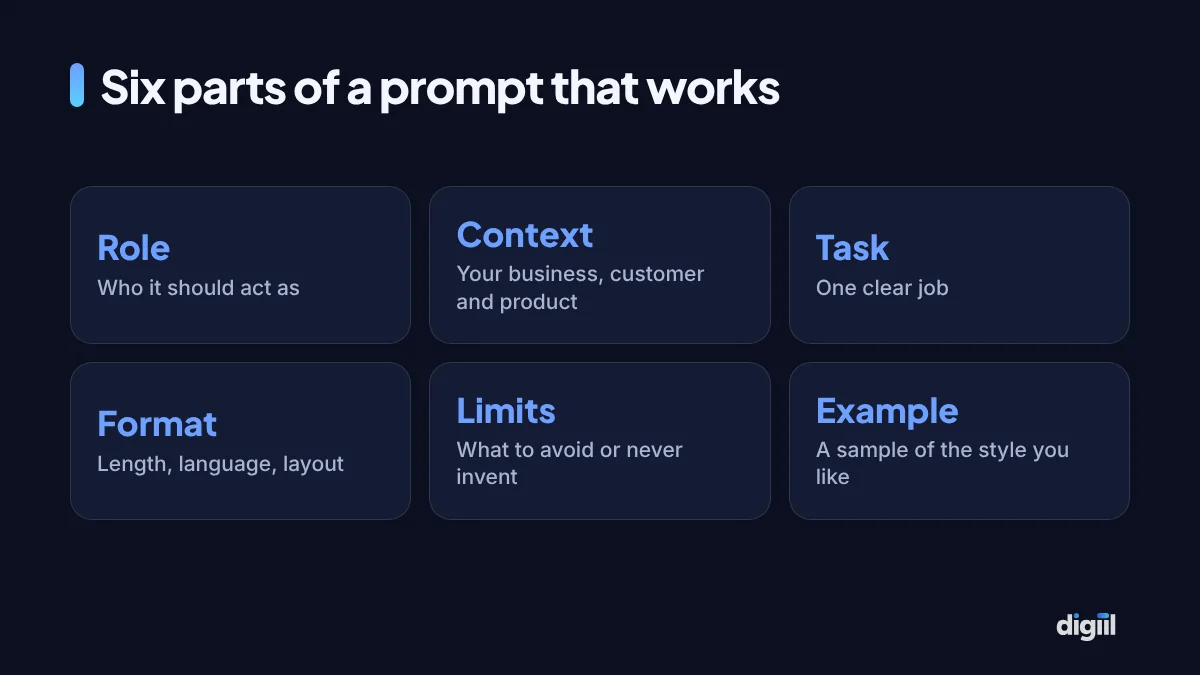
ChatGPT answers the question you actually typed, with no knowledge of your business. Type “write a Facebook post for my shop” and you get something generic, because the request was generic. Give it what a new employee would need on day one and the result changes completely.
You do not need all six parts every time. Role, context and task do most of the work. Format and limits tidy the result. An example is the fastest way to get your own voice.
Weak: Write a post about our new panjabi.
Strong: You write social posts for a men’s clothing shop in Dhaka. Our buyers are men aged 25 to 40 who shop for Eid and weddings. Write a Facebook post for a new cotton panjabi, price Tk 1,850, six colours, delivery all over Bangladesh. Use simple Banglish, under 60 words, no emojis, and end by asking which colour they like.
Two habits to add. First, treat the first answer as a draft and reply with corrections: “shorter”, “less formal”, “remove the second line”. Second, when a prompt works, save it. A shared document of ten proven prompts is worth more than any course.
Customers and sales
1. Reply templates for the questions you answer every day
Price, delivery, sizes, returns. Have them written once, properly, and paste them from quick replies.
You are a polite customer service agent for [business], which sells [products] in Bangladesh.
Write short reply templates for these questions: price, delivery charge and time,
payment methods, return policy, how to order.
Facts: [paste your real prices, charges and policy].
Language: [Bangla / Banglish / English]. Friendly, under 40 words each.
Do not add any fact I have not given you.
2. Answering a complaint without making it worse
Paste the customer’s message with names removed. Ask for a calm reply that apologises once, states what you will do and gives a time. Then edit it so it sounds like you.
A customer wrote this: "[message]".
What happened on our side: [facts]. What we can offer: [refund / exchange / redelivery].
Write a reply that is sincere, short and specific. No excuses, no template phrases.
3. A quotation or proposal from rough notes
Service businesses lose hours here. Dictate or type your notes after a client call and ask for a structured proposal: the client’s problem, what you will do, timeline, price, next step. Check every number yourself.
4. Preparing for a sales call
I sell [service] to [type of company]. Tomorrow I am meeting [role] at a [industry] firm.
List the ten objections I am most likely to hear, with a short honest answer to each.
Then give me five questions to ask that reveal whether they are a good fit.
5. Follow-up messages that do not sound desperate
Ask for three versions of a follow-up for a quote sent five days ago: one short, one that adds a useful piece of information, one that offers a call. Pick, adjust, send.
Marketing and content
6. Product descriptions in bulk
Paste a table with product name, material, size, price and one special point per product. Ask for a description of 50 to 70 words for each in a fixed layout. For twenty products this is ten minutes instead of a day. Read each one: it will sometimes invent a feature that sounds plausible.
7. A month of social media ideas
We are a [business] in [city]. Our customers are [who]. Our goals this month: [goal].
Give me 20 post ideas in a table: date, topic, format (photo, Reel, carousel, Live),
first line of the caption. Mix product posts, tips, customer stories and behind the scenes.
Include these dates: [Eid, Pohela Boishakh, pay day, your sale].
It gives ideas. Real photos, real customers and your own voice are still your job. Our guide to social media marketing in Bangladesh covers what to do with the calendar.
8. Ad copy variations to test
Give it one ad that has worked and ask for five versions, each leading with a different angle: price, quality, speed, social proof, problem. Testing angles is how you learn what your buyers care about. Budget questions are answered in Facebook ads cost in Bangladesh.
9. Outlines and first drafts for blog posts
Ask for an outline, then fill it with what you know that the internet does not: your prices, your process, your cases. Publishing its unedited draft is a poor idea, for reasons explained in AI content and SEO.
10. Turning one piece of content into five
Paste a blog article or the transcript of a video. Ask for a Facebook post, a LinkedIn post, three short Reel scripts and an email, each written for that channel.
Operations and admin
11. Finding the pattern in customer feedback
Copy fifty reviews or inbox complaints, remove names and phone numbers, and ask:
Here are 50 customer comments. Group them into themes.
For each theme give the count, two typical quotes and one practical fix.
Then tell me the three changes that would remove the most complaints.
This is one of the highest-value uses on the list, and few businesses do it.
12. Writing down how work is done
Describe a routine out loud, such as how an order is packed and handed to the courier, and ask for a numbered standard operating procedure with a checklist. New staff learn faster and you stop repeating yourself.
13. Job posts and interview questions
Write a job post for a [role] at a [business] in [city]. Duties: [list]. Salary: [range].
Keep it honest and under 200 words. Then give me eight interview questions
that test real skill for this role, with what a good answer sounds like.
14. Spreadsheet help
Describe your columns and what you want, and ask for the exact Excel or Google Sheets formula with an explanation. On plans that accept file uploads, you can upload a sales export with customer details removed and ask questions such as “which five products earned the most profit last quarter?”. Always check a few figures by hand.
15. Thinking through a decision
I run a [business]. I am deciding whether to [decision]. Facts: [numbers and situation].
Ask me any questions you need first. Then list the risks, what would have to be true
for this to work, and the cheapest way to test it before committing.
It will not know your market better than you. It is good at asking the questions you skipped.
One task from start to finish
Seeing a single job done fully is more useful than another ten prompts. Take use number 11, customer feedback, for a shop that sells bedsheets online.
- Collect. The owner copies the last 60 reviews and complaint messages from the page inbox into a document and deletes names, phone numbers and addresses.
- Ask. She pastes them with the prompt above and adds one line of context: “We sell cotton bedsheets at Tk 1,200 to 2,800, delivered by courier across Bangladesh.”
- Read critically. The answer groups comments into five themes. The largest is colour looking different from the photo. The second is late delivery outside Dhaka. She checks ten original comments against the summary to make sure it has not exaggerated.
- Dig. She follows up: “For the colour complaints, which products are mentioned most?” Three designs account for most of them.
- Act. She reshoots those three in daylight, adds a line about screen colour differences to every listing, and asks for a first draft of a delivery-time table by division, which she corrects from her courier’s real figures.
The whole exercise takes under an hour. Notice the division of work. The tool did the reading and sorting. She supplied the data, checked the result, and made the decisions.
ChatGPT or one of the others?
ChatGPT is the best-known assistant, not the only one. Google’s Gemini, Anthropic’s Claude and Microsoft’s Copilot do broadly the same jobs, and each has a free tier.
- If your work lives in Google Workspace, Gemini sits inside Gmail, Docs and Sheets, which saves copying and pasting.
- If your company uses Microsoft 365, Copilot does the same inside Word, Excel and Outlook.
- For long documents and careful writing, many people prefer Claude.
- For the widest range of features in one place, including images, voice and custom assistants, ChatGPT is a sound default.
The prompts in this article work in all of them. Try the same real task in two tools for a week and keep the one your team actually opens. The habit matters more than the brand.
Inside our own team, the biggest win has not been finished copy. It has been the dull middle of the work: turning call notes into a client brief, drafting report summaries that a person then checks, and producing ten headline options so a human can pick the best two.
Where it lets you down
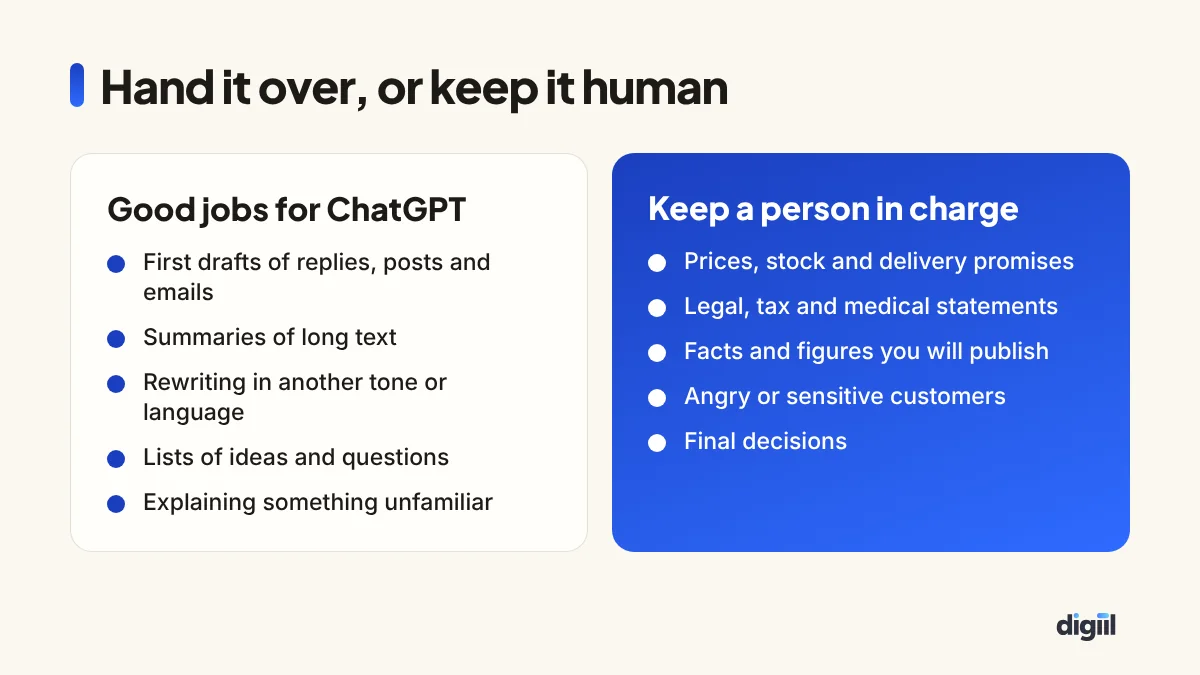
- It states wrong things confidently. Invented statistics, laws that do not exist, features your product lacks. Anything factual needs checking before it leaves the building.
- It does not know your stock, prices or policies unless you supply them in the conversation.
- Its knowledge has a cut-off date. For current exchange rates, regulations or platform rules, use a version with web search and still open the source.
- Its default voice is recognisable. Customers notice long, over-polite, generic text. Edit until it sounds like a person from your team.
- Local detail is thin. Area names, courier habits, how people really phrase things in Chattogram or Sylhet: add these yourself.
Rules for the team
Write these down before more than one person starts using it.
- Nothing private goes in. No customer names with phone numbers or addresses, no passwords, no bank or card details, no unsigned contracts.
- A human reads everything before a customer does.
- Facts and prices come from our own records, never from the chat.
- Use the company account, with the data-sharing setting reviewed, not personal accounts.
- Save good prompts in the shared library.
Bringing it into daily work
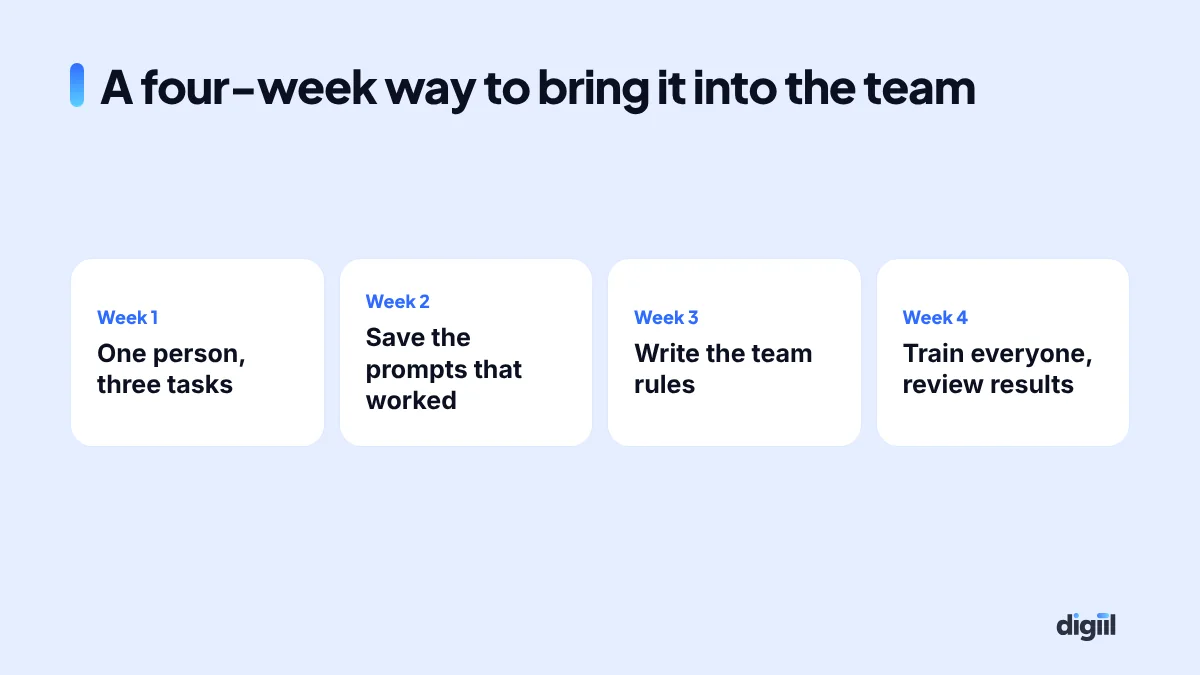
Start with one person and three tasks from the list above, chosen because they eat time every week. After a fortnight, keep what saved time and drop the rest. Only then train the others. Teams that announce “we are using AI now” without choosing tasks tend to stop within a month.
On paid plans you can create a custom GPT: a saved assistant that already holds your product list, policies and tone, so nobody has to paste the context again. For a small team that is usually the step that makes the habit stick.
What comes after ChatGPT
ChatGPT is a tool you talk to. The next step is tools that act without being asked each time: a chatbot that answers the Facebook inbox at midnight, or an automation that reads an order and updates the sheet. If that is where you are heading, read about Facebook page chatbots and our round-up of AI tools for small businesses, or look at our AI automation service.
Quick answers
Is the free version of ChatGPT enough for a small business?
For testing and light daily use, yes. Paid plans give higher limits, stronger models and features such as file analysis and custom GPTs. Start free, note where it holds you back, then decide.
Does ChatGPT understand Bangla?
Yes. It reads and writes Bangla script and understands Banglish reasonably well. Its Bangla can sound formal or translated, so ask for a conversational tone and have a native speaker read anything that goes to customers.
Is it safe to put business information into ChatGPT?
Do not paste customer personal data, passwords, bank details or confidential contracts. Check the data controls in settings, where you can stop your chats being used to train models. Business and enterprise plans come with stronger privacy terms.
Can ChatGPT replace a content writer or customer service agent?
It replaces typing, not judgement. A person who knows the product still has to check facts, add real experience and deal with unusual cases. Teams that use it well get more done with the same people.

Amanat has 7+ years in digital marketing and has managed $8M+ in Google and Meta ad spend for 235+ brands in the UK, USA, Australia and Bangladesh. He holds 20+ certifications, including Digital Marketing Strategy from Harvard Business School Online. More about Amanat