
A travel website published 600 AI-written destination pages in two months. Traffic jumped at first. Then, after a Google update, it fell off a cliff. Meanwhile, a small tour company used AI only to speed up research and first drafts, then added its guides’ real experiences, photos and tips. Its traffic grew slowly and kept growing.
Both used AI. The difference was how. This guide explains AI content and SEO: what Google actually says, where AI helps, where it hurts, and a safe workflow you can follow.
What Google says about AI content
Google’s public guidance is clear: it focuses on the quality of content, not how it is made. Helpful, reliable, people-first content can rank whether a person, AI or both created it.
But Google’s spam policies target scaled content abuse: producing many pages mainly to manipulate rankings, with little value for users. Using AI to churn out such pages falls into this.
Where AI helps SEO
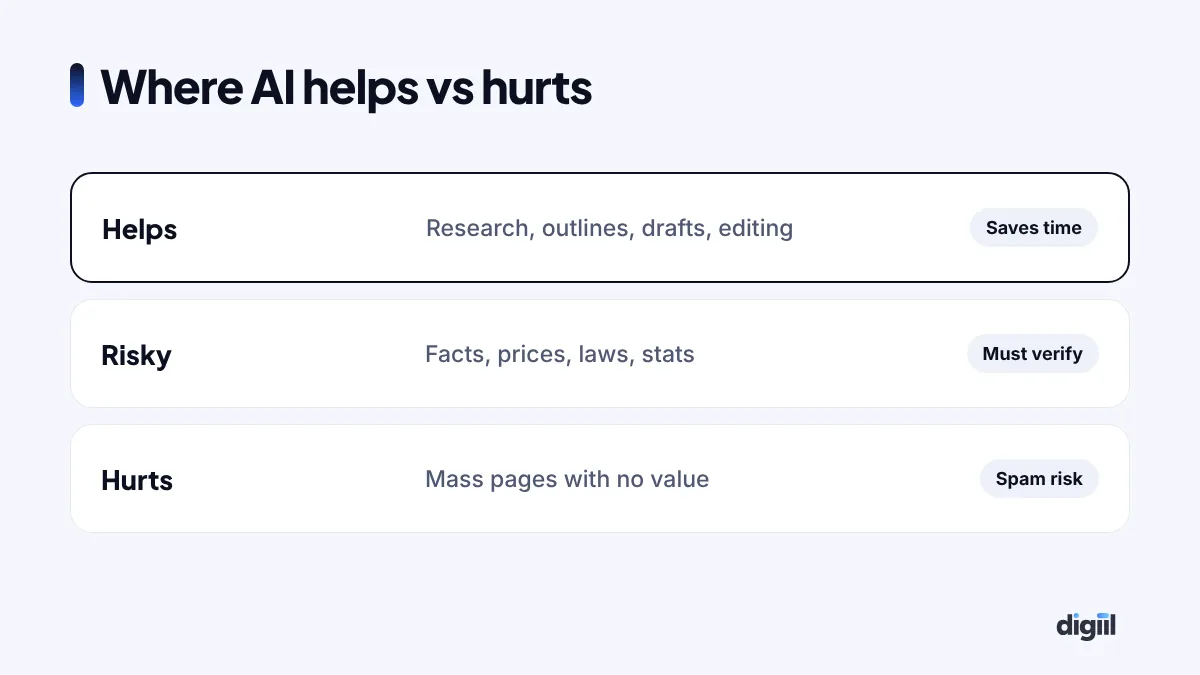
- Research: summarising sources, finding questions people ask.
- Outlines: structuring a topic logically.
- First drafts: getting words on the page faster.
- Editing: simplifying sentences, fixing grammar, improving readability.
- Metadata: title and description ideas.
- Schema and code: drafting structured data for review.
- Translation: Bangla and English versions, with human review.
Where AI hurts
- Made-up facts: AI can invent statistics, laws or sources. Always verify.
- Outdated information: prices, rules and platforms change.
- Generic content: without real experience, articles sound like everyone else.
- Mass-produced pages: hundreds of thin pages can trigger spam actions.
- No accountability: content with no clear author or expertise is less trustworthy.
Add what AI cannot: experience
Google’s quality guidelines emphasise E-E-A-T: experience, expertise, authoritativeness and trust. AI has no first-hand experience. You do. Add:
- Real examples from your work and clients.
- Original photos, screenshots and data.
- Your opinion and recommendations.
- Local details that only someone in Bangladesh would know.
- A clear author with real credentials.
A safe AI content workflow
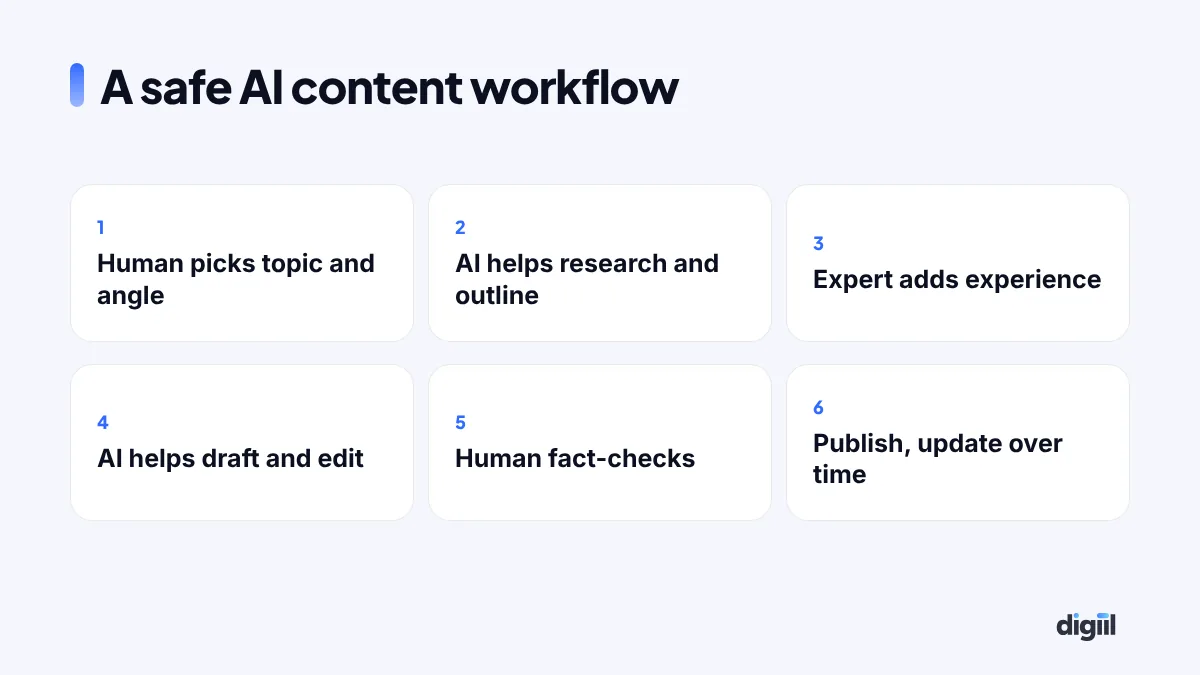
Follow this process for every important page. It keeps quality high while saving time.
Writing for AI Overviews and AI assistants
Search is changing. Google AI Overviews and assistants like ChatGPT answer questions directly and cite sources. To be cited:
- Answer key questions clearly in the first lines of each section.
- Use headings that match real questions.
- Include specific facts, numbers and dates, with sources.
- Show authorship and expertise.
- Keep pages updated.
Read more about answer engine optimisation and our on-page SEO checklist.
AI content quality checklist
| Check | Question |
|---|---|
| Purpose | Does this page truly help someone? |
| Accuracy | Are all facts, prices and dates verified? |
| Experience | Does it include real examples or insights? |
| Originality | Does it add something others do not? |
| Readability | Is it simple and clear? |
| Author | Is a real, qualified person responsible? |
Common mistakes
- Publishing unedited AI drafts.
- Generating hundreds of near-identical location or product pages.
- Trusting AI statistics without checking.
- Removing all personality and opinion.
- No author or about page.
Prompts that produce better drafts
Vague prompts produce generic content. Give AI context:
- Who the reader is: “small business owners in Bangladesh, new to SEO”.
- What they need: “a clear, step-by-step guide with examples”.
- Your angle: “from the view of an agency that has run hundreds of campaigns”.
- Style rules: “short sentences, simple words, active voice, no hype”.
- Facts to include: paste verified data and sources yourself.
Then rewrite the draft in your voice and add your own examples.
Updating old content with AI help
AI is very useful for refreshing existing pages:
- Paste the old article and ask what is missing compared to current top results.
- Ask for clearer headings and shorter paragraphs.
- Generate FAQ ideas from “People also ask” questions you collect.
- Then verify every fact and update dates, prices and screenshots yourself.
Signals that your content needs more human input
| Signal | Fix |
|---|---|
| Sounds like every other article | Add your opinion and a real story |
| No specific numbers or examples | Add verified data and cases |
| Long, complex sentences | Simplify for real readers |
| No author information | Add a real author box with credentials |
| High bounce, low time on page | Answer the question earlier |
The future: AI search and your website
As more answers appear directly in AI tools, websites that are clear, trustworthy and specific will be cited and clicked. Brand searches will matter more. Build content that people would bookmark and share, not just content that matches keywords.
A real editing example
AI draft: “Facebook ads can be a great way to grow your business in Bangladesh. It is important to target the right audience and create engaging content.”
Human edit: “For a Dhaka clothing page selling Tk 1,200 kurtis, we usually start Facebook ads at Tk 1,000–1,500 a day for message campaigns. The first week tells you which two of five creatives to keep.”
The second version is specific, local and clearly based on experience. That is the kind of sentence Google and AI tools reward, and the kind readers trust.
A simple policy for your team
- AI can help with research, outlines and first drafts.
- A named person edits, fact-checks and approves every page.
- Every article adds at least one real example, number or image from your work.
- No AI-generated reviews, testimonials or fake quotes, ever.
- Old pages are reviewed every six months.
Write this down. It keeps quality steady as your content grows.
The tour company’s approach
The tour company uses AI to research destinations and draft outlines. Its guides add personal tips, best times to visit, real costs and photos from their trips. An editor checks every fact. They publish two articles a month instead of twenty, and each one keeps bringing bookings.
AI content and SEO can work together. Use AI for speed, humans for experience and accuracy, and never publish anything you would not be proud to put your name on. If you want an SEO content strategy that uses AI responsibly, see our SEO services.
- Google rewards helpful content, however it is made.
- Mass-produced, low-value AI pages risk spam penalties.
- Use AI for research, outlines, drafts and editing.
- Add real experience, verify facts and show the author.
- Write clear answers to be cited by AI Overviews and assistants.
Your questions, answered
Does Google penalise AI-generated content?
Google says it rewards helpful content however it is produced. But using AI to mass-produce low-value pages to manipulate rankings breaks its spam policies.
Can AI content rank on Google?
Yes, if it is accurate, helpful, original in insight and meets the searcher's needs. Human expertise and editing usually make the difference.
Should I disclose AI use?
Google suggests explaining how content was created where readers would reasonably want to know. Always show who is responsible for the content.
Will AI Overviews kill my traffic?
They change how people search. Pages with clear answers, original insight and strong trust signals are more likely to be cited and still earn clicks.

Amanat has managed $4M+ in Google and Meta ad spend for brands in the UK, USA, Australia and Bangladesh since 2020. He holds 20+ certifications, including Digital Marketing Strategy from Harvard Business School Online. More about Amanat