Mitu has sold handwoven jamdani from her Narayanganj page for six years. A few years ago, a new saree post would bring a few hundred messages by evening. This year, the same kind of post, with the same follower count, reached a few hundred people and brought six messages. She assumed the page had been penalised and nearly paid someone who promised to “unlock” her reach.
Nothing was wrong with the page. The feed had changed, and her posts had not.
Here is the uncomfortable part first. Facebook does not show your posts to most of your followers, and it never promised to. A page with 50,000 followers can publish a post that reaches 900 people. That is normal now, and no setting will switch it off.
What you can do is earn more distribution, post by post. To increase Facebook page reach you need to understand what the feed is trying to do, stop the habits that work against it, and give it more of what it already favours. That is what this guide covers.
Why reach is low for almost every page
Three things happened over the past decade. The number of pages and creators grew far faster than the time people spend scrolling. Meta moved the feed towards friends, groups and, more recently, recommended content from accounts people do not follow. And video, especially Reels, took a large share of the screen.
The result: your post competes with everything else that person could be shown at that moment, and being followed is only a small advantage. There is a bright side. Because so much of the feed is now recommended content, a small page can reach far beyond its own followers when a post holds attention.
What the feed rewards
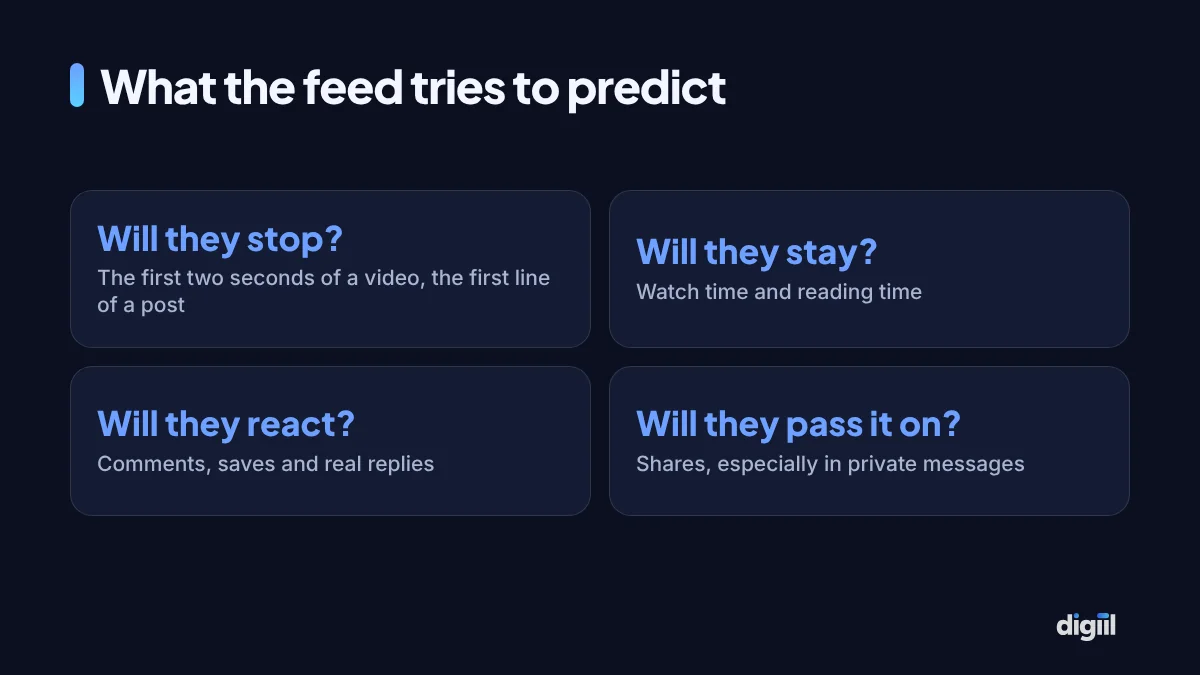
For each person, Facebook’s ranking system scores the available posts by predicting how that person will respond. Meta does not publish exact weights, but it has said repeatedly what kinds of signals count. They come down to four questions.
A post that gets many shares and long watch time from the first few hundred viewers is shown to more people like them. A post that people scroll past is quietly retired. Each post is judged largely by its own performance, although a page that regularly gets ignored builds a weaker history.
Notice what is absent from the list: follower count, how long the page has existed, and how many hashtags you used.
Before anything else: check the page is healthy
Some reach problems are restrictions. Go to your page, open Settings, and look for Page status (sometimes shown under Page quality or Account status). It lists any content removed for breaking rules and whether the page is still eligible to be recommended. Repeated copyright claims, misleading claims or engagement bait can reduce distribution for weeks.
If the page is clean, the fix is in the content.
Nine changes that raise reach
1. Make short vertical video your main format
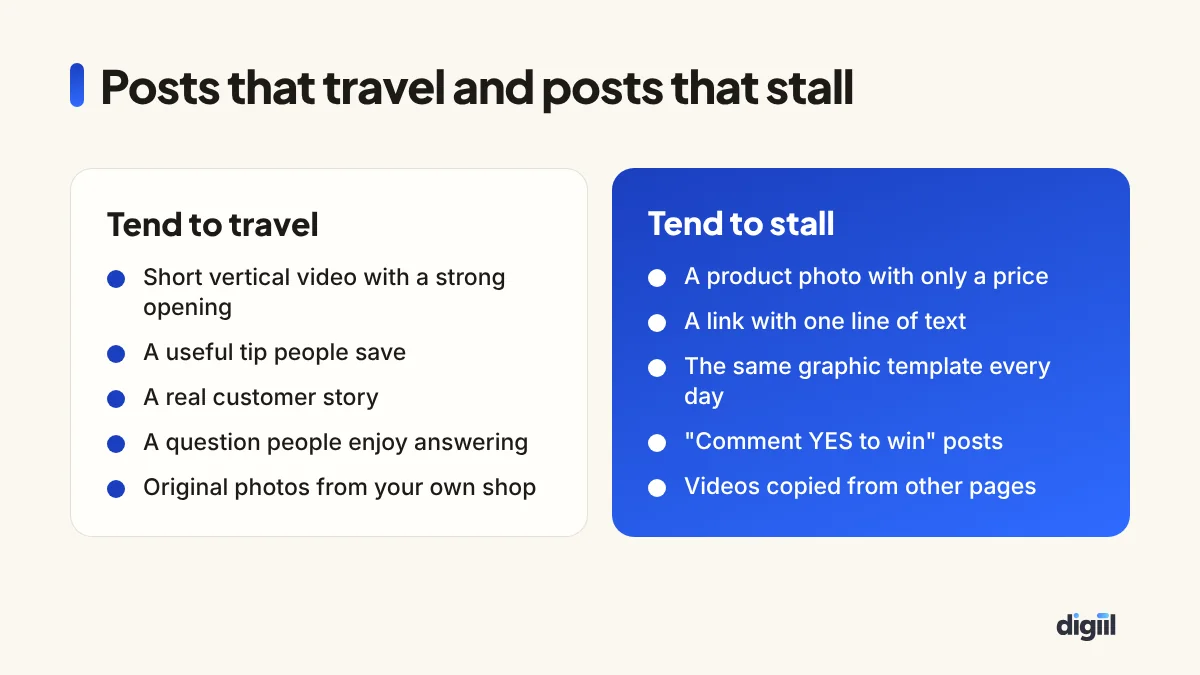
Reels receive more distribution to non-followers than any other format. You do not need a studio. A phone, daylight and a steady hand are enough. Show the product being used, packed, made or compared. Keep most videos between 15 and 45 seconds until you learn what your audience watches to the end.
2. Win the first two seconds
Start with the result, the problem or the surprise, not with a logo or “Assalamu alaikum, welcome to our page”. Put a short line of text on screen, because many people watch without sound.
3. Post things people want to send to someone
A share in Messenger or WhatsApp is the strongest vote a post can get. Ask of every post: who would forward this, and to whom? “Three mistakes when buying a first sofa” gets sent to a friend who is furnishing a flat. “New sofa, Tk 32,000” does not.
4. Use original material
Meta has stated that it favours original content and limits pages that repost other people’s videos. Your own photos, your own voice and your own shop will outperform downloaded clips, and they build trust as well.
5. Start conversations you will take part in
Ask questions with real answers: “Which colour would you pick for a holud?”, “What is the worst delivery experience you have had?”. Then reply to comments in the first hour. Threads with back-and-forth replies count for more than a row of emojis.
6. Keep a steady rhythm
Four or five good posts a week, every week, beat fifteen in one week followed by silence. The system and your audience both learn when to expect you.
7. Be careful with links
Posts whose only purpose is to send people off Facebook tend to get less reach. When you must share a link, give the post value by itself: the key point, a photo, a reason to care. Test the link in the first comment against the link in the post and keep whichever does better on your page.
8. Bring people from outside
Activity from other places helps a post early: share Reels to your Instagram, send new posts to your WhatsApp broadcast or community, mention the page on packaging and invoices, and take part honestly in relevant groups. Our guide to Facebook group marketing explains how to do that without spamming.
9. Repeat what worked
Every month, list your five best posts by shares and watch time. Make new versions of each: the same idea with a different product, a different opening or a different customer. Most pages ignore their own evidence and keep guessing.
Format by format
Each format has its own job, and its own way of going wrong.
Reels and short video
The format with the widest reach beyond followers. Film vertically, keep the subject large in the frame, and add captions on screen. End with one clear next step, such as “message us for the price list”. Avoid filling the first seconds with an intro animation. Use music from Facebook’s own library so the audio is not removed later.
Photos and carousels
Still the easiest posts to make, and still useful when the photo itself is interesting. A carousel of five to eight images, such as “six ways to style one saree”, holds attention longer than a single picture because people swipe. Real photographs do better than graphic templates with text on them.
Text posts
Underrated for service businesses and personal brands. A short, honest observation from your work, written the way you talk, often outperforms a designed post. Put the point in the first line, since the rest is hidden behind “See more”.
Live
Live video notifies some followers and keeps viewers far longer than recorded clips. It suits product demonstrations, question-and-answer sessions and live selling. Announce it a day ahead, go live at the same time each week, and keep the recording on the page afterwards.
Stories
Stories mostly reach people who already follow you closely. Use them for daily updates, polls and reminders. They support the relationship more than they grow the audience.
Language, captions and timing
Write the way your customers write to you. If your inbox is full of Banglish, a stiff English caption creates distance. Many pages in Bangladesh do best with Bangla or Banglish captions and Bangla text on video.
Keep captions useful. One or two short lines that add something the image does not: the price, the size, the story, the question. Two or three relevant hashtags are plenty. Long strings of them do nothing.
Post when your followers are online. The Professional dashboard shows the hours your audience is most active. For many consumer pages here that is late evening. Posting an hour before the peak gives the post time to gather early responses.
A weekly rhythm you can keep up
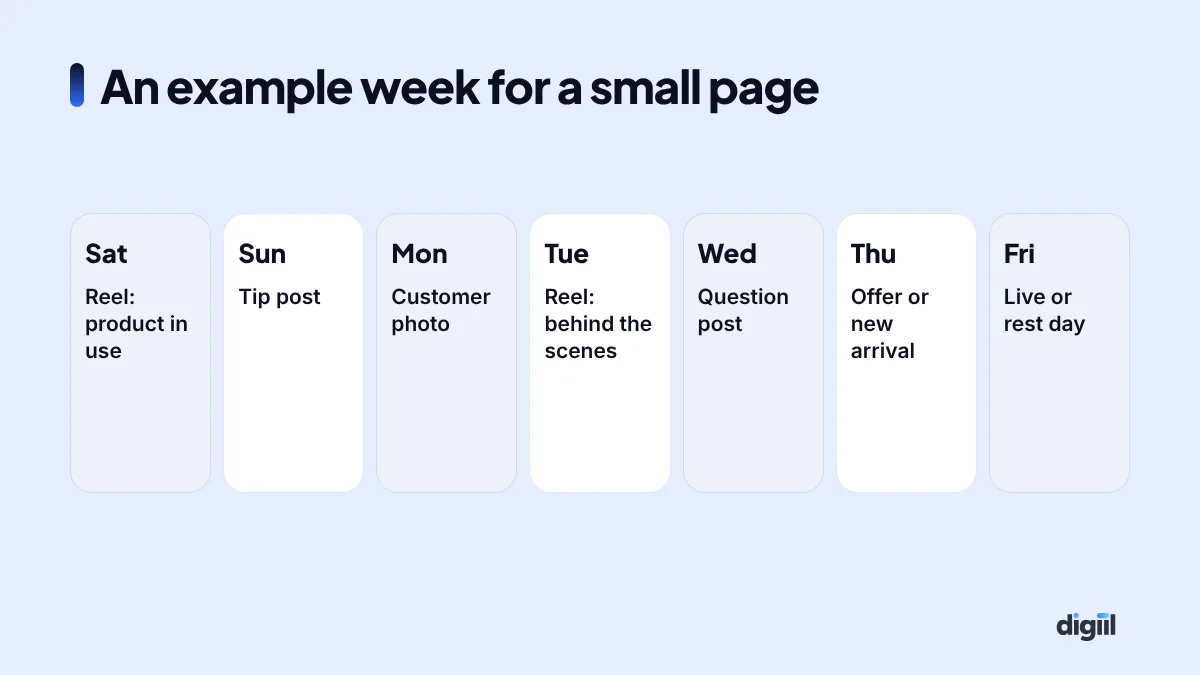
This is an example, not a rule. The point is variety with a pattern: two or three videos, one helpful post, one piece of customer proof, one question and one sales post. If you only ever post offers, people learn to scroll past you. Better product photos lift every one of these, and they do not need expensive equipment. See product photography on a budget.
Habits that cut reach
- Engagement bait. “Like if you agree”, “Tag three friends”, “Comment YES”. Meta’s systems are built to detect and demote these.
- Clickbait and misleading claims. “You will not believe…” headlines and exaggerated health or income promises.
- Reposting other pages’ videos, or uploading clips with another app’s watermark.
- Copyrighted music or footage without rights. It can mute the video or remove it.
- Buying likes or followers. Fake followers never engage, so every post starts with a poor response rate.
- Deleting and reposting the same post because the first hour was slow.
- Posting the same file to ten groups in a minute. It looks like spam because it is.
Where paid reach fits
Organic and paid are not opposites. A sensible pattern for a small business: post organically, watch which posts earn shares and long watch time, and put a small budget behind those proven posts through Ads Manager. You are then paying to amplify something people already liked, which is cheaper than paying to push something they ignore. The difference between the Boost button and Ads Manager is explained in Facebook Boost vs Ads Manager.
Working with creators is the other route to new audiences. A creator’s post reaches their followers with their credibility attached. See influencer marketing in Bangladesh.
A 30-day reset for a page that has gone quiet
- Days 1 to 3: audit. Check Page status. List your ten best and ten worst posts of the past six months and write down what separates them.
- Days 4 to 7: prepare. Film eight to ten short videos in one session. Batch work keeps the rhythm going on busy days.
- Weeks 2 and 3: publish to the pattern. Five posts a week, at least two of them Reels. Reply to every comment within the hour during working time.
- Week 4: review. Compare views, shares and the non-follower share with the month before. Keep the two formats that did best and replace the weakest.
Most pages see movement within the month. If nothing changes after six weeks of consistent, original posts, the problem is usually the offer or the audience, not the algorithm.
How to tell whether it is working
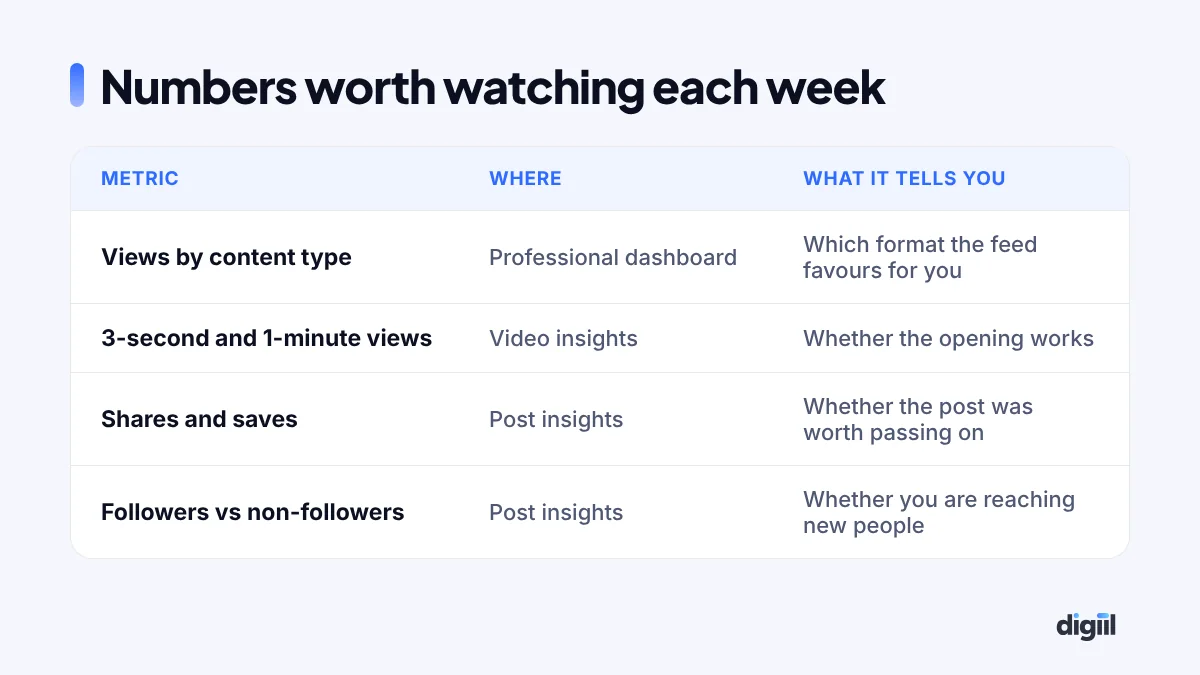
Open the Professional dashboard from your page, or Insights in Meta Business Suite. Meta now reports “views” as its main measure across formats, alongside reach. Look at trends over four weeks, not single days, and compare formats with each other.
The most useful single figure is the share of views that came from non-followers. When that rises, your content is being recommended, and follower growth follows.
Mitu’s turnaround came from changes, not a trick: short Reels of the loom at work, a question in every caption that invited real replies, and fewer near-identical photos of the same saree. Views from non-followers climbed first. Messages followed a few weeks later.
Give any new approach a month. Reach responds to a pattern of good posts, not to one. And keep the purpose in view: reach matters because it leads to messages, orders and enquiries. A post seen by 3,000 likely buyers in your delivery area is worth more than one seen by 60,000 strangers. For the wider plan, read social media marketing in Bangladesh, or see our social media service.
Reach questions, answered briefly
Why did my Facebook page reach suddenly drop?
The usual reasons are a run of posts that got little interaction, a switch away from video, posting far less often, or a restriction on the page for breaking a rule. Check Page status in your settings first, then compare your recent posts with the ones that did well.
How many times a day should I post?
For most small pages, once a day or four to five times a week is enough. Quality and consistency matter more than volume. Several weak posts a day can lower average engagement.
Do links in posts reduce reach?
Posts that send people away from Facebook often get less distribution than native video or photos. If you need to share a link, write a proper post around it, or put the link in the first comment and test which performs better for your page.
Does boosting a post hurt organic reach?
There is no evidence that paying for ads lowers organic reach. The two are decided separately. Many pages simply notice organic reach more once they start comparing it with paid numbers.

Amanat has 7+ years in digital marketing and has managed $8M+ in Google and Meta ad spend for 235+ brands in the UK, USA, Australia and Bangladesh. He holds 20+ certifications, including Digital Marketing Strategy from Harvard Business School Online. More about Amanat