Two Bangladeshi online stores sell almost the same sneakers. Store A spends most of its marketing budget on Facebook ads. Store B spends less on ads but ranks on Google for “sneakers price in Bangladesh”, “running shoes for men BD” and dozens of model names. When ad costs rose before Eid, Store A’s profit shrank. Store B barely noticed.
That is the power of e-commerce SEO in Bangladesh. Once your pages rank, they bring buyers every day without paying for each click. This guide shows what to fix and build, in the order that matters.
Where to focus first
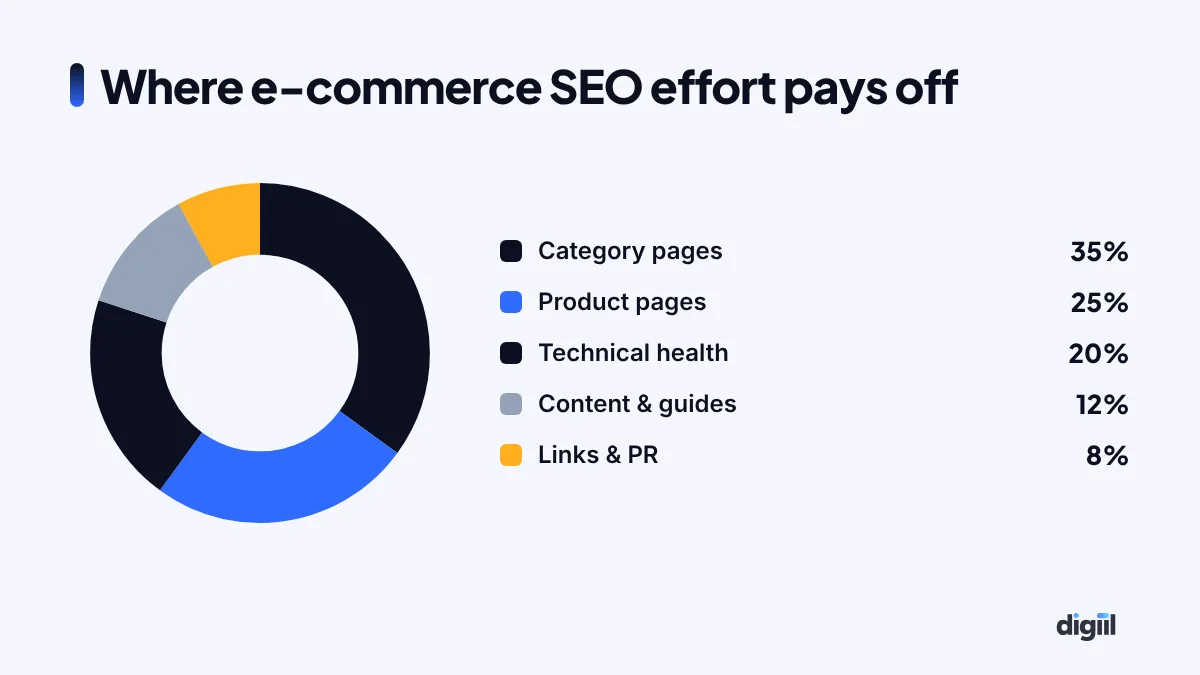
Most store owners start by writing blog posts. But for online stores, the biggest wins usually come from category pages. People search “ladies bag”, “baby diaper price” or “gaming mouse” much more than one exact model. Category pages match those searches.
1. Build category pages that deserve to rank
- Clear title and H1 matching how people search: “Men’s Sneakers in Bangladesh”.
- A short intro above the products, and a helpful buying guide below: sizes, materials, price ranges, delivery.
- Filters that help users, without creating thousands of indexable junk URLs.
- Internal links to related categories and top products.
- FAQs answering real questions: “Is cash on delivery available?”, “How do I choose size?”
2. Make product pages unique
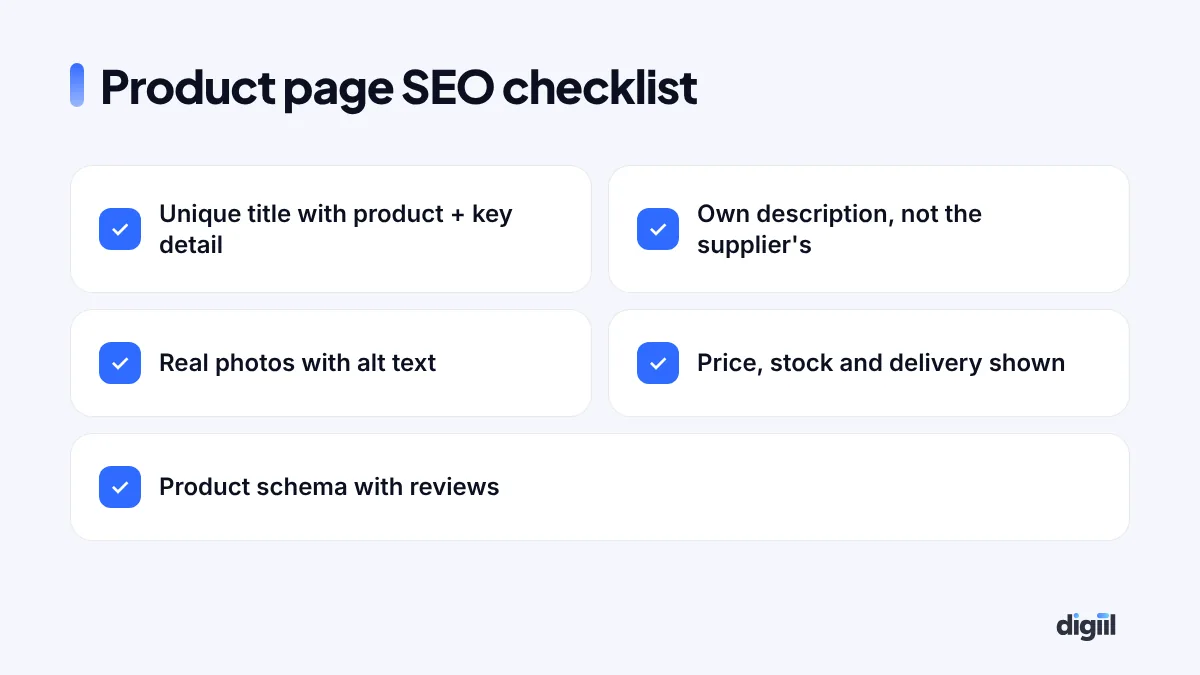
Many Bangladeshi stores copy supplier or international descriptions. If 20 sites have the same text, Google has no reason to choose yours. Write your own: who it is for, real measurements, what is in the box, warranty, delivery time and honest pros and cons.
Use your own photos where you can. Add alt text that describes the image, like “black leather wallet with card slots”.
3. Fix technical basics
| Issue | Why it hurts | Fix |
|---|---|---|
| Slow mobile pages | Buyers leave, rankings drop | Compress images, good hosting, caching |
| Duplicate URLs from filters | Wastes crawl budget, splits signals | Canonical tags, noindex thin filter pages |
| Broken links and 404s | Bad experience, lost link value | Fix links, add redirects |
| No XML sitemap | Pages found slowly | Generate and submit in Search Console |
| Missing HTTPS | Trust and security warnings | Free SSL certificate |
Read our web hosting guide if your store is slow.
4. Add product structured data
Product schema tells Google the name, price, currency (BDT), availability and reviews. It can help your listings show price and star ratings in search results. Most good SEO plugins for WooCommerce and Shopify apps add it. Check it with Google’s Rich Results Test.
5. Handle out-of-stock and discontinued products
- Temporarily out of stock: keep the page, show “back soon”, offer alternatives and a notify button.
- Gone for good: redirect (301) to the closest product or category.
- Seasonal items: keep evergreen URLs like /eid-collection/ and update them each year.
6. Create content that supports sales
Blog content helps when it answers questions buyers have before purchasing:
- “How to choose the right size of school bag”
- “Original vs fake skincare: how to check”
- “Best budget smartwatches in Bangladesh”
Each guide should link to the relevant category and products. Our keyword research guide shows how to find these topics.
7. Earn links and mentions
Online stores earn links through product reviews by bloggers and YouTubers, local news about launches or social causes, brand collaborations and supplier or partner pages. Avoid buying cheap link packages; they can do more harm than good.
8. Do not forget the store’s trust signals
Google wants to rank stores people can trust. Show your trade licence and UBID where required, clear return and refund policies, delivery times, contact details and real reviews. These also follow the Digital Commerce Operation Guidelines and improve conversions.
Measure e-commerce SEO properly
- Organic sessions to category and product pages in GA4.
- Organic revenue and orders, not just traffic.
- Rankings for your top category keywords.
- Search Console clicks and impressions by page.
Common mistakes
- Thin category pages with only a product grid.
- Copied product descriptions.
- Indexing thousands of filter and search pages.
- Deleting old product pages without redirects.
- Huge image files that slow mobile pages.
Internal linking for online stores
Internal links tell Google which pages matter most and help shoppers find products. For e-commerce:
- Link from the homepage to your most important categories.
- Use breadcrumbs: Home › Women › Bags › Leather Tote.
- Link related categories: “Men’s sneakers” to “Running shoes” and “Socks”.
- Link buying guides to the exact categories and products they mention.
- Show “related products” and “frequently bought together” on product pages.
Avoid hiding important categories deep in menus that need four clicks to reach.
Reviews on product pages
Real customer reviews help SEO and sales. They add fresh, unique text in your customers’ own words, answer questions other shoppers have and can show star ratings in search results with product schema. Ask buyers for reviews a few days after delivery, include photo reviews where possible, and reply to negative ones professionally. The Digital Commerce Operation Guidelines also expect honest treatment of reviews, so never delete genuine negative reviews or post fake ones.
SEO for Bangla product searches
Some shoppers search in Bangla: “ছেলেদের জুতা”, “বাচ্চাদের ডায়াপার দাম”. You can capture these by:
- Adding a short Bangla description section on key category pages.
- Including common Bangla names of products in FAQs.
- Making sure your site displays Bangla fonts correctly and fast.
A 90-day e-commerce SEO plan
| Weeks | Focus |
|---|---|
| 1–2 | Technical audit: speed, indexing, duplicates, sitemap, Search Console |
| 3–6 | Rewrite top 10–20 category pages with guides and FAQs |
| 7–9 | Unique descriptions for top 50–100 products, product schema |
| 10–12 | Buying guides linked to categories, outreach for reviews and links |
After 90 days, look at which categories gained impressions and clicks, and double down on what works.
Marketplaces vs your own store
Selling on marketplaces like Daraz can bring quick sales, but the customer belongs to the marketplace, and so does most of the search traffic. Your own store, with SEO, builds an asset you control. Many brands use both: marketplaces for reach, their own site for loyal customers and better margins. Your SEO effort should always point to your own domain.
Image SEO for product photos
Google Images brings shoppers too, especially for fashion, furniture and décor. Help your images rank:
- Use descriptive file names:
red-cotton-saree-tangail.webp, notIMG_4482.jpg. - Write alt text that describes the product honestly.
- Compress images and use WebP so pages stay fast.
- Show several angles and a lifestyle photo.
Our product photography guide shows how to take better photos with just a phone.
A site structure that ranks
For an online store, structure is SEO. A clear structure helps Google understand which page should rank for which search.
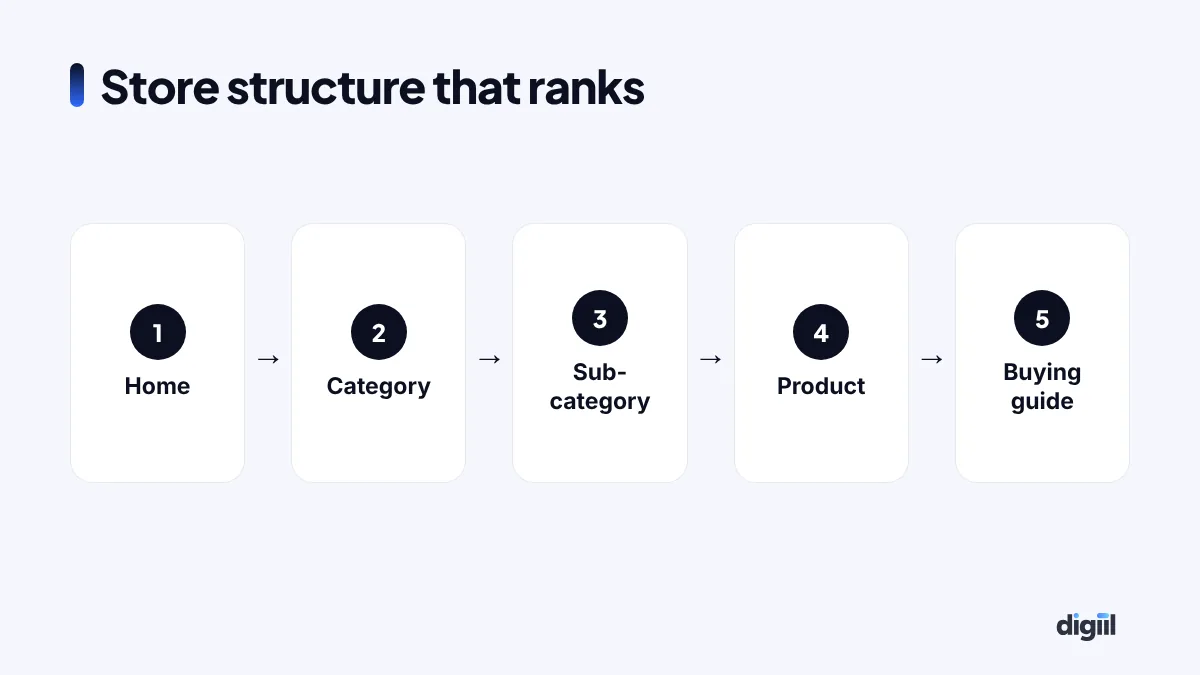
| Level | Example URL | Targets searches like |
|---|---|---|
| Home | / | Brand name, broad store terms |
| Main category | /women/ | “women’s clothing online Bangladesh” |
| Sub-category | /women/kurtis/ | “kurti online shopping Bangladesh” |
| Filtered category (selected only) | /women/kurtis/cotton/ | “cotton kurti price in Bangladesh” |
| Product | /product/blue-block-print-kurti/ | Specific product and model searches |
| Guide | /blog/how-to-choose-kurti-size/ | Questions before buying |
Keep every product within three clicks of the home page. Do not let thousands of filter combinations get indexed. Only index the filter pages people actually search for.
Where e-commerce organic traffic comes from
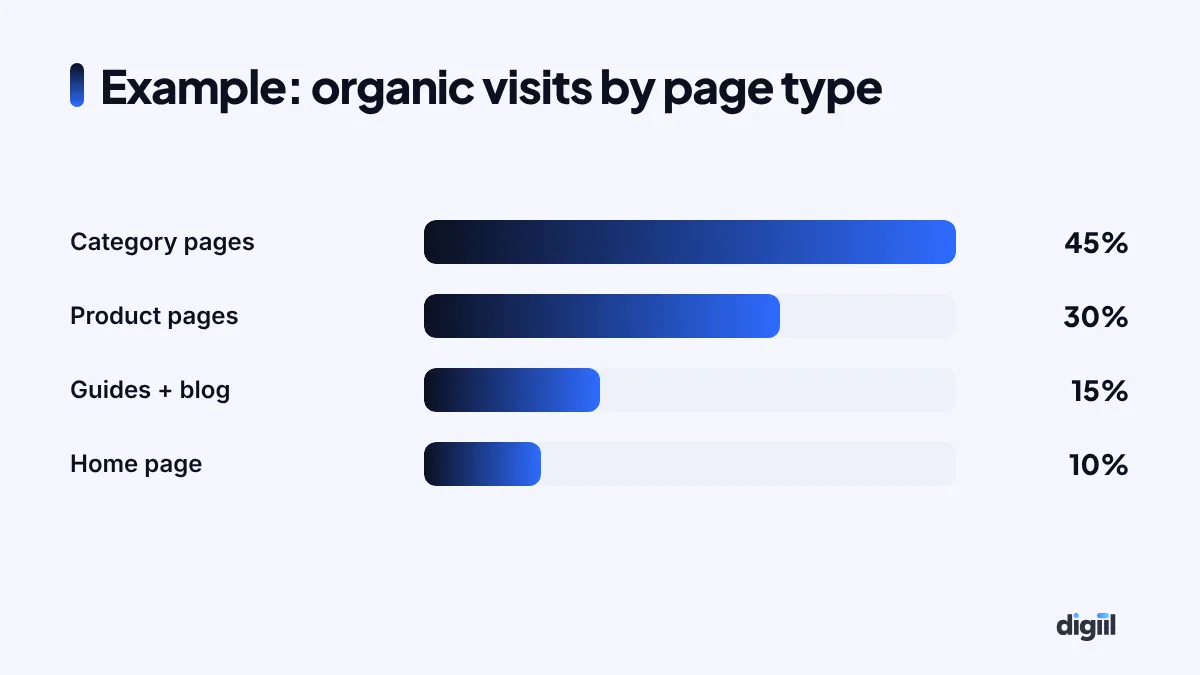
In most stores we work with, category pages bring more organic traffic than any other page type, followed by product pages and then guides. Your mix may differ, but this is why category pages deserve your best SEO effort first.
Is SEO worth it for your store? Run the numbers
E-commerce SEO takes months, so check that the prize is big enough before you start. Use search volumes for your main category keywords, not single products, and your store’s real conversion rate.
Stores with many categories usually find the maths works well, because each category page can rank for its own group of searches. If only one or two keywords matter in your niche, ads and marketplaces may be a better first investment.
How Store B did it
Store B rewrote its top 15 category pages with buying guides and FAQs, wrote original descriptions for its 100 best-selling products, compressed every image, and cleaned up filter URLs. It also published a few honest comparison guides. Over the next months, organic orders grew to become a steady share of sales, and the store became far less dependent on ads.
E-commerce SEO in Bangladesh is a long game, but it builds an asset you own. Start with categories, fix the technical basics and make every product page worth ranking. If you want help, see our e-commerce SEO service.
- Category pages usually bring the biggest SEO wins for stores.
- Write unique product descriptions with real details and photos.
- Fix speed, duplicate URLs and broken links.
- Add product schema and handle out-of-stock pages properly.
- Measure organic orders and revenue, not just traffic.
Your questions, answered
How long does e-commerce SEO take?
Technical fixes can help in weeks. Ranking competitive category pages usually takes several months of steady work.
Should I use the supplier's product descriptions?
Avoid copying them word for word. Many stores use the same text, so Google has little reason to rank yours. Write your own, with real details.
What should I do with out-of-stock products?
If the product will return, keep the page live and show when it is expected. If it is gone for good, redirect to the closest product or category.
Is WooCommerce or Shopify better for SEO?
Both can rank well. What matters more is speed, clean structure, unique content and good internal links.

Amanat has managed $4M+ in Google and Meta ad spend for brands in the UK, USA, Australia and Bangladesh since 2020. He holds 20+ certifications, including Digital Marketing Strategy from Harvard Business School Online. More about Amanat