Sohel cut the price of his cotton panjabis from Tk 1,650 to Tk 1,450 to beat a competitor. Orders rose. Profit fell, because after the courier fee, returns and the ad cost per order, each panjabi now earned him less than Tk 100. Before Eid he was busier than ever and had less money to show for it.
Pricing is the decision with the biggest effect on profit and the least thought behind it. Many online sellers check two competitors, go fifty taka lower, and hope volume will make up the difference. It rarely does. A good product pricing strategy starts from what an order actually costs you, then decides how to sit in the market.
This guide is built around one formula and a worked example. Bring your own numbers and a calculator.
Price = full cost per delivered order + the profit you want, adjusted for what buyers will pay and what competitors charge.
Step 1: Find the full cost per order
Product cost is only the start. Every order also carries packaging, delivery, payment charges, a share of the orders that come back, and the marketing it took to win it.
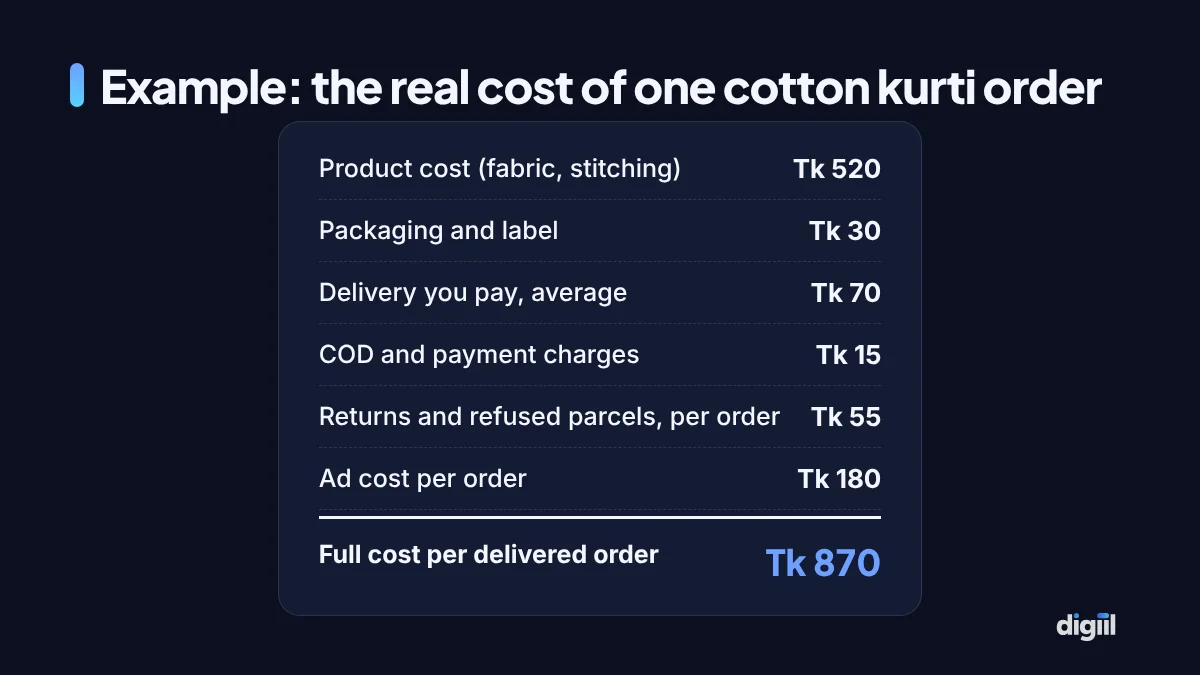
The figures are an example, but the categories are the ones sellers forget. Two deserve extra attention.
Returns and refused parcels
With cash on delivery, some parcels are refused at the door and some are returned. You pay delivery both ways and sometimes lose the product. Spread that cost over your delivered orders. If 10 out of every 100 orders fail and each failure costs Tk 150 in courier charges and damage, every delivered order carries about Tk 17 of that loss. Our guide to reducing fake COD orders shows how to bring the rate down.
Ad cost per order
If you spend Tk 18,000 on ads in a month and get 100 delivered orders from them, each order carries Tk 180 of ad cost. Leaving this out is how sellers end up “busy but broke”.
Delivery charges depend on your courier and zones. Compare options in courier services for e-commerce in Bangladesh.
Step 2: Set your floor price
Your floor is the lowest price at which an order still breaks even. Below it, every sale loses money. In the example, the floor is Tk 870. Use the calculator to find yours.
Write the floor next to every product in your sheet. It is the number you check before any discount, campaign or price match.
Step 3: Understand margin and markup
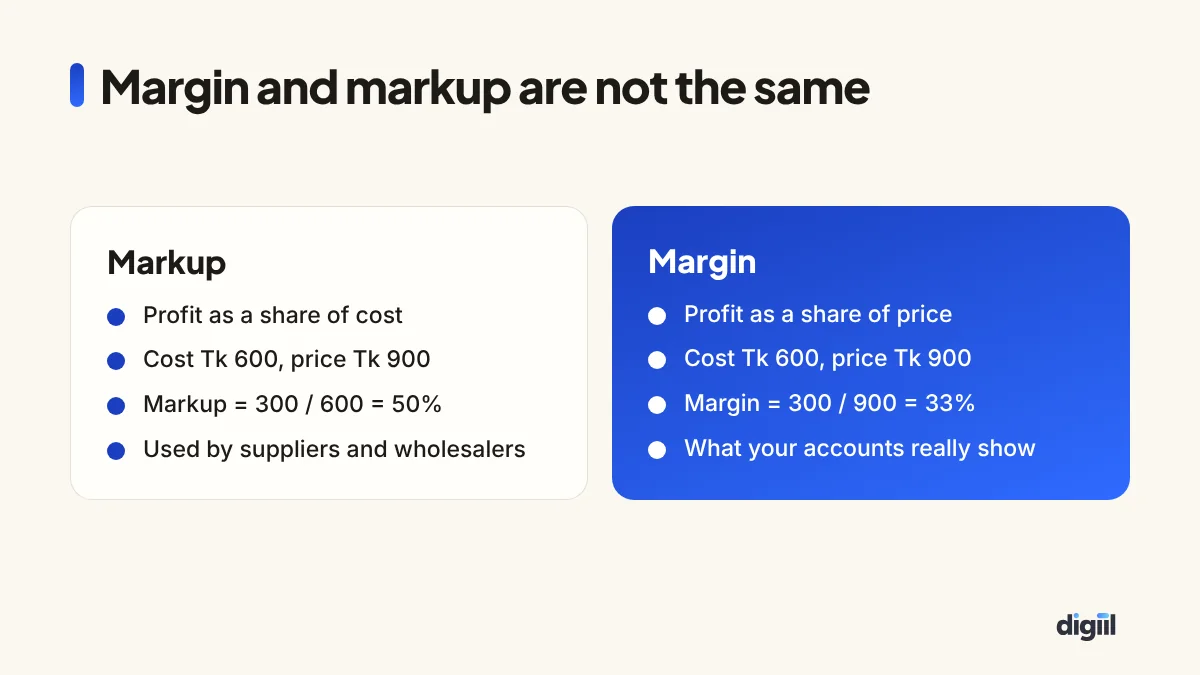
Mixing these up is one of the most common pricing mistakes. A supplier who says “add 50% and you are fine” means markup. Your profit as a share of revenue, which is what pays your bills, is margin, and it is always lower. To hit a target margin, use this:
Price = cost ÷ (1 − target margin)
For a 35% margin on a Tk 870 full cost: 870 ÷ 0.65 = about Tk 1,340.
| Markup on cost | Equals margin of |
|---|---|
| 25% | 20% |
| 50% | 33% |
| 66% | 40% |
| 100% | 50% |
| 150% | 60% |
Step 4: Choose a pricing method
Cost-plus
Full cost plus a fixed margin. Simple and safe, and the right starting point. Its weakness: it ignores what buyers would happily pay, so you may leave money on the table for products people love.
Competitor-based
Price relative to similar products. Useful for checking you are in a sensible range. Dangerous as the only method, because you copy competitors’ mistakes and their costs are not yours. Compare like for like: fabric, size, packaging, delivery terms and reviews.
Value-based
Price by the value to the buyer. A handmade wedding gift, a product that solves a painful problem, or a brand with strong trust can charge well above cost-plus. Ask what the buyer compares you with. A custom cake is not compared with a supermarket cake. It is compared with the importance of the occasion.
Tiered pricing
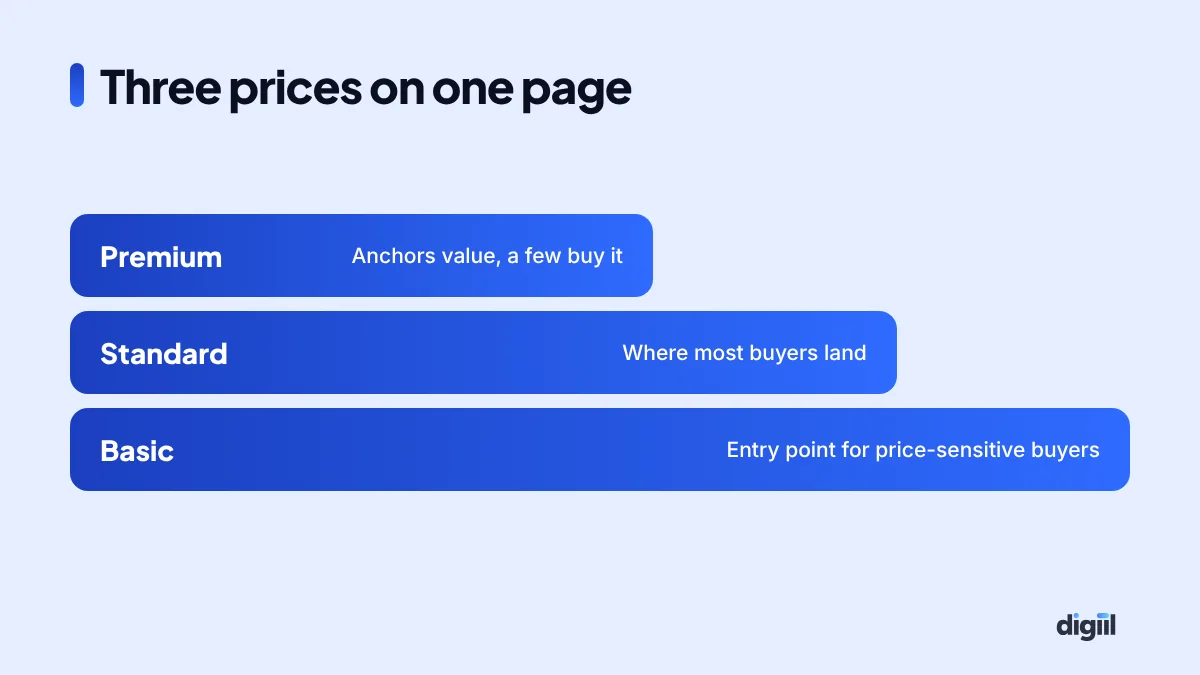
Offer a basic, standard and premium version, or single, pair and family pack. The premium option makes the standard one look reasonable, and many buyers choose the middle. It also lets you serve price-sensitive buyers without lowering prices for everyone.
Bundles
Combine items that go together: a panjabi with pyjama, three skincare products as a routine, a phone case with a screen protector. Bundles raise order value and make direct price comparison harder, which protects margin.
Step 5: Use price presentation carefully
- Charm prices, such as Tk 990 instead of Tk 1,000, are common because buyers read the first digit. Test whether they help in your category.
- Round prices can signal quality for premium products and gifts.
- Show the per-unit value for packs: “Tk 330 per piece in a pack of three”.
- State delivery charges early. A surprise charge at checkout is one of the main reasons people abandon a purchase.
- Anchor honestly. Showing a crossed-out “regular price” is only fair if that was a real price. Invented “was” prices damage trust and can break consumer protection rules.
Step 6: Do the discount maths before the discount
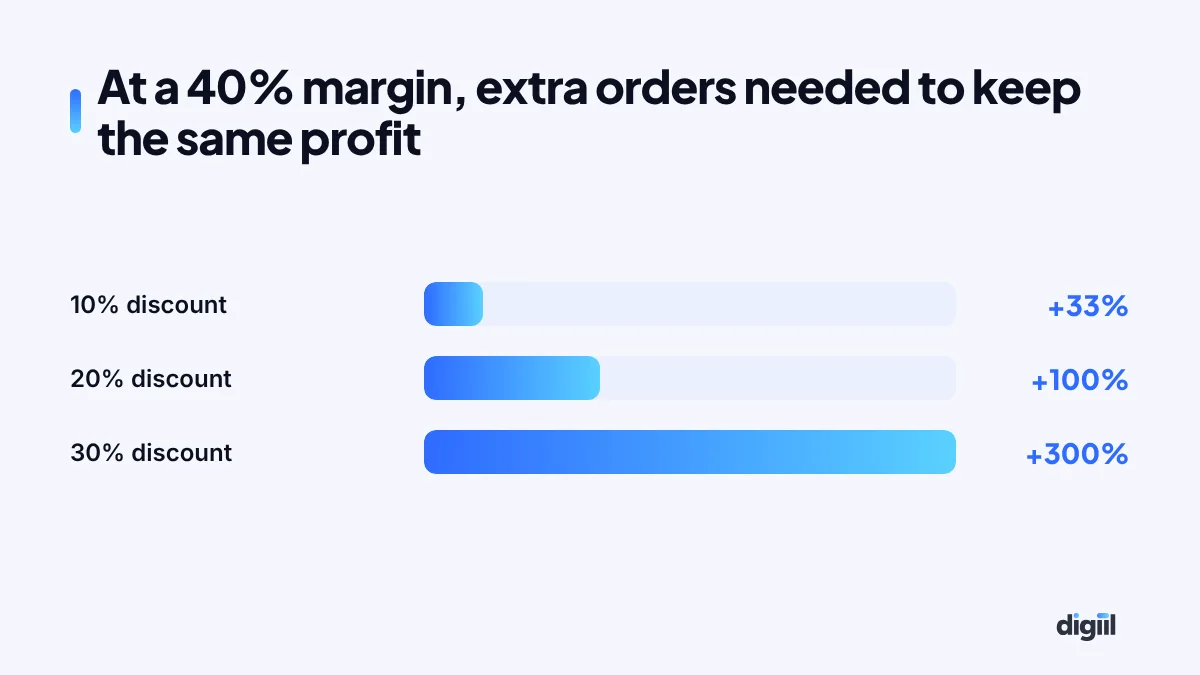
A discount comes straight out of your margin. At a 40% margin, a 20% discount halves your profit per order, so you need twice as many orders to earn the same total. That is the maths in the chart, and it surprises most sellers.
Enter your margin and the discount. The result is how much more you must sell just to stand still.
Better ways to run an offer
- Free gift that costs you little but feels valuable.
- Free delivery above a minimum order, which raises basket size.
- Bundle price instead of a percentage off single items.
- Discounts only on slow stock, not on bestsellers.
- Time-limited offers tied to real occasions, such as Eid or Pohela Boishakh, rather than constant sales that train buyers to wait.
Step 7: Test, then adjust
Pricing is not set once. Try a higher price on new stock, a bundle on one product, or a different delivery threshold for two weeks, then compare orders, conversion rate and profit, not just revenue. Change one thing at a time.
Signs your price is too low: you sell out quickly, nobody negotiates, and you are busy but never have cash. Signs it is too high: many product views and add-to-carts but few orders, and buyers asking for discounts in almost every chat. In the second case, also check whether photos and product information justify the price. Good presentation supports higher prices. See product photography on a budget.
Pricing in different situations
Selling on a marketplace and your own site
Marketplace fees, vouchers and campaign rules change your cost per order. Some sellers price slightly higher on the marketplace to cover fees and reward direct buyers on their own site or page. Keep the difference modest so buyers do not feel tricked. See how to sell on Daraz.
Wholesale and bulk orders
Set a minimum quantity and a tiered price that still respects your floor. Account for credit terms: a 60-day payment term costs you money in the meantime.
Imported products
Exchange rates, customs duties and shipping costs move. Review prices whenever a new shipment arrives rather than keeping old prices on new, more expensive stock.
A one-page pricing sheet
For each product, keep: full cost per delivered order, floor price, current price, margin, competitor range, and the lowest price allowed in a campaign. With that sheet, pricing decisions take minutes and nobody on the team sells below cost by accident.
When Sohel ran his numbers through a sheet like this, he moved back to Tk 1,590 with a free gift box on two-piece orders. He sold slightly fewer single panjabis, many more pairs, and made more money each week than he had at the lower price.
If you are just starting, our guide on how to start an e-commerce business in Bangladesh covers the wider plan. If you want a store that shows prices, bundles and delivery charges clearly, see our WooCommerce development service or book a free 15-minute strategy call.
Pricing questions sellers ask
What is a good profit margin for an online shop in Bangladesh?
It depends on the category. Clothing and cosmetics often need healthy gross margins to survive ad costs and returns, while electronics usually run on thin margins and high volume. Work out your full cost per delivered order first, then decide the margin that leaves real profit after ads.
Should I always be cheaper than my competitors?
No. A price war rewards the business with the lowest costs, which is rarely a small seller. Compete on photos, trust, delivery, service and bundles, and price close to the market rather than below it.
Does Tk 999 really sell better than Tk 1,000?
Prices ending just below a round number often perform better because buyers read the first digit. The effect varies by category and audience. Test it on your own products rather than assuming.
How do I raise prices without losing customers?
Improve something visible at the same time: packaging, a free gift, faster delivery. Raise prices on new stock or new arrivals first. Tell loyal customers in advance and give them a short window at the old price.
Should delivery be free?
Free delivery is a strong selling point, but it is never free to you. Either build it into the product price or offer it above a minimum order value that protects your margin.

Amanat has 7+ years in digital marketing and has managed $8M+ in Google and Meta ad spend for 235+ brands in the UK, USA, Australia and Bangladesh. He holds 20+ certifications, including Digital Marketing Strategy from Harvard Business School Online. More about Amanat