Two online skincare stores spent the same on ads last year. Store A celebrated 5,000 new customers. Store B had 3,000 new customers, but 40% of them came back to buy again, some four or five times. Store B made more profit with fewer new customers, and its ad costs felt much lighter.
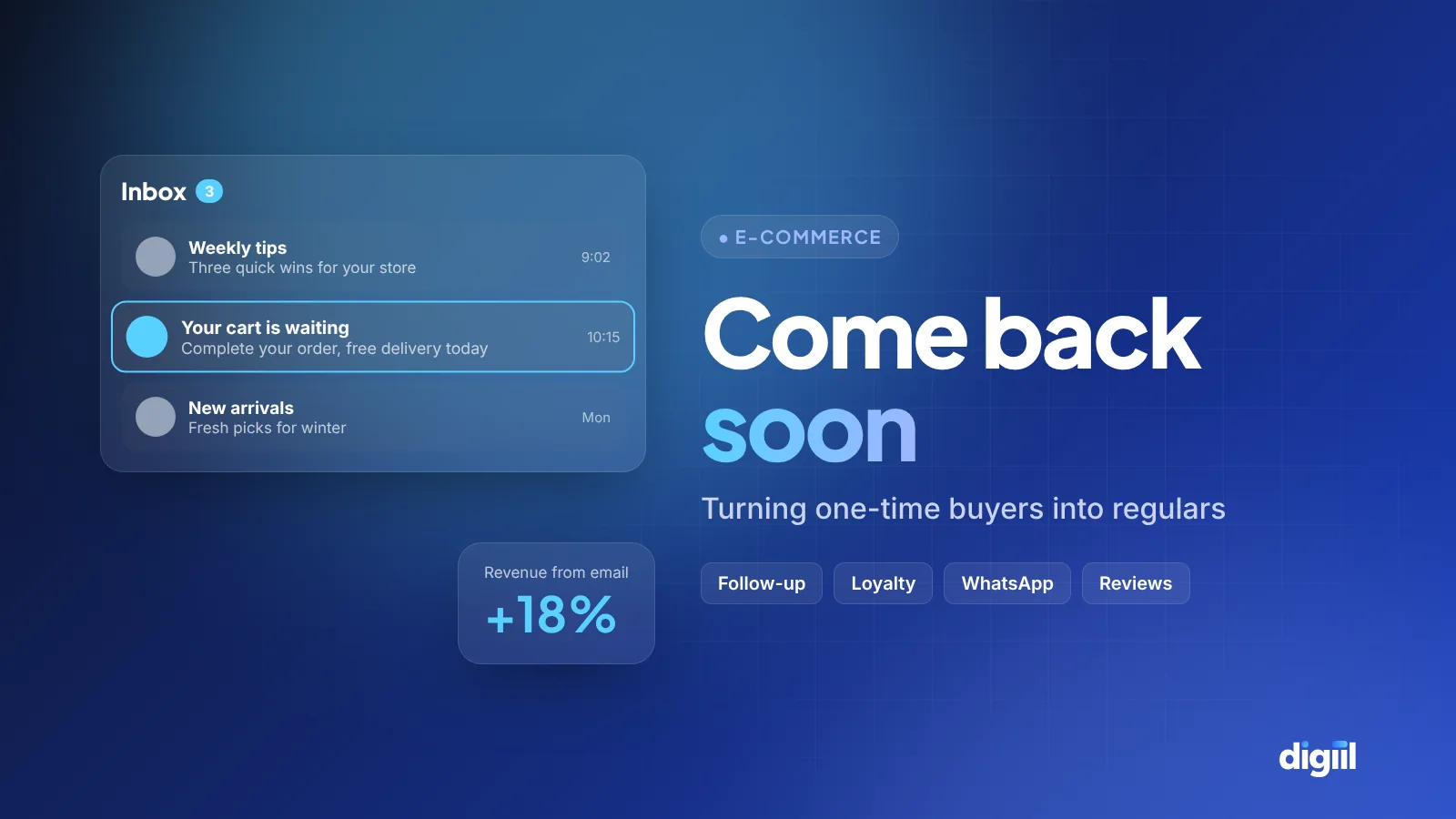
Customer retention for e-commerce is the quiet engine of profitable online stores. This guide shows how to turn first orders into lasting relationships.
Why retention changes everything
- Finding a new customer through ads is expensive and getting more expensive.
- A returning customer costs little to reach: a WhatsApp message, an email, a post.
- Repeat customers trust you, so they often buy more and complain less.
- Happy regulars bring friends and family.
Retention starts with the first order
Nobody returns after a bad first experience. Get these right:
- Accurate product photos and descriptions.
- Fast, polite replies before purchase.
- Order confirmation and clear delivery time.
- Careful packaging, maybe with a thank-you card.
- Easy returns when something goes wrong.
See our guide on choosing a courier, because delivery is a big part of the experience.
Build a follow-up timeline
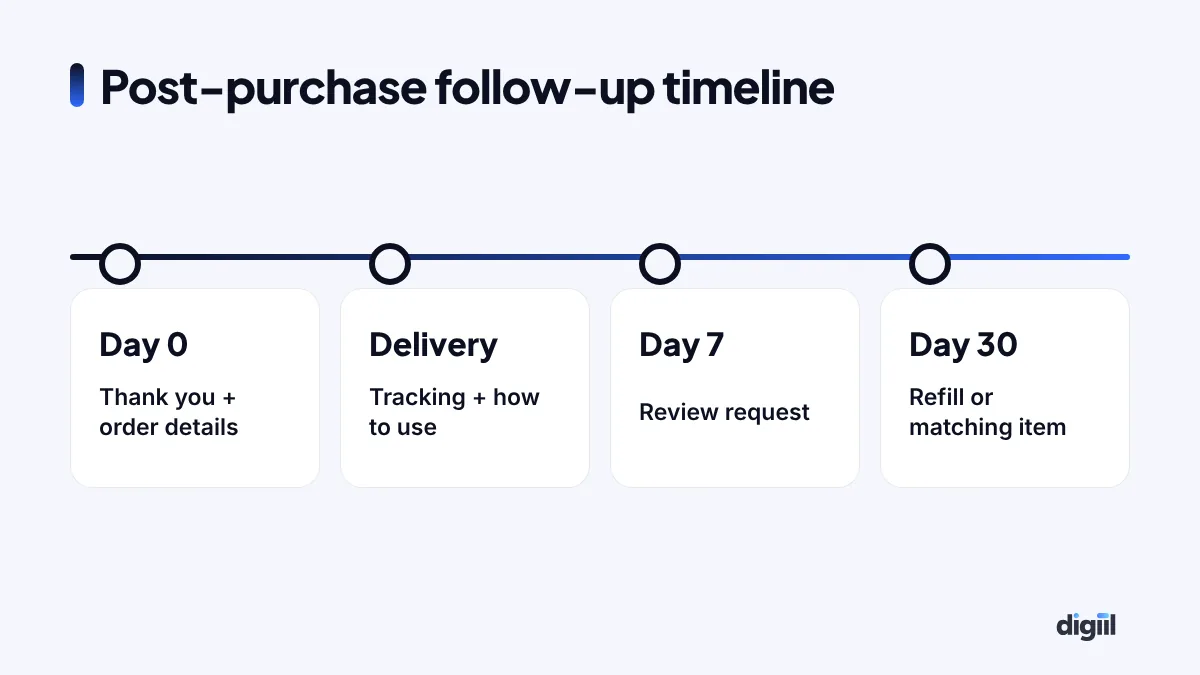
Automate this with WhatsApp templates or email where possible. Our WhatsApp API guide and email marketing guide explain how.
Give people a reason to come back
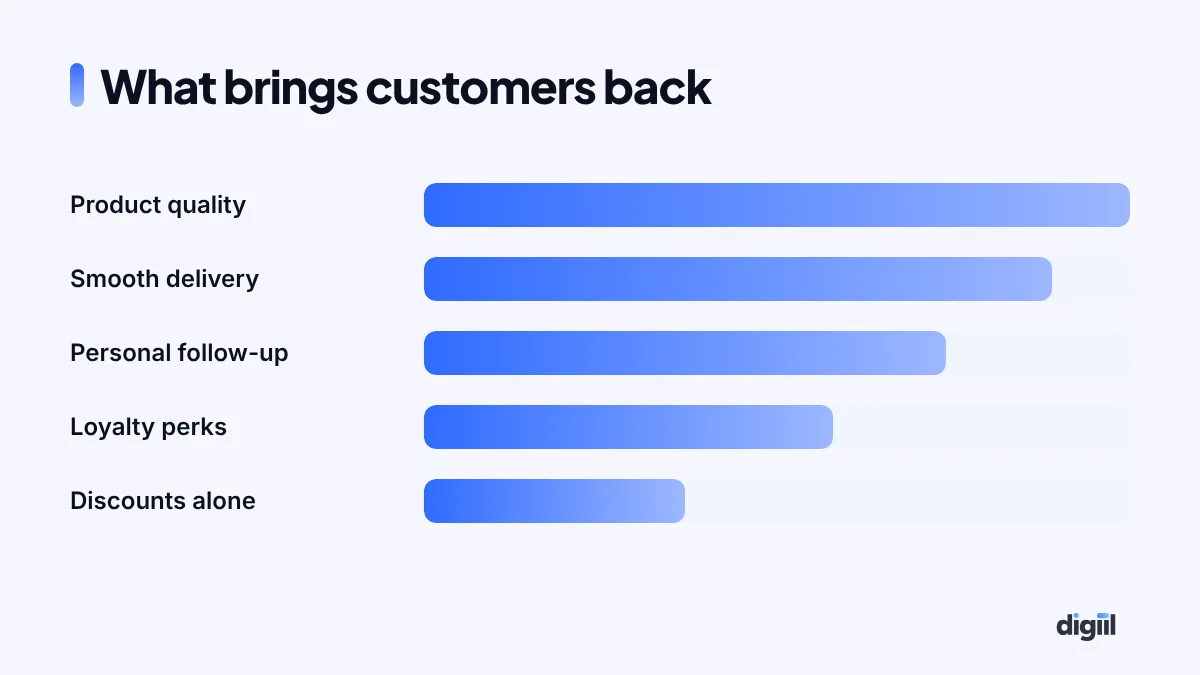
Refill and replacement reminders
If a product lasts about a month, remind the customer before it runs out. This works for skincare, baby products, food, supplements and pet supplies.
Personal recommendations
Suggest items that go with what they bought: a matching dupatta, a phone cover for their new phone, a refill pack.
Simple loyalty perks
- A free gift on the fifth order.
- Points on each purchase that turn into discounts.
- Early access to new collections and sales.
- Birthday offers.
VIP treatment
Your top customers deserve special care: personal messages, first access to limited items, a small surprise in their parcel.
Collect and use customer data carefully
Keep a simple customer list: name, phone, email (with permission), what they bought and when. Use it to send relevant messages, not spam. Always respect opt-outs and keep data secure.
Reviews build loyalty both ways
Asking for reviews makes customers feel heard. Reply to every review and act on feedback. Public replies show new visitors you care, and the Digital Commerce Operation Guidelines expect honest handling of reviews.
Numbers to track
| Metric | What it shows |
|---|---|
| Repeat purchase rate | Share of customers who buy again |
| Time between orders | When to send reminders |
| Customer lifetime value | Total value of a customer over time |
| Revenue from returning customers | How much retention contributes |
| Unsubscribes and blocks | If messages are too frequent |
When you know lifetime value, you can afford to spend more on ads to win a first order, because you know what that customer is worth over time.
Common mistakes
- Spending everything on new customers.
- Never contacting customers after delivery.
- Sending daily promotions to everyone.
- Ignoring complaints.
- Giving bigger discounts to new customers than to loyal ones.
Win-back campaigns for sleeping customers
Customers who have not ordered in 60–90 days are not lost yet. Try:
- A friendly “we miss you” message with new arrivals.
- A small, time-limited perk for their next order.
- A short survey asking why they stopped, with a thank-you gift.
Their answers often reveal problems you can fix: delivery delays, sizing issues, prices.
Retention ideas by category
| Category | Retention idea |
|---|---|
| Skincare and beauty | Refill reminders, routine guides |
| Fashion | New collection previews, style tips |
| Food and groceries | Weekly subscriptions, repeat order button |
| Baby products | Size-up reminders as babies grow |
| Electronics | Accessories, warranty reminders, care tips |
Retention starts with packaging
The unboxing moment is a marketing moment. A neat package, a thank-you card, a care guide, a small sample or a QR code to a “how to use” video all make customers feel valued and more likely to return.
The maths of retention: why a 10% lift matters
Most store owners look at one number: cost per order. That number only tells half the story. The other half is what a customer is worth over a year.
Here is a simple example. The numbers are for illustration, but the pattern is what we see in real stores.
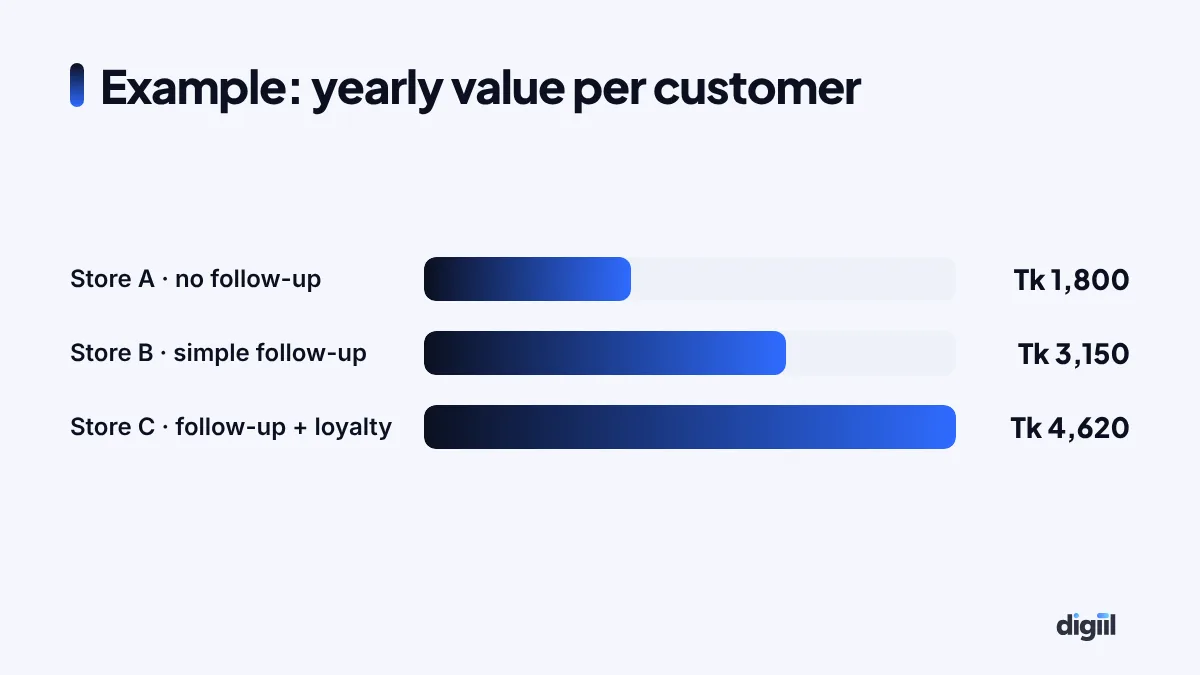
| Store | Average order | Orders per customer per year | Yearly value per customer |
|---|---|---|---|
| Store A (no follow-up) | Tk 1,500 | 1.2 | Tk 1,800 |
| Store B (simple follow-up) | Tk 1,500 | 2.1 | Tk 3,150 |
| Store C (follow-up + loyalty) | Tk 1,650 | 2.8 | Tk 4,620 |
All three stores pay the same to get a new buyer. Store C can afford to pay more than twice as much for that buyer and still make more profit. That is how retention lets you outbid competitors on Facebook without losing money.
Repeat buyers cost less to serve
A repeat buyer already trusts you. In our experience with Bangladeshi stores, repeat orders are far less likely to be refused at the door. They need fewer confirmation calls. They ask fewer questions in the inbox. Every one of those saves money that never shows in your ad dashboard.
A 30-day retention plan you can start this month
You do not need software to start. You need a list, a calendar and discipline.
Week 1: Build your list
- Export every delivered order from the last 12 months: name, phone, product, date, amount.
- Put it in one Google Sheet. Remove duplicates and failed orders.
- Add a column for “last order date” and one for “total orders”.
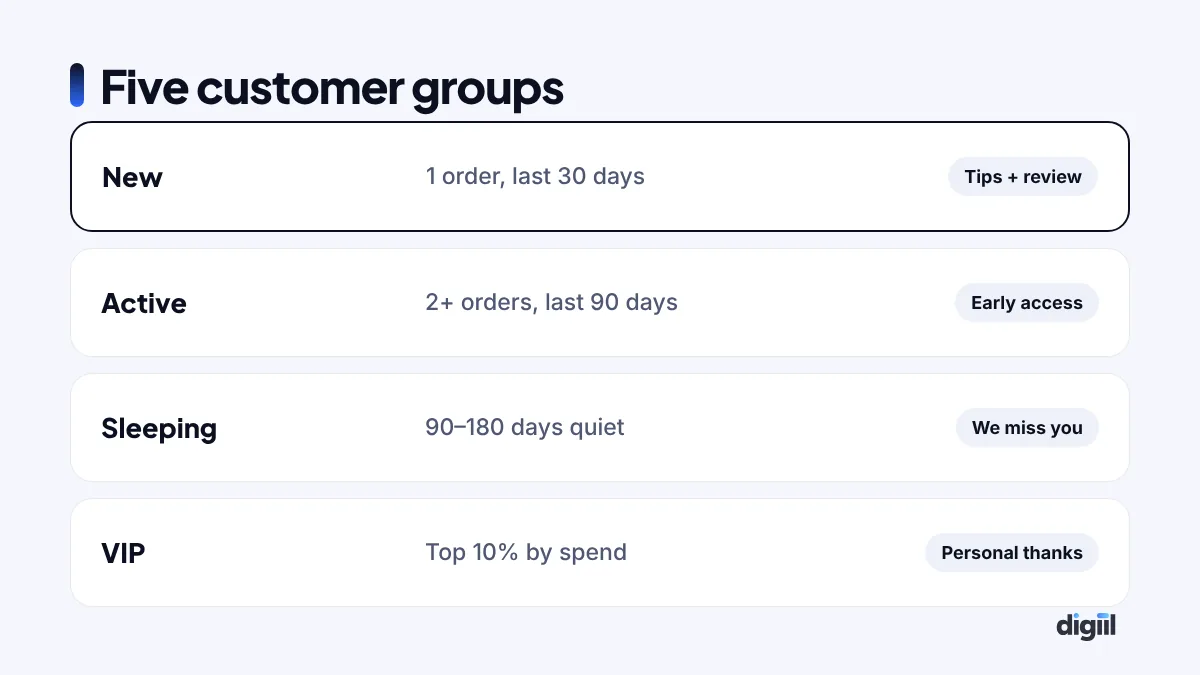
Week 2: Split customers into groups
| Group | Rule | What to send |
|---|---|---|
| New | 1 order in the last 30 days | Thank-you, how-to-use tips, review request |
| Active | 2+ orders, last one within 90 days | Early access to new stock, bundles |
| Sleeping | No order for 90–180 days | “We miss you” offer, best-sellers |
| Lost | No order for 180+ days | One honest win-back message, then stop |
| VIP | Top 10% by spend | Personal thanks, gifts, first look |
Week 3: Send your first two campaigns
Start with the “New” and “Sleeping” groups. They give the fastest results. Use WhatsApp for short personal messages and SMS for reminders. Keep each message short and useful.
Week 4: Measure and repeat
Count orders from each group. Note which message, offer and channel worked. Next month, do it again with the winners. Our email marketing guide shows how to automate this once it works by hand.
Messages that bring customers back
Here are four short scripts. Change the details to fit your shop and your voice.
Day 3 after delivery
“Assalamu Alaikum, apa. Your kurti reached you on Monday. Does the size fit well? If anything is wrong, reply here and we will fix it.”
Day 10: review request
“If you liked the order, could you share a photo or a few words? It helps other buyers trust us. Thank you!”
Day 45: refill or next step
“Your face wash usually lasts about six weeks. Want us to send another one? Same price, free delivery inside Dhaka this week.”
Day 120: win-back
“It has been a while! We have new Eid stock in your size. Here are three pieces we think you will like.”
Notice what these messages do. They are about the customer, not the store. They are short. They give a reason to reply. That is why they work.
Loyalty programmes that actually work in Bangladesh
Points systems sound good. In practice, most small stores do not need them. Simple rewards work better because people understand them at once.
- Free delivery on the next order. Delivery charge is a real pain point. Removing it is a strong reason to return.
- A gift on the third order. Small, useful and on-brand: a scrunchie, a sample, a pouch.
- Early access. Let repeat buyers see new stock 24 hours before everyone else.
- Refer a friend. Both people get Tk 100 off. Track it with a simple code.
Avoid deep discounts as the main reward. They train customers to wait for a sale and they eat your margin.
Calculator: what retention is worth for your store
The maths above shows why retention matters in general. This calculator shows it for your store: how much profit one customer brings over time, whether that justifies what you pay to win them, and what more repeat orders add.
Look at last year’s orders to fill in “orders per customer per year”. Most store platforms and order sheets can show how many customers ordered more than once. Even a rough number is better than guessing.
How Store B did it
Store B added a handwritten thank-you card to every parcel, sent a “how to use” WhatsApp message after delivery, asked for a review on day seven and sent a refill reminder on day 28. Regulars got early access to new products. None of it was expensive. All of it added up to customers who kept coming back.
Customer retention for e-commerce turns ad spend into long-term profit. Start with a great first experience, follow up thoughtfully and reward loyalty. If you want help building retention flows with WhatsApp, email and automation, see our email marketing and AI automation services.
- Repeat customers make ad spend far more profitable.
- A great first order is the foundation of retention.
- Use a follow-up timeline: thanks, how-to, review, refill.
- Reward loyalty with simple perks and VIP care.
- Track repeat rate and lifetime value.
FAQs
Why is customer retention important for online stores?
Repeat customers cost far less to reach than new ones and often spend more over time. Retention makes ad spend more profitable.
What is a good repeat purchase rate?
It depends on the product. Consumables like skincare and food should have higher repeat rates than furniture or electronics. Track your own trend and improve it.
Do loyalty programs work for small stores?
Simple ones do: points, a free gift on the fifth order or early access for regulars. Keep rules easy to understand.
How often should I message past customers?
Only when you have something useful: a refill reminder, a new arrival they would like, or an occasional offer. Too many messages lead to blocks.

Amanat has managed $4M+ in Google and Meta ad spend for brands in the UK, USA, Australia and Bangladesh since 2020. He holds 20+ certifications, including Digital Marketing Strategy from Harvard Business School Online. More about Amanat