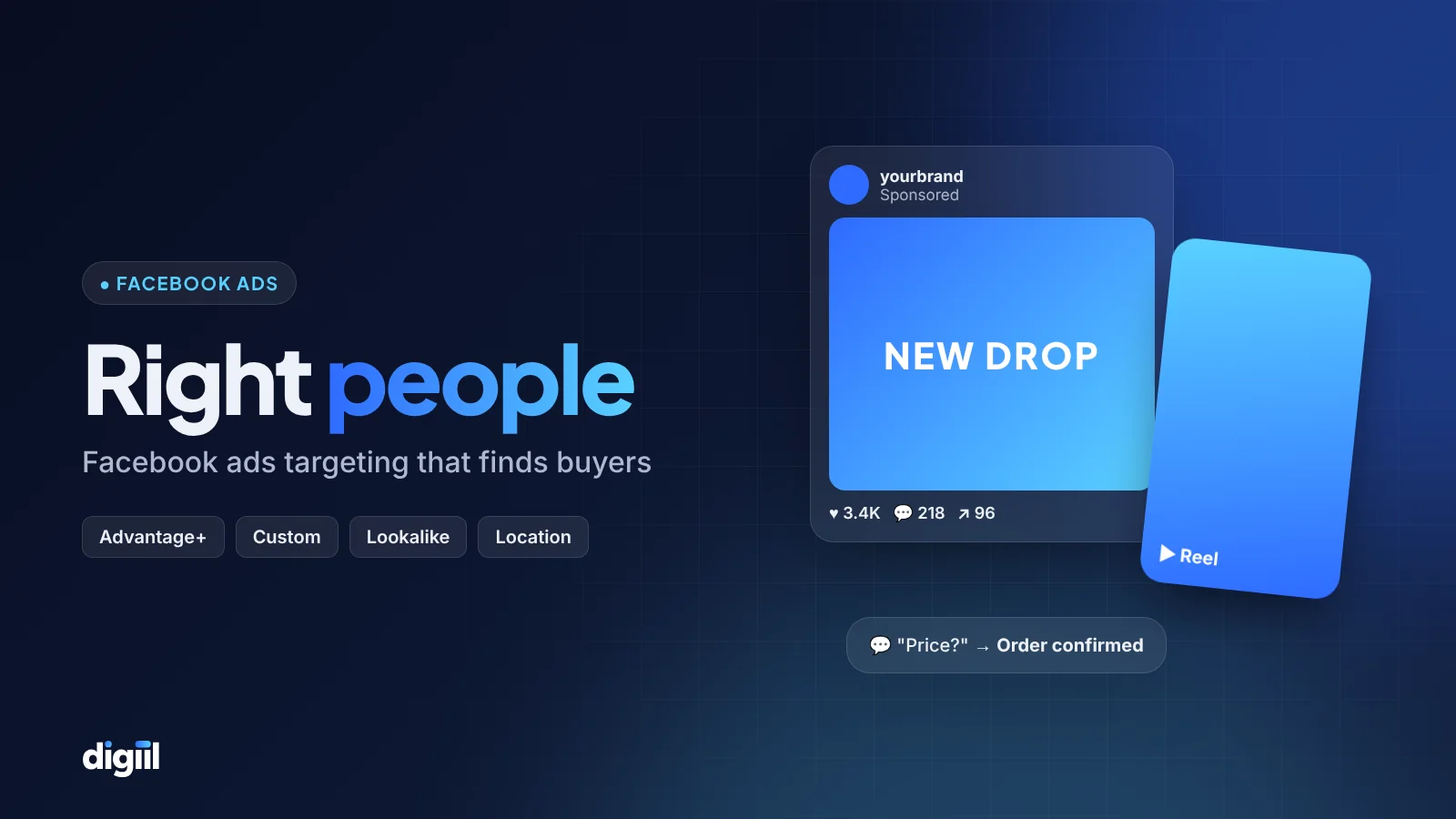
Rafi sells leather wallets from a small workshop in Hazaribagh. He boosted a post for Tk 3,000, picked “Bangladesh, age 18 to 65, interest: shopping”, and waited. He got 400 likes, 30 comments asking “price?” and two orders. The wallet was fine. The photo was fine. The problem was Facebook ads targeting: he paid to show a Tk 1,800 wallet to students who were never going to buy it.
Targeting is how you tell Meta who your buyer is. In 2026 the system does much of the work itself, but it still needs the right signals from you. This guide shows what to set, what to leave alone, and how to build audiences that actually buy in Bangladesh.
How does Facebook ads targeting work in 2026?
A few years ago, advertisers picked dozens of interests and behaviours by hand. Today Meta leans on machine learning. You give it a goal, a creative and a starting point. It then tests your ad on different people and moves the budget towards those who act.
That means three things decide who sees your ad:
- Your settings: location, age, language and any audiences you add.
- Your creative: the image, video and words. A video of a bridal makeover finds brides. The ad itself is now a targeting tool.
- Your data: the pixel and Conversions API events that tell Meta who bought. Better data means better targeting.
What are the main audience types?
1. Advantage+ audience (broad, AI-led)
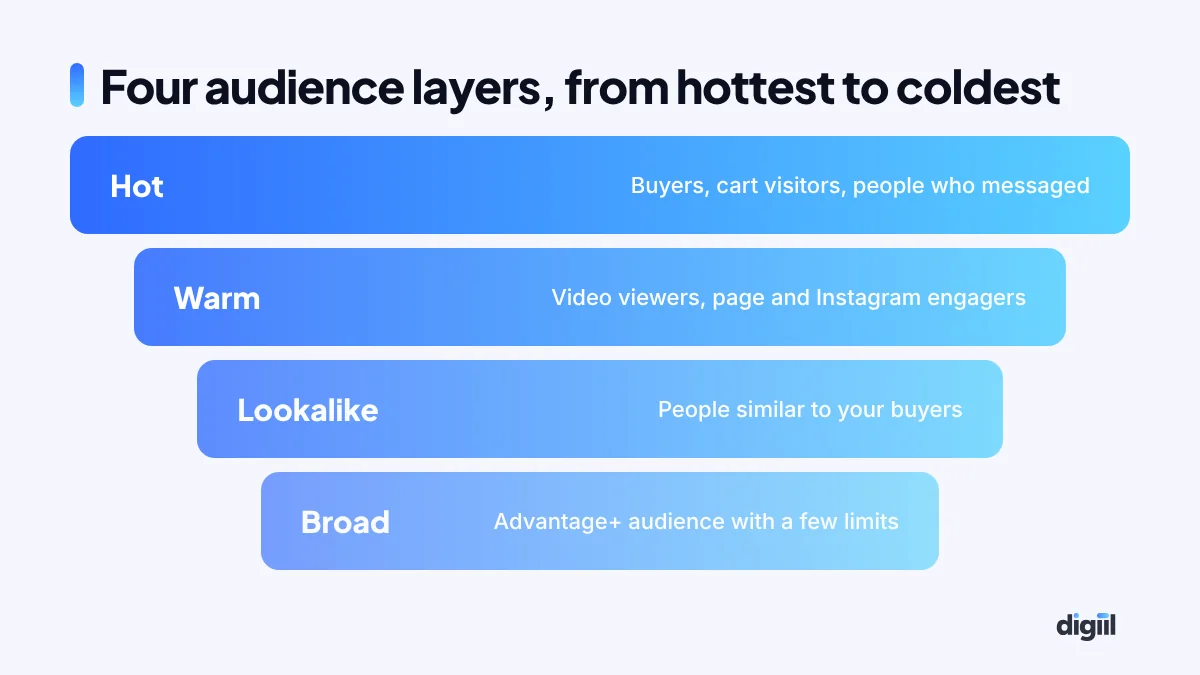
This is the default in Ads Manager. You can add “audience suggestions” such as interests or an age range, but Meta may go beyond them when it expects better results. Location and minimum age stay as hard limits.
It works best when your pixel already has purchase data and your creative clearly speaks to one type of buyer.
2. Original audience options (manual)
Here your choices are strict: age 25 to 40 means 25 to 40. Use this when you must stay inside a group, for example a women-only product, a course for HSC students, or a B2B offer for business owners.
3. Custom audiences (people who already know you)
These are built from your own data:
- Website visitors, product viewers and people who added to cart.
- People who messaged your page or WhatsApp.
- Video viewers and Instagram or Facebook page engagers.
- Customer lists: phone numbers and emails of past buyers.
They are small but valuable. Most cheap sales come from here. Our guide to setting up the Meta Pixel on WooCommerce shows how to collect these visitors properly.
4. Lookalike audiences (people like your buyers)
You give Meta a source, such as your last 500 buyers, and it finds people in Bangladesh who behave in similar ways. A 1% lookalike is the closest match. Larger percentages reach more people but match less closely.
Which location settings work in Bangladesh?
Location is the one setting you should always get right, because it is a hard limit.
| Business type | Location setting | Why |
|---|---|---|
| Nationwide online shop | All of Bangladesh | Courier reaches every district; give Meta room |
| Inside-Dhaka delivery only | Dhaka city, or pins with radius | Avoid paying for orders you cannot deliver |
| Restaurant, salon, clinic | Pin on the shop + 3 to 8 km radius | People rarely travel far for these |
| Coaching centre | The city or area you teach in | Parents choose nearby options |
| Export or service business | Target countries, one campaign each | Costs differ a lot by country |
Two small settings matter here. First, choose “people living in this location” when you sell to residents, so you do not pay for travellers. Second, if you deliver outside Dhaka but returns are high in some districts, run a separate ad set for those areas so you can watch the numbers. Our post on reducing fake COD orders explains why this matters.
What age, gender and language should I pick?
Keep these wide unless your product has a real limit.
- Age: think about who pays, not who likes. For a Tk 2,500 product, starting at 22 or 24 usually cuts a lot of empty “price?” comments. For kids’ products, target the parents.
- Gender: leave it open unless the product is clearly for one group. Husbands buy sarees as gifts. Wives buy panjabis.
- Language: most people leave this empty. If your ad is in English and aimed at a premium buyer, the creative will do the filtering for you.
Do interests still matter?
Less than before, but they still help in two cases.
New accounts with no data. A new pixel knows nothing. A few relevant interests give Meta a starting hint. Pick interests that describe a buyer, not a browser. “Online shopping” is everyone. “Leather goods” or “Men’s fashion accessories” is closer.
Narrow B2B or niche offers. For a restaurant POS system, interests such as “restaurant management” plus the job title “business owner” help the algorithm start in the right place.
Do not stack ten interests in one ad set. You will never know which one worked. Group similar interests together and test one theme per ad set.
How do I build my first audiences step by step?
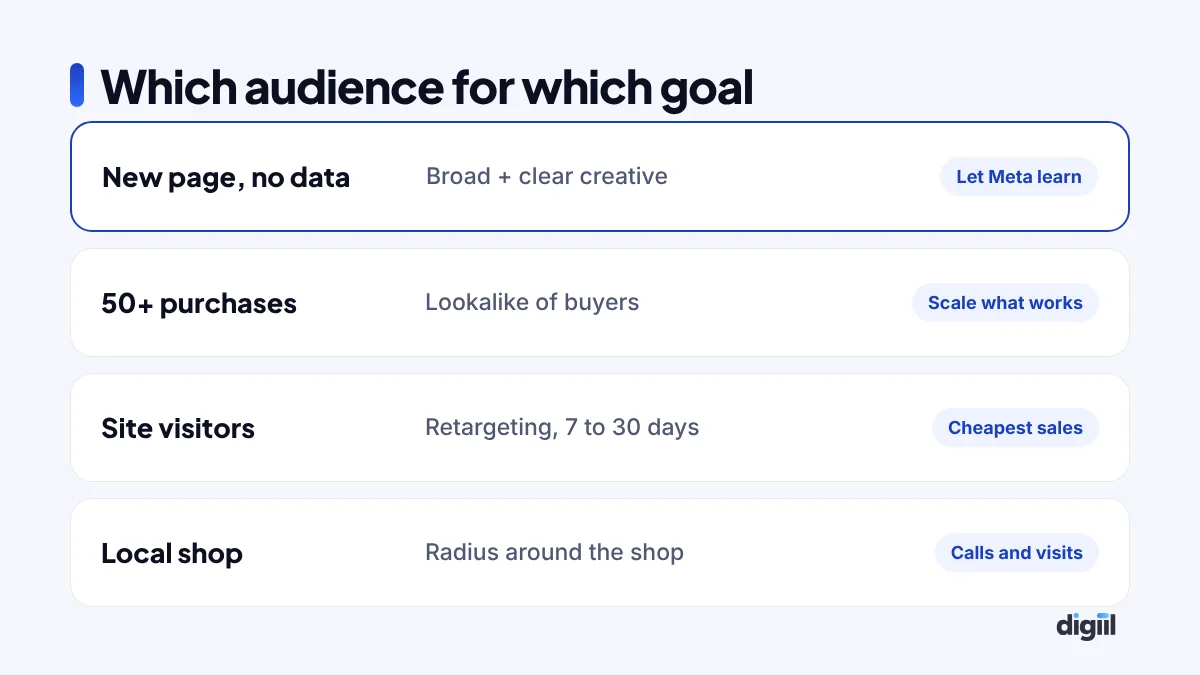
- Fix tracking first. Make sure purchases or leads reach Meta through the pixel and Conversions API. If numbers in Ads Manager and your order list do not match, read how to fix ad tracking before spending more.
- Create your warm audiences. In Audiences, build: website visitors 30 days, add to cart 14 days, page and Instagram engagers 90 days, people who messaged 90 days.
- Upload your buyer list. Export phone numbers of real customers from your order sheet or courier panel. Upload it as a customer list. Meta matches it securely.
- Build one lookalike. Use the buyer list as the source, Bangladesh as the location, 1% to start.
- Launch three ad sets with the same ads: broad Advantage+ audience, the 1% lookalike, and retargeting of warm audiences with a smaller budget.
- Wait. Give each ad set enough time and budget to collect results before you judge it. Changing things every day resets learning.
How much budget does each audience need?
A simple starting split for a small online shop is 70% on new people (broad and lookalike) and 30% on retargeting. Retargeting audiences are small, so too much money there shows the same ad to the same people again and again.
To see how budget turns into reach, clicks and orders with your own numbers, use this calculator.
The formula is simple: budget ÷ cost per click gives visitors, and visitors × conversion rate gives orders. Small changes in any one step change the result a lot. For realistic cost ranges, see Facebook ads cost in Bangladesh.
What targeting mistakes waste the most money?
- Optimising for the wrong thing. An “engagement” campaign finds people who like and comment. If you want orders, choose Sales or Leads and send the right event.
- Audiences that are too small. A 20,000-person audience with a daily budget gets tired within days. Costs rise and results fall.
- Overlapping ad sets. Five ad sets with similar interests compete with each other. Fewer, larger ad sets learn faster.
- No exclusions. When you run a “first order” offer, exclude existing buyers where you can, so you do not pay to give discounts to people who would buy anyway.
- Boosting without a plan. The Boost button hides most of these options. Our comparison of Boost vs Ads Manager shows what you gain by switching.
- Judging too early. One bad day is noise. Look at 7-day numbers.
How do I know if my targeting is working?
Do not judge targeting by likes. Check these numbers instead:
| Number | What it tells you | If it is bad |
|---|---|---|
| Cost per purchase or lead | The real price of a customer | Test new creative first, then audience |
| Frequency | How often each person saw the ad | Above 3 to 4 on cold audiences: widen or refresh |
| Click rate | Whether the ad interests this audience | Low rate: wrong people or weak hook |
| Delivered order rate | Whether buyers are real | Many returns: tighten age and area |
The last row is special to Bangladesh. With cash on delivery, a cheap “purchase” in Ads Manager can still be a returned parcel. Match ad results with courier data every week.
What happened to Rafi’s wallets?
Rafi stopped boosting. He installed the pixel on his small website, uploaded 180 past buyers’ phone numbers, and made a short video of the wallet being stitched by hand. He ran two ad sets: a broad one with age 24 and above, and a 1% lookalike of his buyers. He spent the same Tk 3,000 over a week.
This time the comments were fewer, but the orders were real: mostly office workers and people buying gifts. Nothing about the wallet changed. The right people simply saw it.
That is all good Facebook ads targeting is: clear data, a clear picture of the buyer, and patience to let the system learn. If you want a team to set this up and manage it for you, see our Meta ads service or book a free 15-minute strategy call.
- Meta now finds buyers mainly from your data and creative, so fix tracking first.
- Location and minimum age are hard limits. Most other settings are hints under Advantage+ audience.
- Build warm custom audiences and one lookalike from real buyers.
- Start with broad, lookalike and retargeting ad sets using the same ads.
- Judge by cost per delivered order, not likes or comments.
Questions people also ask
What is the best audience size for Facebook ads in Bangladesh?
There is no single perfect number. For a national product, an audience in the millions gives Meta room to find buyers. For a local shop, a few lakh people inside your delivery area is fine. Very small audiences cost more and tire quickly.
Should I use Advantage+ audience or pick interests myself?
Start with Advantage+ audience and add only the limits you truly need, such as location and minimum age. Test a manual interest audience next to it with the same ad. Keep whichever brings cheaper real orders after one to two weeks.
Can I target only Dhaka or only one area?
Yes. You can choose a division, a city, or drop a pin and set a radius around it. A radius around your shop or delivery zone works well for restaurants, clinics and salons.
How many purchases do I need for a lookalike audience?
Meta can build a lookalike from a source of at least 100 people from one country, but quality matters more than size. A list of a few hundred real buyers usually beats a list of thousands of page likers.
Why does my ad reach people outside my target?
With Advantage+ audience, your interests and age range are treated as suggestions, so Meta may go wider if it expects better results. Location and minimum age are respected as hard limits. Use the original audience options if you need strict control.

Amanat has managed $4M+ in Google and Meta ad spend for brands in the UK, USA, Australia and Bangladesh since 2020. He holds 20+ certifications, including Digital Marketing Strategy from Harvard Business School Online. More about Amanat