Of every hundred people who visit an online store, only a few buy on that visit. The rest were not all uninterested. Some were on a bus. Some wanted to ask a spouse. Some got a phone call. Facebook retargeting ads are how you reach those people again on Facebook and Instagram, and they are usually the cheapest sales in an ad account.
They are also the easiest ads to do badly. The common mistake is to put every past visitor into one audience and show them one “Come back, 10% off” ad for a month. This guide takes the opposite approach: separate groups by how close they came to buying, and tell each one what it needs to hear.
How retargeting works
Meta lets you build custom audiences from people who have already met your business. There are three sources.
- Your website, through the Meta Pixel and Conversions API. Every page view, product view, add to cart and purchase is an event you can build an audience from, looking back up to 180 days.
- Facebook and Instagram activity: people who messaged you, engaged with your page, watched your videos or opened a lead form. These go back up to 365 days.
- Your own customer list, uploaded as phone numbers or emails.
You then run an ad set that targets only that audience, with a message written for it. If your store runs on WooCommerce, set up the tracking first with our Meta Pixel for WooCommerce guide.
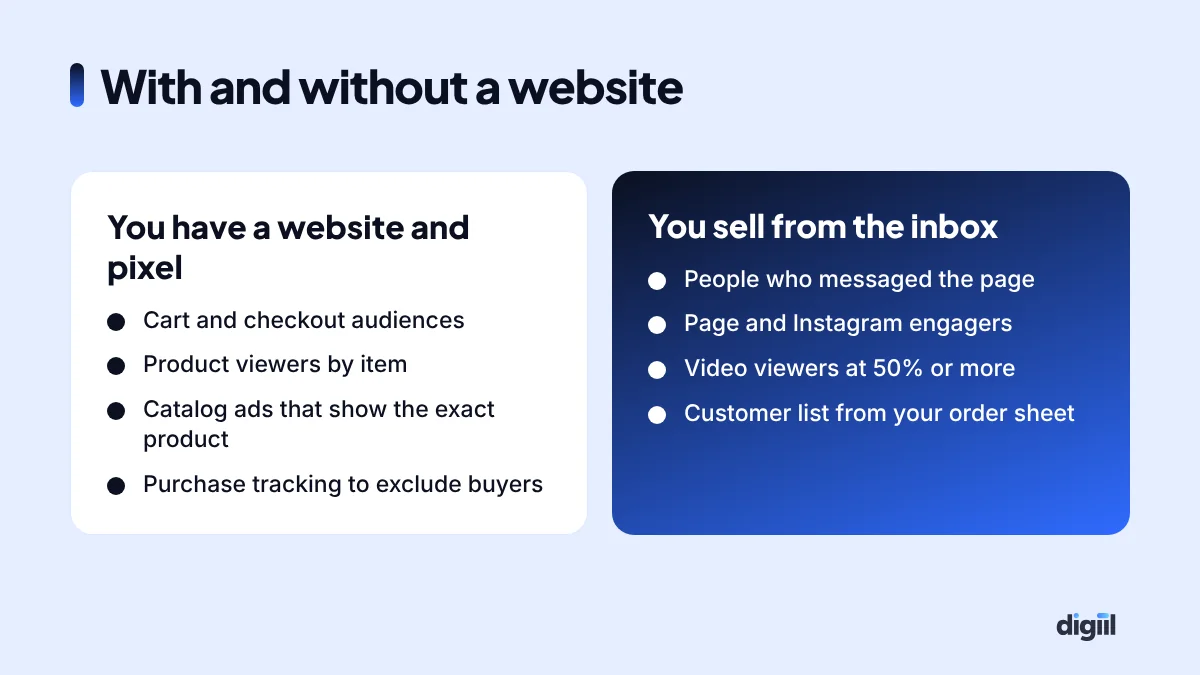
The audiences worth building
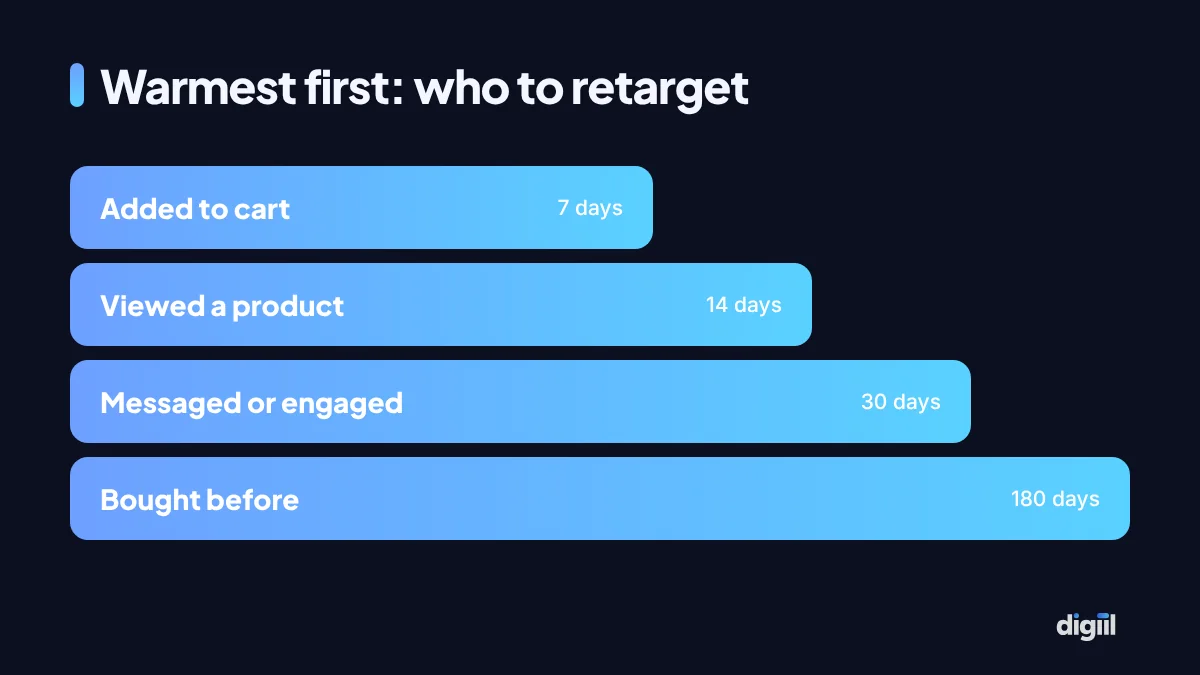
The windows in the image are sensible starting points for products people decide on within days. Stretch them for expensive or considered purchases such as furniture, courses or B2B services, where a decision can take months.
Two rules keep the groups clean. Exclude each warmer group from the cooler one, so a person who added to cart is not also treated as a general visitor. And exclude recent buyers from everything except the ads meant for buyers.
- Open Audiences in Ads Manager, choose Create audience, then Custom audience.
- Pick the source: Website, Customer list, Video, Instagram account, Facebook Page or Lead form.
- Choose the event and window. For example, “AddToCart” in the past 7 days.
- Add an exclusion inside the same audience where the tool allows it, such as excluding “Purchase” in the past 7 days.
- Name it clearly: “WEB – ATC 7d – no purchase”.
Give a new audience a day or two to fill before judging its size.
What to say to each group
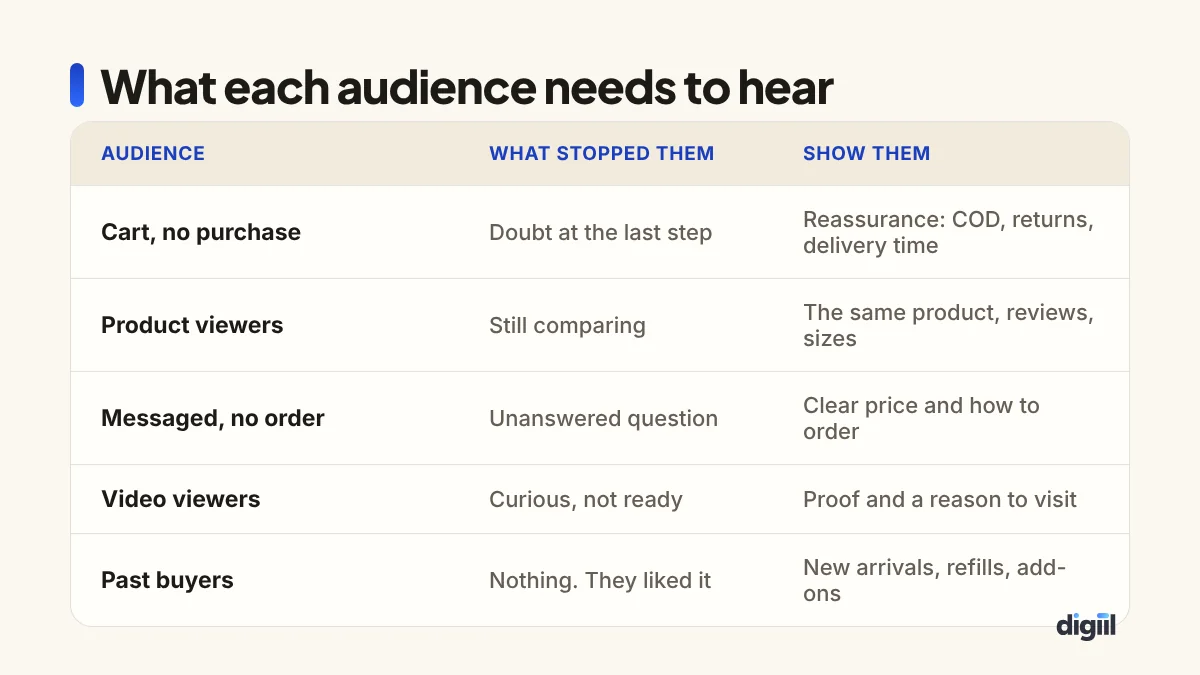
Think about why the person did not finish. Someone who reached checkout does not need to be told the product exists. They need the last doubt removed. Someone who watched half a video does not need a discount. They need a reason to look closer.
Cart and checkout abandoners
Remind and reassure. Show the product, then answer the silent questions: Can I pay on delivery? How many days? Can I return it? A short customer review works better than a discount here. Keep discounts in reserve for the last day or two of the window, if you use them at all.
Product viewers
Show the exact items they looked at. This is what catalog ads do automatically, covered below. Add what the product page may not have made obvious: size guide, real-life photos, how it compares with the cheaper option.
People who messaged and went quiet
For inbox sellers this is the most valuable group. Run an ad with the price stated, the delivery charge, and a button that opens the chat again. Many of these people simply lost the conversation among others.
Engagers and video viewers
They know your name and little else. Use proof: a customer story, a before and after, a bestseller list. The aim is a visit or a message, not an immediate sale.
Past buyers
Treat them as customers, not prospects. New arrivals, refills at the time the product would run out, matching items, early access to a sale. Combine ads with SMS or WhatsApp for this group. More on keeping customers in customer retention for e-commerce.
Days 1 to 3 after an abandoned cart: the same shoe, with “Cash on delivery, 7-day size exchange”.
Days 4 to 6: a 15-second video of a customer unboxing it, with star rating.
Day 7: free delivery if ordered today.
After day 7 the person drops into the wider visitor group and sees general bestseller ads less often.
Catalog ads: showing the exact product
If you have more than a handful of products, upload a catalogue to Meta Commerce Manager and connect it to your pixel. An Advantage+ catalog ad (previously called a dynamic product ad) then fills itself with the items each person viewed or added to cart, with current price and photo.
It needs three things to work: product IDs in the catalogue that match the IDs your pixel sends, a feed that updates when prices or stock change, and enough traffic for the audience to fill. On WooCommerce, the official Facebook plugin or a feed plugin handles the catalogue.
Retargeting for service and lead businesses
Most retargeting advice is written for online shops. Clinics, coaching centres, real estate firms and B2B companies have no cart to abandon, but the same idea applies with different signals.
- Visited a key page. People who viewed the pricing, admission or “book an appointment” page without enquiring are your equivalent of cart abandoners.
- Opened a lead form and did not submit. Meta lets you build this audience directly from instant forms.
- Watched most of a long video. Someone who watched 75 percent of a three-minute explanation of your service is seriously interested.
- Enquired but did not become a client. Upload this list from your CRM or sheet.
Because decisions take longer, use longer windows of 60 to 180 days and rotate the message: first a case study, then answers to common objections, then an invitation to a call or visit. A property buyer may need to see you for three months before booking a site visit. One ad repeated for three months will not do it. A sequence might.
Parents who visited the fees page in the past 60 days first see a short video of last year’s results. Two weeks later they see a teacher answering “How many students per batch?”. In the final fortnight before classes start they see the admission deadline with a WhatsApp button. Three messages, each answering the question a parent has at that stage.
Which ad formats suit retargeting
- Catalog carousel: best for product viewers, because it shows what they actually looked at.
- Short testimonial video: best for people close to deciding. A real customer removes doubt faster than your own claims.
- Single image with an offer or deadline: for the last days of a window.
- Click to WhatsApp or Messenger: for people who prefer to ask before ordering. See our click to WhatsApp ads guide.
- Collection or instant experience: for buyers, to show new arrivals without leaving the app.
Prepare at least three creatives for each warm audience. A small audience sees each ad many times, so variety matters more here than in prospecting.
Budget and frequency
Retargeting audiences are small, so they cannot absorb much money. Ten to twenty percent of ad spend is the usual range for a small account. Put more in and the only effect is that the same people see the same ad more times.
Watch frequency, the average number of times each person saw the ad. Across a 7-day window, somewhere up to four or five is comfortable for most products. Past that, results usually fall and irritation rises.
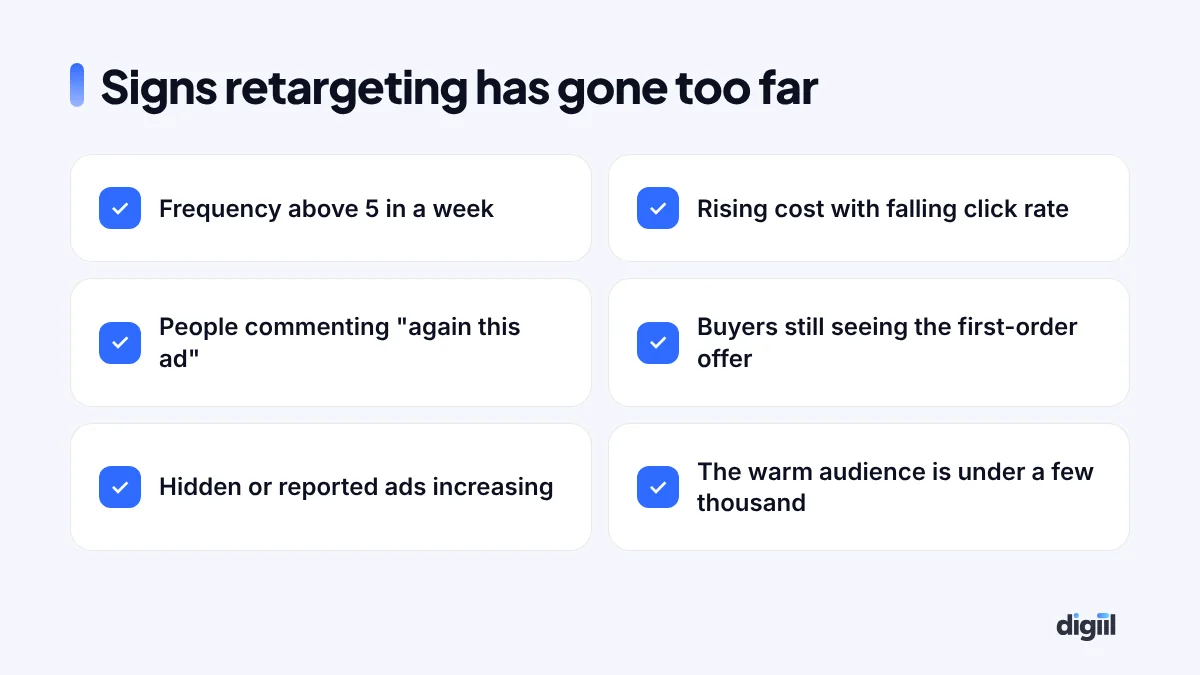
The cure for high frequency is one of three things: lower the budget, widen the window so the audience is larger, or add more ad variations so people are not looking at the same image every time.
The more warm audiences you want, the more new visitors you need at the top. Retargeting cannot grow without prospecting. For the cold side of the account, see our Facebook ads targeting guide.
Retargeting when Meta automates the audience
With Advantage+ audience and Advantage+ sales campaigns, Meta already shows your ads to past visitors as part of a broad campaign, because they are the people most likely to convert. That raises a fair question: do you still need separate retargeting?
Often yes, for one reason. Automation decides who sees an ad. It does not write a different message for someone who abandoned a cart. A separate retargeting ad set lets you say the specific thing that group needs. If you run both, exclude your retargeting audiences from the broad campaign where the campaign type allows, or at least compare results so you are not paying twice for the same sale.
Measuring it honestly
Retargeting always looks wonderful in Ads Manager, with the highest return in the account. Part of that is real and part is flattery. Some of those people would have come back and bought anyway, and the ad simply happened to be the last thing they saw.
Two checks keep you honest. First, look at total sales and total ad spend across the whole account, not only the retargeting line. If adding retargeting raised the reported return but total sales did not move, it is taking credit, not creating sales. Second, pause it for two weeks once a year and see what happens to revenue.
If your pixel under-reports purchases, the exclusions fail and buyers keep seeing ads. Sort that out with how to fix ad tracking.
When we audit retargeting, the waste we find most often is not the creative. It is audiences that never exclude buyers. A shop keeps showing the same kurti to someone who bought it four days ago, pays for the impression and irritates a customer it has already won. Excluding purchasers from the last 30 days takes two minutes and usually shows up in cost per result within the week.
Mistakes to avoid
- One audience, one ad, thirty days. The single most common setup and the weakest.
- No purchase exclusion. Customers see “Still thinking about it?” for something already on their doorstep.
- Leading with discounts. It teaches people to abandon carts on purpose and wait.
- Retargeting too small an audience with a daily budget it cannot spend sensibly.
- Ignoring the landing page. If they left because the page was slow or confusing, bringing them back to the same page changes nothing.
- Using sensitive wording. “We noticed you looked at…” feels like being watched, and ads that imply knowledge of personal circumstances break Meta’s rules.
A setup you can finish this week
- Confirm the pixel records ViewContent, AddToCart and Purchase correctly.
- Build four audiences: cart 7 days, product viewers 14 days, messaged or engaged 30 days, buyers 180 days.
- Create one retargeting campaign with two ad sets: cart plus product viewers, and engagers. Exclude buyers from both.
- Write two ads for each ad set, following the table above.
- Give it 10 to 15 percent of your daily spend and check frequency after seven days.
If you would like this built and managed alongside your prospecting campaigns, see our Meta ads service or book a free 15-minute strategy call.
Questions people also ask
What is the difference between retargeting and remarketing?
In everyday use they mean the same thing: showing ads to people who have already interacted with your business. Some people reserve "remarketing" for email and SMS to existing contacts, but Meta and most marketers use the words interchangeably.
How big does a retargeting audience need to be?
Meta needs a matched audience of at least about 100 people before it will deliver, and in practice a few thousand is where retargeting starts to run smoothly. Smaller sites should combine windows or use engagement audiences.
How much of my budget should go to retargeting?
For most small accounts, roughly 10 to 20 percent. The warm audience is small, so more money only shows the same ads to the same people more often.
Can I retarget without a website?
Yes. You can build audiences from people who messaged your page, engaged with your posts, watched your videos or opened a lead form, and you can upload a customer list.
Why is my retargeting audience smaller than my visitor numbers?
Not every visitor can be matched to a Facebook account. Browser privacy features, ad blockers and visitors who are not logged in all reduce the match. Sending events through the Conversions API as well as the pixel improves it.

Amanat has 7+ years in digital marketing and has managed $8M+ in Google and Meta ad spend for 235+ brands in the UK, USA, Australia and Bangladesh. He holds 20+ certifications, including Digital Marketing Strategy from Harvard Business School Online. More about Amanat