Ask ten marketers about Google Ads vs Facebook Ads and you will hear ten firm opinions. Most of them are right for the businesses those marketers usually work with. The useful question is not which platform is better, but which one fits the way your customers buy.
Below are six rounds, with a winner for each, then a way to place your own business, and a plan for when you are ready to run both.
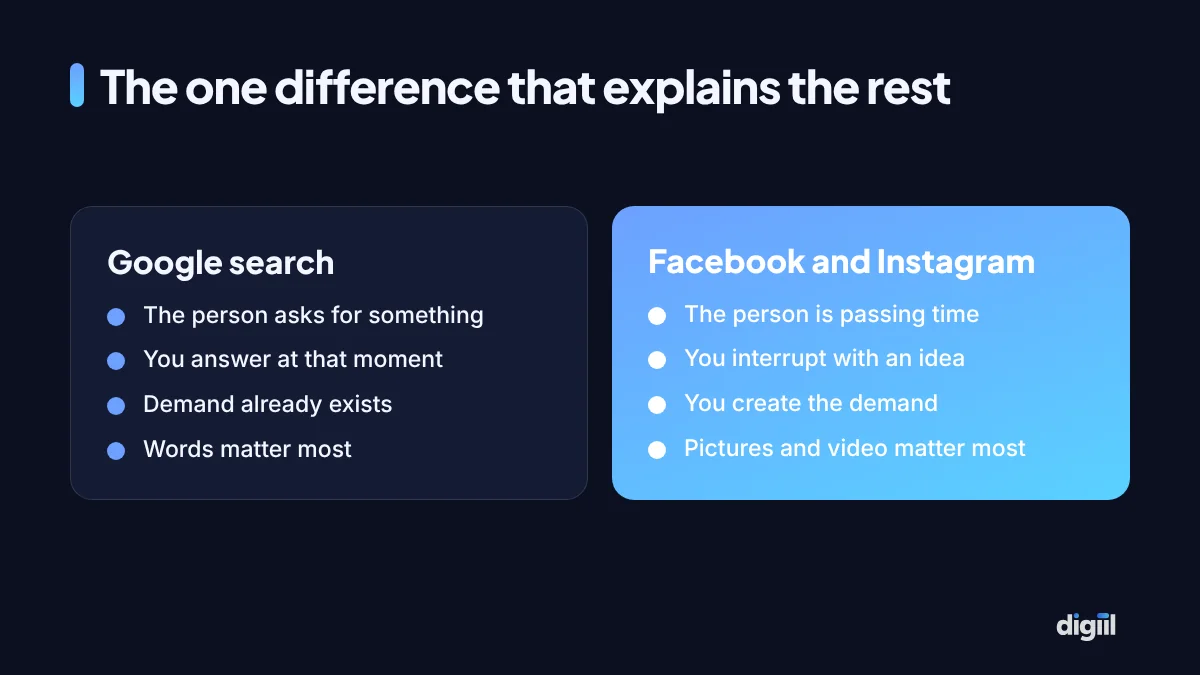
Keep that picture in mind. Almost every difference that follows comes from it.
Round 1: Intent
A person who types “dentist in Mirpur 10” into Google has a toothache and wants an appointment. A person scrolling Facebook in the evening wants nothing in particular. Your ad reaches the first person at the moment of need and the second person at a moment of leisure.
That gap in intent shows up in conversion rates. Search visitors who click an ad for exactly what they searched often enquire at a higher rate than social visitors.
Winner: Google, whenever people already search for what you sell.
Round 2: Reach and discovery
Google search can only show your ad when someone searches. If people do not know your product exists, or do not know to search for it, there is no search to win. A new skincare brand, a novel kitchen gadget or a fashion label cannot buy searches that are not happening.
Facebook and Instagram are used daily by a very large share of internet users in Bangladesh. You can put a product in front of people who match your buyer before they ever think of looking.
Winner: Meta, for new products, new brands and impulse purchases.
Round 3: Cost
Clicks on Google search usually cost more than clicks on Meta, because a searcher is worth more to advertisers. In crowded categories, such as study abroad, property and finance, the gap is large.
But cost per click is the wrong measure. What matters is cost per sale. A Tk 40 search click that converts at 8% costs Tk 500 per lead. A Tk 8 social click that converts at 1% costs Tk 800. The cheaper click produced the more expensive lead.
Run your own figures for each platform: budget ÷ cost per click = visitors, visitors × conversion rate = leads. For real ranges, see Google Ads cost in Bangladesh and Facebook ads cost in Bangladesh.
Winner: it depends, and only your cost per sale can settle it.
Round 4: Targeting
Google targets mainly by what people search, plus location, device, time and, for some campaign types, audiences. The keyword is the targeting.
Meta targets by who people are and what they do: location, age, interests, behaviours, people who visited your site, people who resemble your buyers. Increasingly, Meta’s own system decides who sees your ad based on your conversion data and your creative. Our Facebook ads targeting guide explains how that works now.
Winner: Meta for reaching a type of person. Google for reaching a type of need.
Round 5: Creative effort
A Google search ad is text: headlines, descriptions, links. A capable writer can produce a good one in an hour, and it can run for months.
Meta ads live or die by images and video. They need to stop a thumb in under two seconds, and they wear out within weeks as the same people see them repeatedly. That means a steady supply of new creative.
Winner: Google, if you have little time or no one to make videos. Meta, if you can produce visual content regularly. It is often the deciding factor for small teams.
Round 6: Measurement
Both platforms need proper tracking to optimise. Google measures leads, calls and purchases through its tag or imported GA4 events. Meta needs the pixel, ideally with the Conversions API. Both lose some data to privacy features and both report numbers that will not match your order sheet exactly.
One difference matters for Bangladeshi businesses. Many sales start online and finish in a chat or a phone call. Calls from Google search ads can be tracked with call extensions. Meta chats can be tracked as conversations. Neither knows which chats or calls became paying customers unless you tell it, so keep your own record of source per order.
Winner: a draw. Set up tracking properly on whichever you choose. Start with GA4 for small businesses.
Where does your business sit?
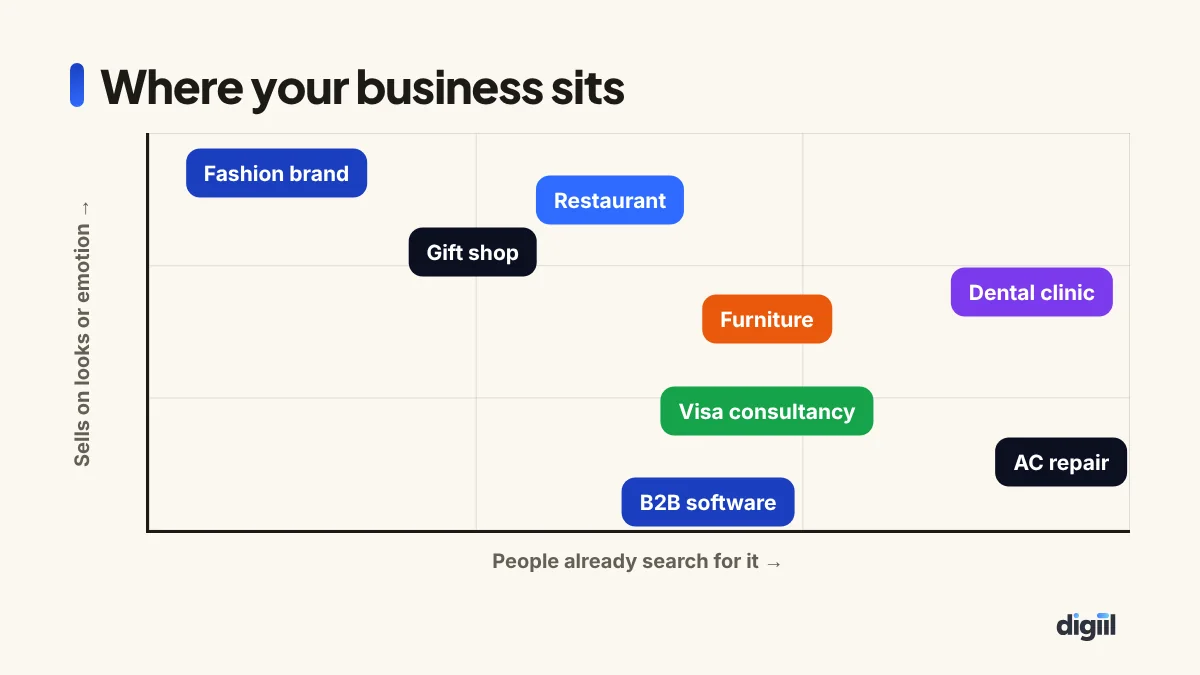
Place your business on two questions. Do people already search for it? Does it sell on looks, taste or emotion? Businesses toward the right of the chart should usually start on Google. Businesses toward the top should usually start on Meta. Those in the middle, such as furniture and restaurants, do well with both.
The points on the chart are rough placements to show the idea, not measured data. Your own business may sit differently: a high-end dental clinic with striking before-and-after results may do very well on Meta too.
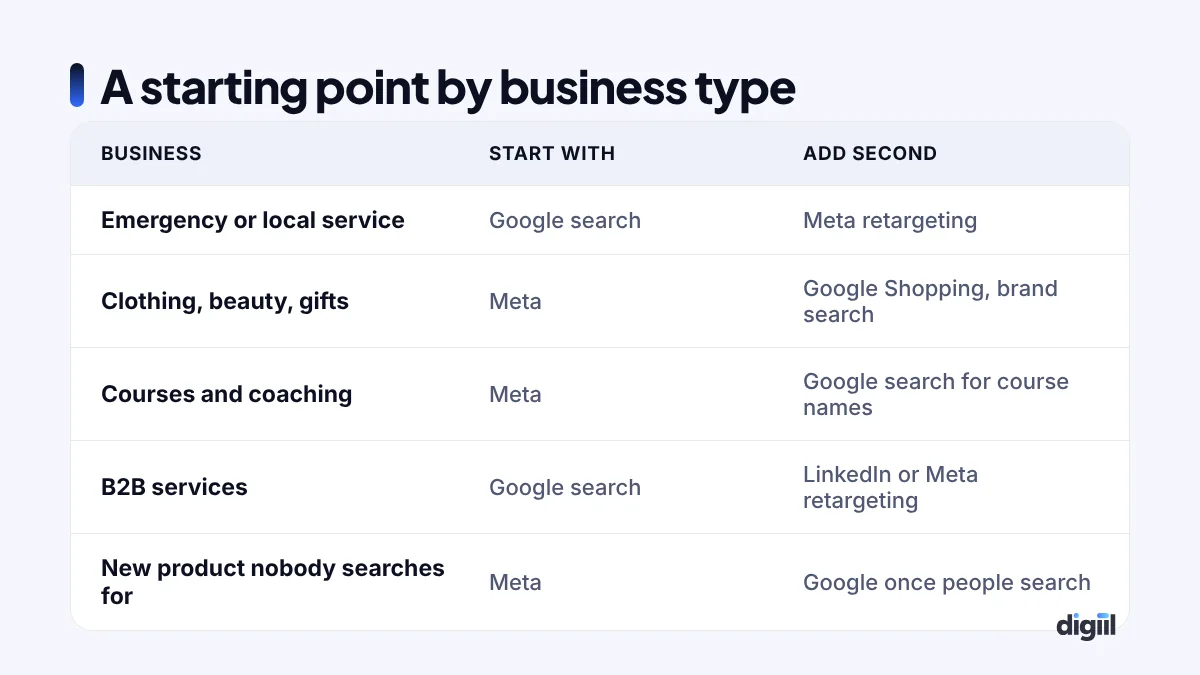
Three businesses worked through
The rounds are easier to apply with real situations. The numbers here are round examples to show the reasoning, not market rates.
A physiotherapy clinic in Chattogram
People search “physiotherapist near me”, “back pain treatment Chattogram” and “physiotherapy cost”. That is clear, local, existing demand, so Google search starts first, with a campaign limited to the city and to clinic hours. The clinic’s Google Business Profile matters as much as the ads, because map results sit above many organic links for local searches.
Meta still has a job: short videos of the physiotherapist explaining a common problem build trust with people who will search later, and retargeting reminds visitors who looked at the treatment page but did not book. The clinic spends most of its budget on Google and a small share on Meta.
A handmade jewellery brand selling nationwide
Almost nobody searches for a brand they have never heard of, and “handmade earrings” is a broad, browsing search. The product sells on looks. Meta starts first: Reels of pieces being made and worn, a catalogue, and ads optimised for purchases. Google comes in later, in two small ways: a search campaign on the brand name to protect it once people start searching, and Shopping ads for specific product terms.
An IT services company selling to other businesses
Decision-makers search for specific solutions: “ERP software for garments”, “managed IT support Dhaka”. Volumes are small, but each client is worth a great deal. Google search starts first with tightly chosen keywords and a long list of negative keywords to keep out job seekers and students. Meta is used for retargeting website visitors with case studies, and LinkedIn may be worth testing for senior roles in larger companies.
Practical differences people find out too late
Setup time
A basic Meta campaign can be live in an hour if you have creative ready. A Google search campaign needs keyword research, ad groups, ad copy, negative keywords and conversion tracking before it is worth switching on. Budget a day for a careful first build.
Learning period
Both systems need data before automated bidding settles. Meta’s learning phase is visible in Ads Manager. Google’s smart bidding also has a learning period after launch or major changes. Judging either platform after three days is judging noise.
Billing
Both platforms bill most Bangladeshi advertisers to an international card, often in US dollars. Bank charges and exchange rates affect the real cost in taka on both. Our guide to paying for ads from Bangladesh covers the card side.
Account risk
Meta ad accounts are restricted more often, sometimes by mistake, and appeals can take time. Google suspensions are less frequent for ordinary businesses but hard to reverse when they happen, especially for policy areas such as finance or health. Read each platform’s advertising policies for your category before you start, and do not run all your sales through one account you cannot afford to lose.
Skills on the team
Google rewards someone who thinks in words and spreadsheets: keywords, search terms, bids. Meta rewards someone who thinks in pictures and stories: hooks, video, offers. Many small businesses choose a platform by accident, based on which skill they happen to have in-house. That is not a bad reason, as long as you know it is the reason.
What about the other platforms?
- YouTube runs through Google Ads. It suits products that need demonstration and audiences who watch long videos. See YouTube ads in Bangladesh.
- TikTok reaches a younger audience with short video, similar in spirit to Meta Reels. It is worth testing for fashion, beauty and food if your buyers are under 30.
- LinkedIn has precise job and company targeting at a high cost per click. It fits B2B offers where one client is worth a lot.
For most small businesses, these come after the first platform is working, not before.
A test that settles it
If you still cannot decide, run both for the same period with the same budget, then compare honestly.
- Set up tracking on both for the same conversion: an enquiry form, a call, a purchase.
- Give each the same budget for three to four weeks.
- Keep a source column in your lead or order sheet, so you know where each paying customer came from.
- Compare cost per paying customer, not clicks, likes or form fills.
- Move the budget towards the winner, and keep a small share on the other if it was close.
Using both together
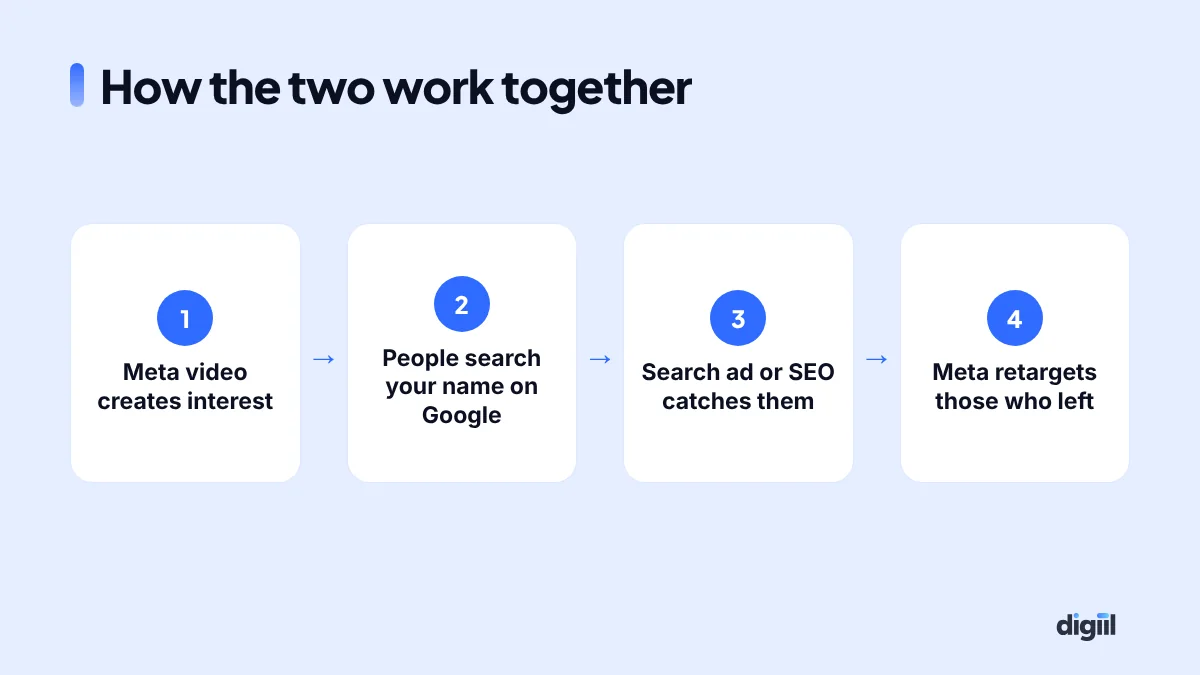
The strongest setups use each platform for what it does best. Meta creates interest among people who did not know you. Some of them later search your brand or product on Google, where a search ad or a good organic result catches them. Those who visit and leave are brought back by Meta retargeting. See Facebook retargeting ads for that part.
This also explains a common puzzle: when a business pauses its Meta ads, branded searches on Google often fall a little later. The platforms report separately, but customers move between them.
As a rough guide to splitting money once both are running, put most of the budget where your proven sales come from, and keep the other as a supporting channel. For a fuller method, see how to set a digital marketing budget.
The short rule
If people already search for what you sell, start with Google. If they need to see it before they want it, start with Meta. If both are true, start with the one you can run well this month, prove it, then add the other.
If you would like a second opinion on which platform suits your business, see our paid ads services or book a free 15-minute strategy call.
Quick answers
Which is cheaper, Google Ads or Facebook Ads?
Facebook usually has a lower cost per click. Google often has a lower cost per sale for services people actively search for. Compare cost per order or qualified lead, not cost per click.
Can a small business afford both?
Yes, but start with one. Split a small budget across two platforms and neither gets enough data to learn. Add the second once the first is profitable.
Which is better for B2B?
For most B2B services, Google search, because decision-makers search for solutions by name. Meta works for B2B retargeting and for owner-led small businesses. LinkedIn suits larger companies and senior roles.
Which is better for e-commerce in Bangladesh?
Most online shops start with Meta, because the products are visual and buyers discover them while scrolling. Google Shopping and search ads become useful once people search for your brand or specific products.

Amanat has 7+ years in digital marketing and has managed $8M+ in Google and Meta ad spend for 235+ brands in the UK, USA, Australia and Bangladesh. He holds 20+ certifications, including Digital Marketing Strategy from Harvard Business School Online. More about Amanat