SEO (search engine optimization) is the work of improving a website so that search engines can find it, understand it and show it higher in their unpaid results when people search for what it offers.
That sentence is accurate and not very useful on its own. So here is the same idea the way we would explain it to a shop owner across a desk.
Somewhere right now, a person is typing “best cardiologist in Chattogram” or “panjabi price in Bangladesh” into Google. Google has to pick about ten pages out of millions. SEO is everything you do to deserve one of those ten places, and then to earn the click.
If you came here by searching “what is SEO”, “SEO meaning” or “SEO ki”, you have already seen it working. This page was written to answer that search. Whether it deserved its place is for you to judge by the end.
Where SEO happens: the results page
A modern Google results page is not a simple list of ten blue links. Understanding its parts shows you what SEO can and cannot do.
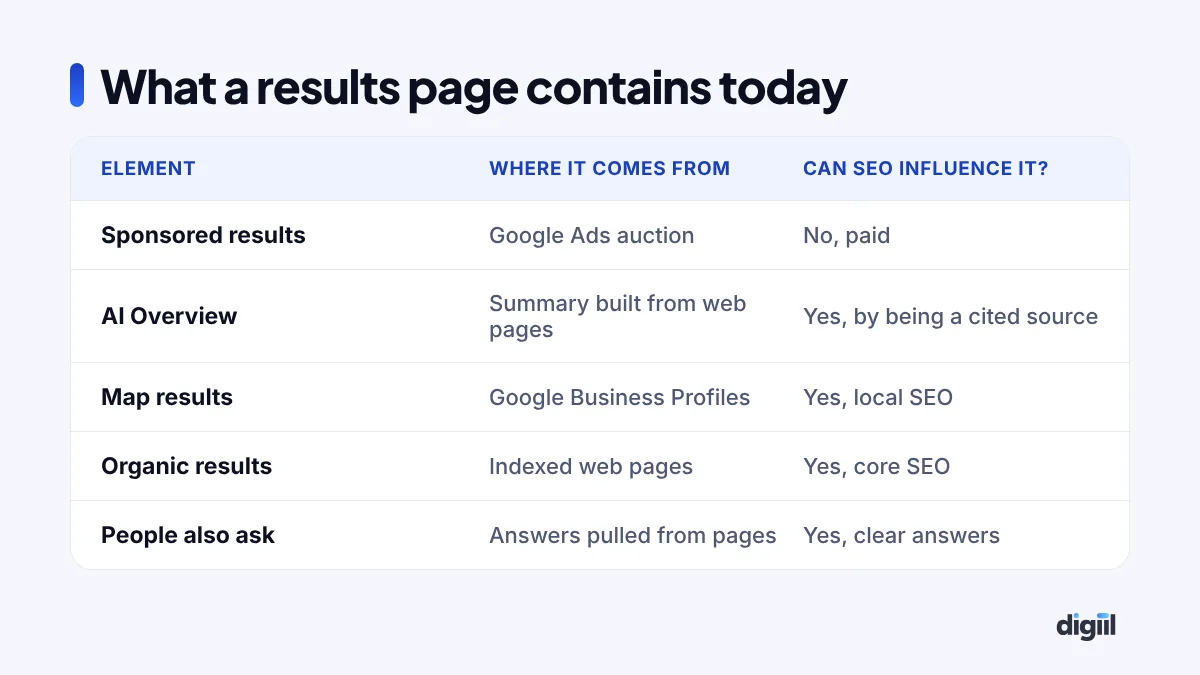
Sponsored results are bought through Google Ads. Everything else on the page is earned. The traffic that arrives from those earned placements is called organic traffic.
Notice that different searches produce different pages. “Dentist near me” shows a map. “How to remove a tea stain” shows an AI Overview and videos. “Buy office chair” shows products. Good SEO starts by looking at what Google already shows for the searches you care about, because that tells you what kind of page it wants.
How search engines work
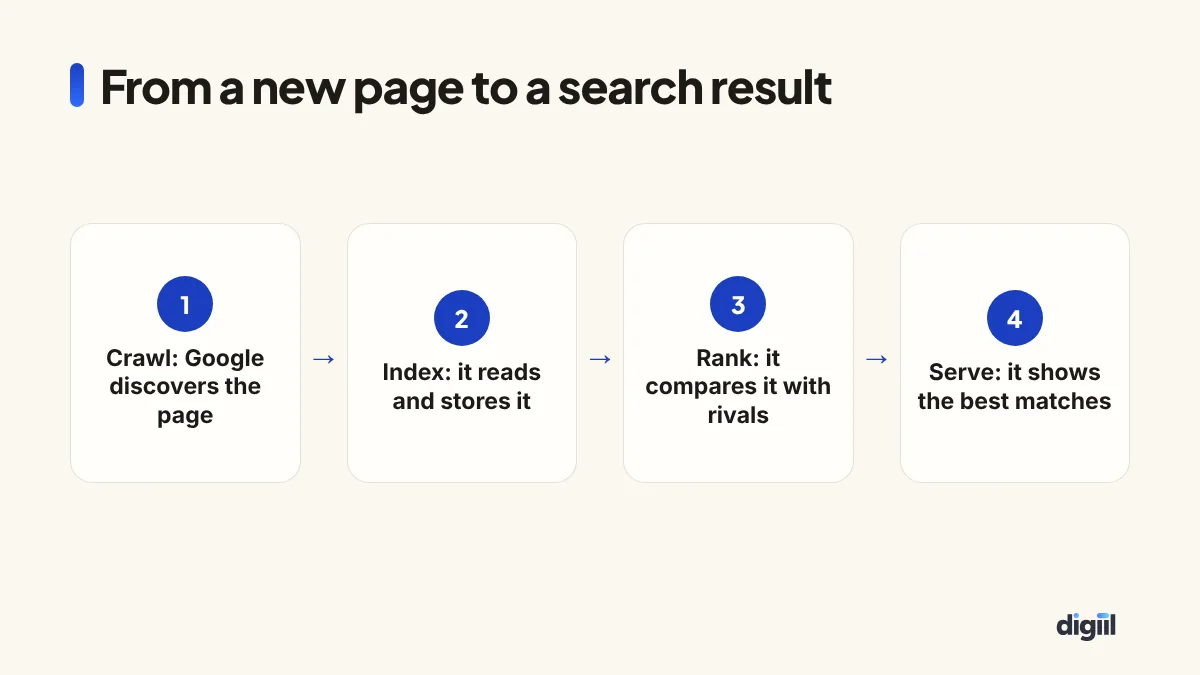
Crawling
Google uses automated programs, called crawlers or Googlebot, that move from link to link across the web and fetch pages. If no link points to your page and it is not in your sitemap, Google may never find it. If your site blocks crawlers by mistake, which happens more often than you would think after a redesign, nothing else you do matters.
Indexing
After fetching a page, Google tries to understand it: the text, the headings, the images, what the page is about and whether it duplicates another page. Pages that pass are stored in the index, a vast library. Not every crawled page gets indexed. Thin, duplicate or blocked pages are often left out.
Ranking and serving
When someone searches, Google pulls candidate pages from the index and orders them. It weighs many signals. Google itself groups them under five headings: the meaning of the query, the relevance of the content, the quality of the content, the usability of the page, and context such as the searcher’s location and language.
This is worth sitting with for a moment. Your website does not have “a ranking”. Your services page might be third for one search and nowhere for another. That is why SEO work is done page by page and search by search.
What Google is trying to reward
Google publishes guidance for site owners, and one phrase sums it up: helpful, reliable, people-first content. Its quality guidelines use the shorthand E-E-A-T: experience, expertise, authoritativeness and trust.
In everyday terms:
- Experience. Does the page show the writer has actually done the thing? A clinic’s page written with the doctor’s input beats a generic health article.
- Expertise. Is the information correct and complete?
- Authoritativeness. Do other reputable sites and people refer to you?
- Trust. Is it clear who runs the site, how to contact them, and is the site secure?
E-E-A-T is not a score you can look up. It is a description of what Google’s systems try to recognise. For topics that affect health, money or safety, the bar is higher.
The three parts of SEO
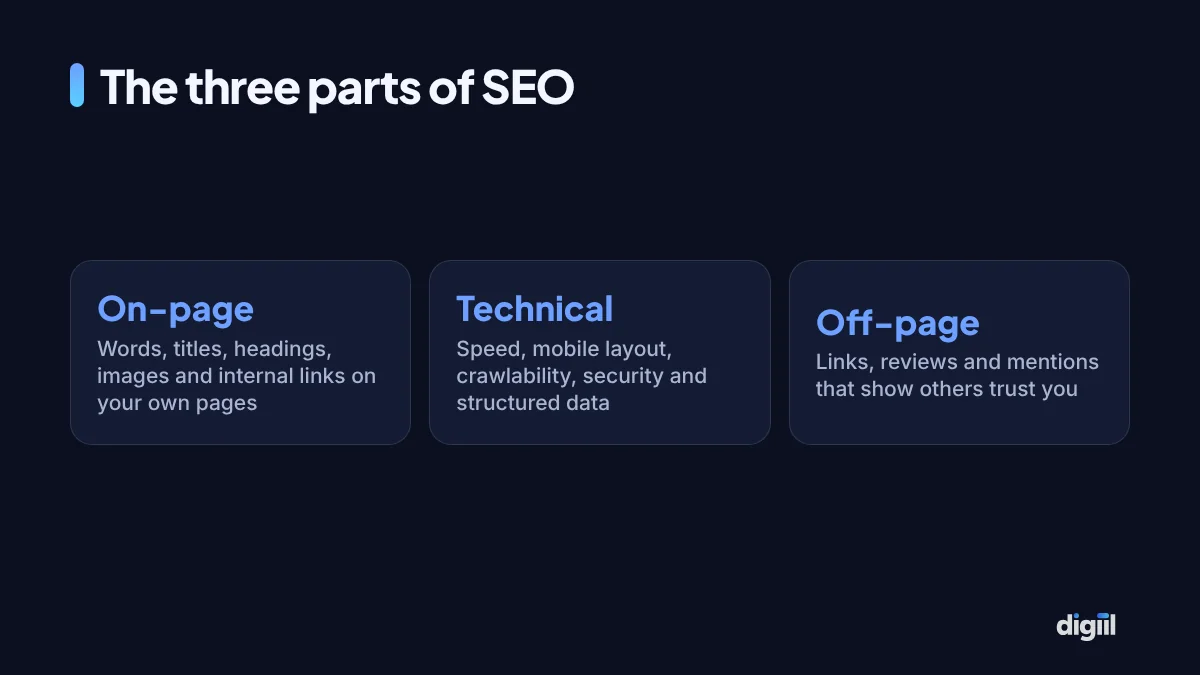
On-page SEO
This is what you write and how you organise it on your own pages. It is where most beginners should spend their first month.
- One main topic per page. A page about “home loan in Bangladesh” should not also try to rank for car loans.
- A clear title tag. This is the blue headline in results. Put the main phrase near the start and give a reason to click.
- A meta description. It does not directly raise rankings, but it is your advert in the results.
- Headings that outline the page. One H1, then H2 and H3 sections a reader can scan.
- Content that answers the search fully. Prices, process, timing, location, proof. Whatever a buyer would ask.
- Descriptive image alt text and compressed images.
- Internal links between related pages, with meaningful link text.
Our on-page SEO checklist turns this into a step-by-step list.
Technical SEO
This makes sure search engines and visitors can use the site without friction.
- Speed. Google measures real-user experience through Core Web Vitals: how quickly the main content appears (LCP), how quickly the page responds to a tap (INP), and whether the layout jumps around (CLS). See our website speed guide.
- Mobile layout. Google mainly uses the mobile version of a page for indexing. Most searches in Bangladesh happen on phones.
- HTTPS. A secure connection is expected.
- Crawlability. A sitemap, a sensible robots.txt, no accidental “noindex” tags, and no chains of broken links.
- Structured data. Extra code that labels things like products, reviews, FAQs and business details so search engines read them without guessing.
Off-page SEO
This is reputation. The best-known signal is the backlink: a link from another website to yours. A link from a respected newspaper, university, industry body or well-read blog tells Google that someone else vouches for you. A hundred links from junk directories tell it nothing good.
For local businesses, reviews and consistent business details across the web matter just as much. A complete profile with real reviews is often the fastest win. Start with our Google Business Profile guide and local SEO for Dhaka.
Keywords and search intent
A keyword is simply what a person types or says. The more useful idea is search intent: why they typed it.
| Intent | Example search | Page that fits |
|---|---|---|
| To learn | how to choose an air conditioner | A guide or article |
| To compare | inverter vs non-inverter ac | A comparison |
| To buy | 1.5 ton inverter ac price in bangladesh | A product or category page |
| To find a place | ac servicing uttara | A local service page and Business Profile |
| To reach a brand | walton service centre number | The brand’s own page |
If your page type does not match the intent, it will not rank however well it is written. A product page will not win a “how to” search, and a blog post will not win a “buy” search.
People in Bangladesh search in English, in Bangla script and in Banglish, sometimes for the same thing. Check all three when you plan a page. Our keyword research guide shows free ways to find what people actually type.
A tutoring centre wants to rank for “coaching”. That single word is vague and crowded. “HSC physics coaching in Mirpur 10” has far fewer searches, but nearly every one is a parent or student ready to enquire, and far fewer competitors have a page for it. Specific phrases like this are called long-tail keywords, and they are where small businesses win first.
Kinds of SEO you will hear about
The three parts above apply to every site. On top of them, people talk about specialities. They are the same craft pointed at different results.
- Local SEO. For businesses that serve an area: clinics, restaurants, showrooms, coaching centres. The work centres on the Google Business Profile, reviews, and pages for each location or service area. The prize is the map results.
- E-commerce SEO. For online stores. Category pages usually matter more than individual products, and the technical side is heavier because stores create thousands of near-duplicate URLs through filters and sorting. See e-commerce SEO in Bangladesh.
- International SEO. For exporters, software firms and agencies selling abroad. It deals with which country and language each page targets.
- YouTube and video SEO. YouTube is a search engine in its own right, and videos appear inside Google results. Titles, descriptions and watch time play the role that titles and content play on a web page. Our YouTube marketing guide covers it.
- AEO and GEO. Newer labels for being quoted in direct answers and in AI-generated responses. The methods overlap heavily with good SEO.
White hat and black hat
You will also hear these two terms. White hat means working within the search engines’ published rules: better pages, better site, real reputation. Black hat means trying to trick the system with hidden text, copied content, fake reviews or purchased link networks. Black hat methods sometimes work for a few months. Then an update or a manual review removes the gains, and recovering a penalised domain can take longer than building a new one. For a real business with a name to protect, it is a poor trade.
What this looks like for real businesses
Its patients search “dentist near me”, “root canal cost Dhaka” and “braces price in Bangladesh”. SEO for this clinic means a complete Business Profile with real patient reviews, one page per treatment with honest price ranges and the dentist’s credentials, and fast loading on phones. It does not need a hundred blog posts.
Its buyers search “leather wallet price in bd” and “office bag for men”. The work is on category pages, product titles, photos with alt text, stock and price markup, and a handful of buying guides. Technical housekeeping matters, because filter pages can swamp the index.
Its buyers search for a problem, such as “inventory software for small pharmacy”. It needs in-depth pages for each use case, comparison pages, case studies, and links from industry sites. Results come more slowly and each customer is worth far more.
Three businesses, three different plans. That is why a fixed “SEO package” with the same task list for everyone rarely fits anyone.
SEO and paid ads
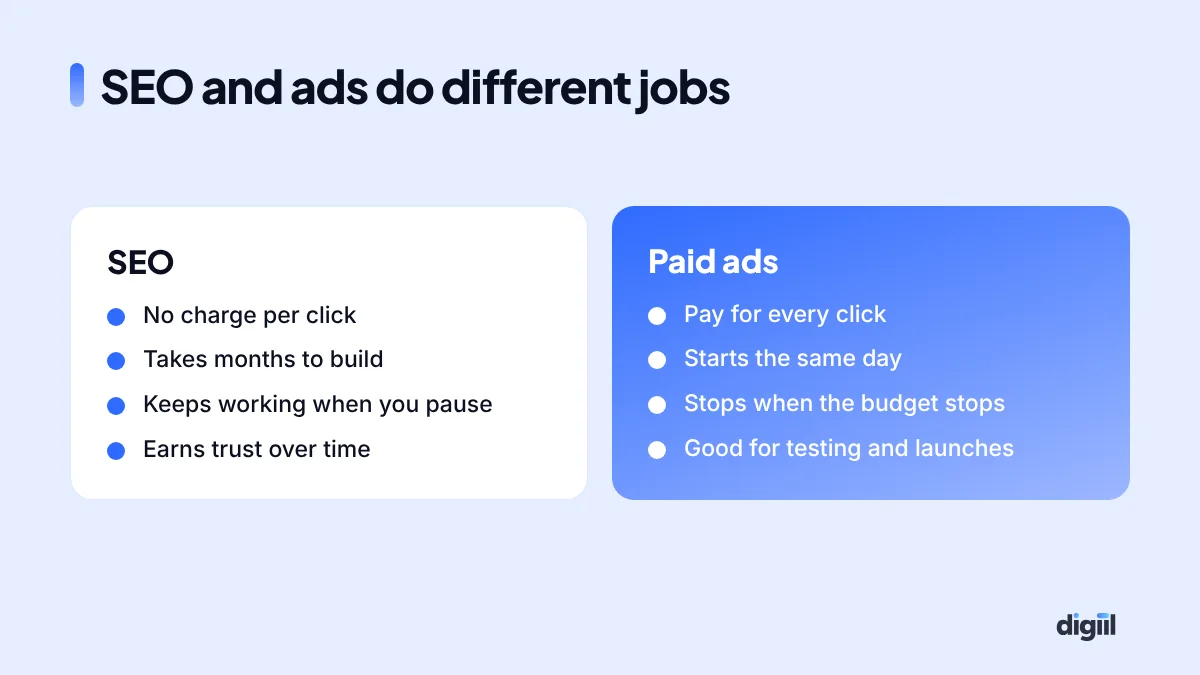
They are not rivals. Ads give you visibility today and stop when the money stops. SEO builds slowly and keeps paying after the work is done. Many businesses run ads for immediate enquiries while SEO grows underneath, then lean on ads less as organic traffic rises. Ads data also tells you which searches convert, which is valuable for choosing SEO targets.
Seven myths that waste money
SEO in the age of AI answers
Google now shows AI Overviews for many searches, and people also ask ChatGPT, Gemini and similar tools for recommendations. Some simple informational searches get answered without a click. Searches where people want to buy, book, compare suppliers or visit a place still send visitors to websites.
What helps you appear in AI-generated answers is, so far, the same as what helps in ordinary search: pages that state facts clearly, answer specific questions directly, show who is behind them, and are referenced by other reliable sites. We look at this in more depth in AI content and SEO.
How to tell if SEO is working
Two free tools from Google do most of the job.
Google Search Console shows which searches your pages appeared for (impressions), how often people clicked, your average position, and any indexing problems. It is the closest thing to seeing your site through Google’s eyes.
Google Analytics 4 shows what visitors did after arriving: which pages they read and whether they called, filled a form or bought. Our GA4 setup guide walks through it.
Watch them in this order: are pages indexed, are impressions rising, are clicks rising, are enquiries rising? Rankings for one favourite keyword are the least useful number, because results differ by person, place and device.
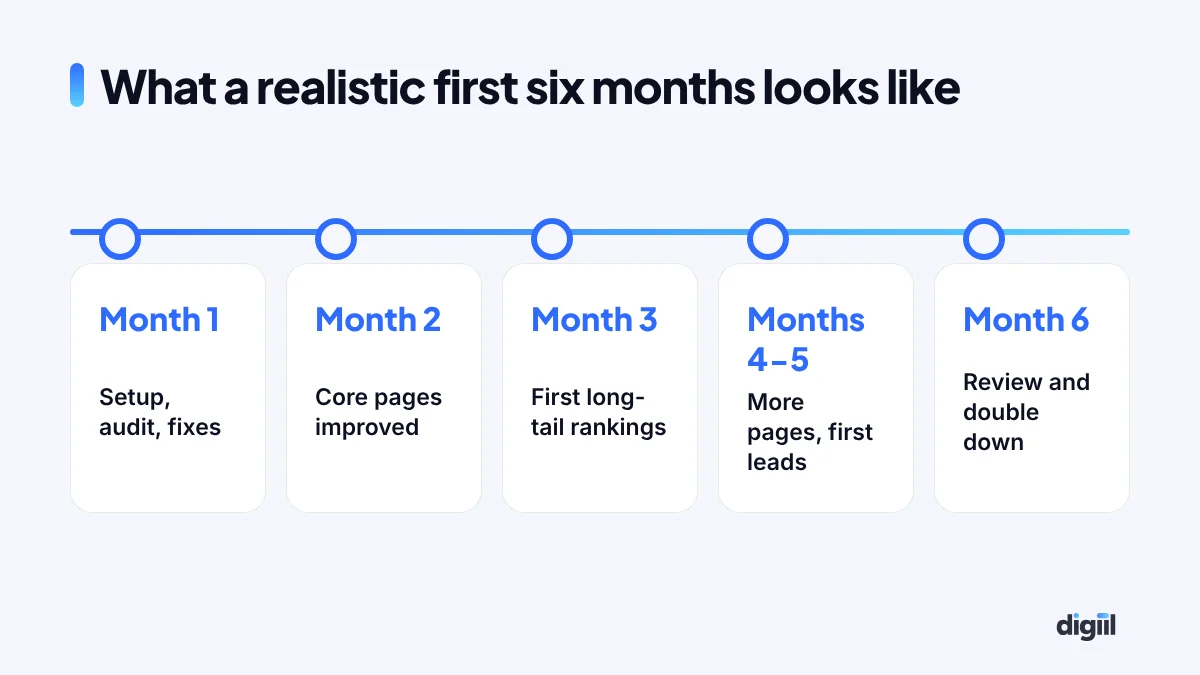
The timeline above is typical, not guaranteed. A new website in a crowded field takes longer. An established local business with a neglected site can move faster.
What ongoing SEO work actually involves
Owners often ask what an SEO person does all month. In a healthy project the work repeats in a cycle:
- Audit. Crawl the site to find broken links, slow pages, missing titles and indexing gaps.
- Research. Find the searches worth winning and study the pages that currently rank.
- Improve existing pages. Often the quickest gain. A page at position 9 needs less work than a new page starting from nothing.
- Create what is missing. New service pages, guides and comparisons where there is demand and no page.
- Earn mentions. Supplier and partner listings, local press, industry directories that real people use, guest articles, and reviews.
- Measure and report. Search Console and Analytics, tied to enquiries and sales.
If a provider cannot show you which of these they did last month, ask. Our guide on how to choose a digital marketing agency lists the questions.
Is it only about Google?
Google handles the large majority of searches in Bangladesh, so it gets most of the attention. Bing matters more than its share suggests, because its index also feeds other assistants and search tools. The same good practice serves both. Verifying your site in Bing Webmaster Tools takes a few minutes and is worth doing once.
What SEO costs
You pay in time, money or both. Doing it yourself costs hours each week. Hiring help costs a monthly fee that depends on how competitive your market is and how much content and technical work is needed. Be wary of very cheap packages that promise hundreds of backlinks. For price ranges and what should be included, see SEO cost in Bangladesh.
Where a beginner should start
- Verify your site in Google Search Console and submit your sitemap. Check that your important pages are indexed.
- Claim and complete your Google Business Profile if you serve customers in a location. Add photos, hours, services and a correct phone number.
- List the ten searches you most want to win. Look at what currently ranks for each one.
- Give each service or product its own page with a clear title, real detail, prices or ranges where possible, and a way to contact you.
- Fix speed on mobile. Compress images first. It is the cheapest gain.
- Ask happy customers for reviews and reply to every one.
- Publish one helpful article a week that answers a question customers ask you in person.
- Check Search Console monthly and improve pages that sit at positions 5 to 15. They are closest to paying off.
If you want a professional look at where your site stands, request our free SEO audit.
A short glossary
- Algorithm
- The set of systems a search engine uses to choose and order results.
- Alt text
- A written description of an image, read by screen readers and search engines.
- Anchor text
- The clickable words of a link.
- Backlink
- A link from another website to yours.
- Canonical
- A tag that tells search engines which version of similar pages is the main one.
- Crawl
- When a search engine’s bot fetches a page.
- CTR
- Click-through rate: clicks divided by impressions.
- Impression
- One appearance of your page in a search result.
- Index
- The search engine’s stored collection of pages.
- Long-tail keyword
- A longer, specific search with lower volume and clearer intent.
- Meta description
- The short summary that may appear under your title in results.
- Organic
- Unpaid. Organic results and organic traffic are earned, not bought.
- SERP
- Search engine results page.
- Sitemap
- A file listing the pages you want search engines to find.
- Structured data
- Code, often called schema, that labels page content for search engines.
The idea to keep
Strip away the vocabulary and SEO comes down to three questions. Can search engines reach and read your pages? Is each page the most useful answer for a specific search? Do other people and sites show that you can be trusted? Work on those three steadily and rankings follow.
If you would like that work done for you, see our SEO services or book a free 15-minute strategy call.
Quick answers
What does SEO stand for?
SEO stands for search engine optimization (optimisation in British spelling). It is the practice of improving a website so it appears higher in the unpaid results of search engines such as Google and Bing.
How long does SEO take to work?
Small improvements can show within weeks. Meaningful growth in enquiries usually takes several months, and competitive searches take longer. It depends on your starting point, your competitors and how consistently the work is done.
Can I do SEO myself?
Yes. The basics need patience more than technical skill: a verified Search Console, a complete Google Business Profile, clear pages for each service and honest reviews. Technical fixes and link building are where most owners bring in help.
Is SEO free?
Clicks from organic results are not charged. The work is not free: it takes time, content, and sometimes tools or professional help.

Amanat has managed $4M+ in Google and Meta ad spend for brands in the UK, USA, Australia and Bangladesh since 2020. He holds 20+ certifications, including Digital Marketing Strategy from Harvard Business School Online. More about Amanat